
Louis Bherer describes programs pairing exercise and cognitive activity. Read about the findings, daily-life implications and limits of the evidence.





On November 1, 2026, The Conversation Canada published an interview with neuropsychologist Louis Bherer about programs combining physical exercise and cognitive stimulation for older adults. Bherer is a professor at Université de Montréal and a researcher and director at the EPIC Centre of the Montreal Heart Institute.
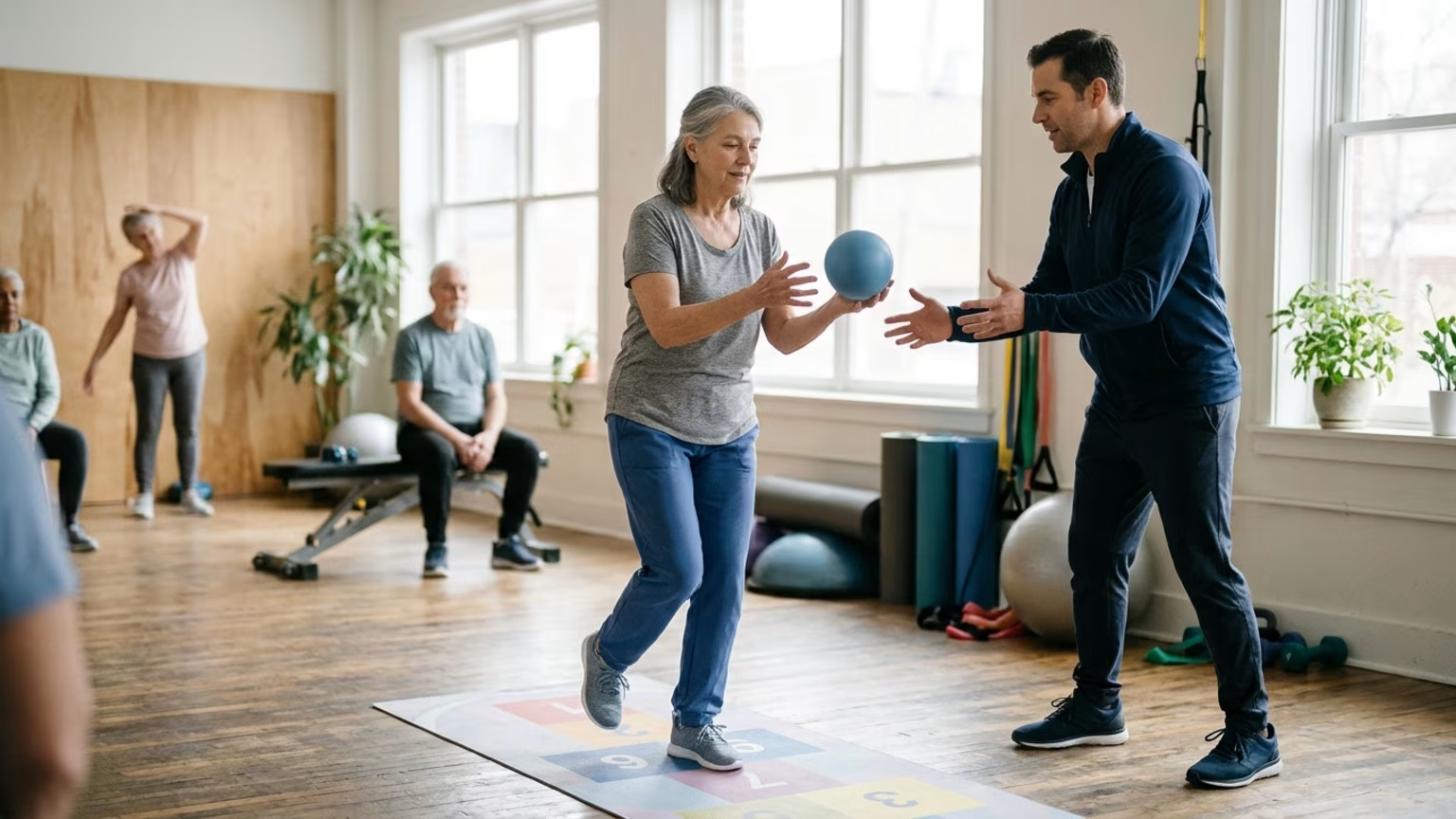
In the interview, Bherer described work at his Montreal laboratory that pairs mental tasks with exercise. His examples include memory games on phones, stationary bikes and treadmills. Muscle-strengthening exercises are also part of the programs.
Bherer told The Conversation that participants range from 50 to 95, with an average age between 68 and 70. They are followed for periods ranging from three months to a year. He says participants do physical training three times weekly.
He reports that some participants with mild cognitive impairment show changes in attention, alertness and response speed after six months of training. Memory changes take longer in his account.
Bherer also argues that heart and brain health are closely connected. His practical approach includes strength, posture and mobility work alongside aerobic activity. Supporting independence as people age is a central goal of the approach he describes.
AARP’s coverage of the U.S. POINTER trial describes another approach involving several lifestyle factors. More than 2,100 adults aged 60 to 79 at increased risk for cognitive decline took part in one of two programs. Both involved physical activity, diet, cognitive and social engagement, and cardiovascular health monitoring.
According to AARP, cognition improved in both groups after two years. The more structured and intensive program showed somewhat greater improvement.
The overlap with Bherer’s account is the attention to several parts of daily life. Both accounts place physical activity within a broader approach that also includes mental engagement.
For adults 60+, the immediate value of Bherer’s interview is a clearer way to organize the discussion about activity. Rather than focusing only on a memory task or an aerobic workout, his approach gives several kinds of activity a place in the routine.
Bherer recommends choosing activities that fit daily life instead of attempting a short-lived lifestyle overhaul. That shifts attention from finding an impressive program to identifying activities that are realistic to keep doing.
The interview provides examples of complementary activities:
The planning principle is variety with a purpose. In Bherer’s account, movement is relevant not only to thinking skills but also to physical function and independence. That gives strength and mobility a place beside the more familiar discussion of aerobic exercise.
This also offers a useful way to think about routine movement alongside planned workouts. The question is where different activities fit into daily life, not simply which activity receives the most attention in a headline.
Bherer’s examples place cognitive activity alongside physical exercise. Cognitive engagement can be paired with movement or have a separate place in the week. The practical idea is to make room for both within an active life.
For someone reviewing a routine, useful questions follow directly from that approach: Where does strengthening fit? Is there attention to posture and mobility? What opportunities are there for cognitive engagement?
These questions keep the discussion tied to recognizable activities. They also move it beyond a narrow choice between exercising the body and exercising the mind. Bherer’s account treats those as complementary parts of his programs.
The World Health Organization’s guidance places physical activity within a broader set of actions. It includes social and cognitive engagement, healthy eating, and management of blood pressure, cholesterol and blood sugar. WHO also identifies reducing environmental risks as part of dementia risk reduction.
WHO says evidence suggests that healthy behaviors and management of relevant health conditions can reduce the risk of cognitive decline and dementia. Its guidance therefore reaches beyond the exercise session itself.
WHO also describes dementia risk as accumulating across the life course, with some factors having greater effects at particular stages. This places a current routine within a longer health picture. For an older adult, the practical implication is to connect everyday activity with ongoing health care rather than give one habit all the attention.
That broader perspective fits a connected view of daily brain-health habits. Exercise, mental engagement and social activity can be discussed together with nutrition and the management of health conditions.
For patients and doctors, this creates a concrete agenda for a conversation. It can cover which activities are realistic and how cognitive and social engagement fit into the week. It can also address which cardiovascular risks need ongoing management. The focus stays on a workable pattern across daily activity and health care.
The Conversation article is an interview reporting Bherer’s account of his programs. It does not provide a sample size, comparison group or numerical effect estimates for the reported improvements. It also does not give enough trial-design detail to establish how much benefit comes from combining activities or whether the combination outperforms either component alone.
Changes in attention, alertness or response speed are not proof that a program prevents dementia. AARP makes the related point that U.S. POINTER was not designed to establish whether its lifestyle programs ultimately prevent dementia. Cognitive outcomes and disease prevention are different questions.
The schedule and timing described in Bherer’s laboratory are also not a universal prescription. His report of changes after six months does not establish a deadline by which another person’s attention or memory should improve. The participants’ training frequency describes those programs rather than a required routine for every older adult.
The practical response is to use the interview as a framework for discussing sustainable activity. Personal decisions about adapting exercise to ability or an existing health condition belong in a discussion with a qualified health professional. The same applies to decisions about managing blood pressure or other health risks.
The value of this development lies in the questions it brings together. Bherer’s account places cognitive activity beside aerobic movement and gives strength, posture and mobility a clear role. It connects the discussion of thinking skills with the wider goal of remaining capable and independent.
For the long-term direction of cognitive health, that is a useful focus. It directs attention toward a range of daily activities and health needs rather than a single task or score. WHO’s broader guidance adds another part of that picture: cognitive health belongs within an engaged life and continuing attention to overall health.
The most useful takeaway is therefore a practical frame for planning. A routine can make room for movement and mental engagement while also addressing physical function, social connection and ongoing care.
A combined exercise approach can sound like another demanding schedule, so FitBrainLab explains the research through practical guidance rather than hype. For adults 60+ who feel uncertain about everyday brain-health habits, its coverage connects movement and mental engagement with a broader view of cognitive aging while keeping early findings separate from established evidence.

Follow FitBrainLab for research-led insights on memory, focus, brain aging, nutrition and mental fitness after 60. Stay connected for new articles, practical guidance and ideas for a sharper, more engaged life.





Build habits that support memory, focus and a curious, connected life.
Read the Blog