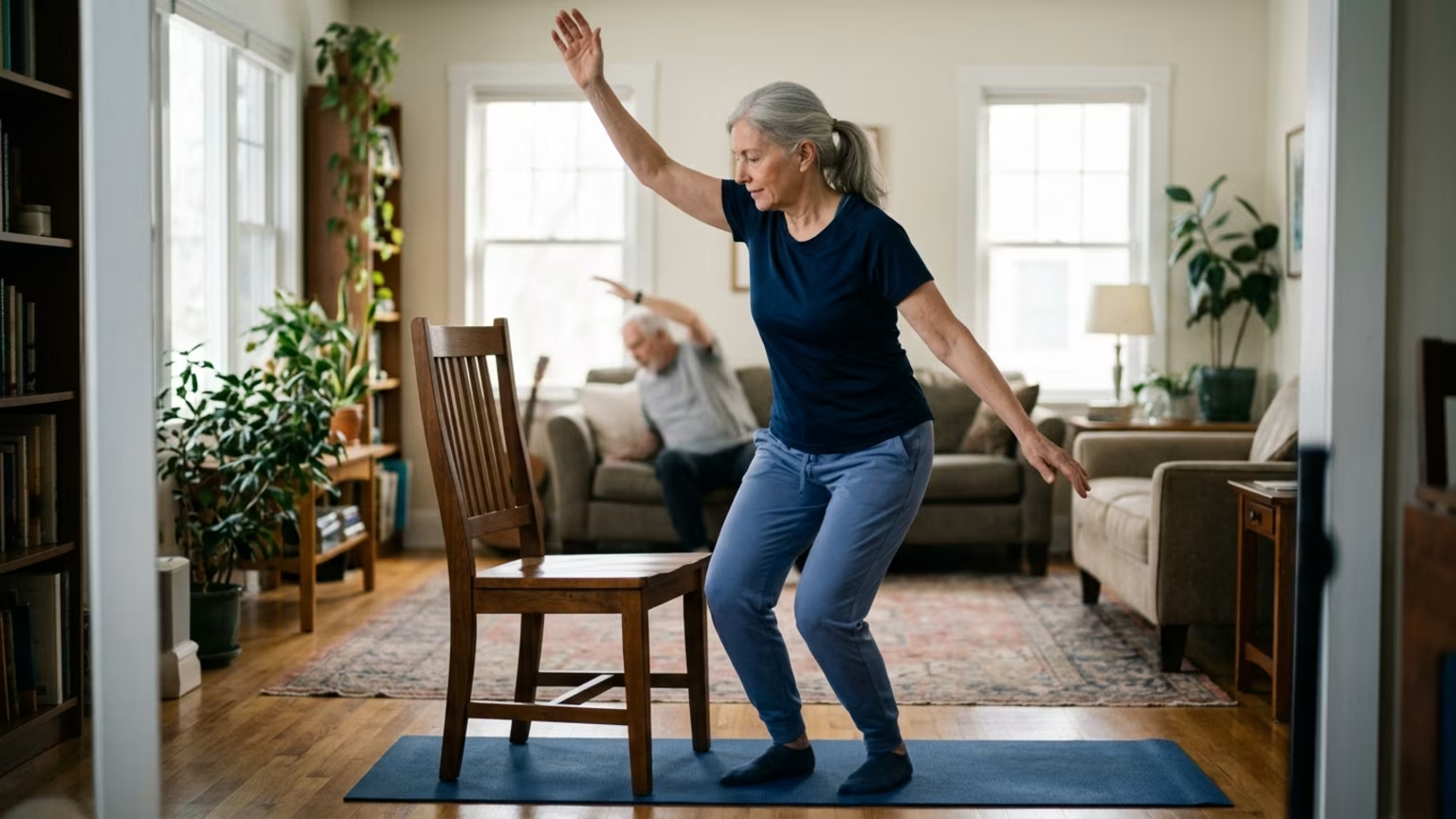

Plan movement after 60 with walking, strength, balance and daily activity. See how physical-health evidence differs from claims about memory.





What should a movement plan after 60 include beyond a daily walk? It should combine aerobic activity with strength work, balance practice and ordinary daily movement, with each serving a different purpose.
These findings do not establish a timetable for memory improvement after starting exercise.
A Cochrane review summarized by PEDro examined 12 trials involving 754 cognitively healthy participants older than 55. It found no evidence that aerobic exercise improved the cognitive abilities measured. That finding also held in analyses where fitness improved. The review noted limitations in study methods and reporting.
The World Health Organization (WHO) reports a broader association between physical activity and improved cognitive health. Its physical activity fact sheet also links activity with better mental health and sleep. These population-level associations and the review's test results are different kinds of evidence.
Taken together, the findings support a cautious view of memory claims. They do not justify promising that a particular exercise routine will prevent cognitive decline. Nor does the review prove that aerobic exercise has no cognitive benefit in every circumstance.
This distinction is practical rather than discouraging. A person does not have to choose between believing a strong brain-health claim and deciding that movement is pointless. The evidence supports keeping the physical-health reasons in view while treating claims about measured memory gains as a separate research question.
For planning, this shifts attention toward purposes the routine can address: endurance, muscle strength and balance. Progress does not need to be judged by whether a name comes to mind faster after a workout.
WHO's dementia guidance places physical activity alongside social and cognitive activity and the management of blood pressure, cholesterol and blood sugar. Its message concerns several contributors to possible risk reduction rather than a single stand-alone measure.
This makes movement one part of a broader approach to health. It also gives a useful reason to build a varied routine: different types of movement address different physical abilities. A daily walk can be a valuable part of that routine without carrying every task.
The named health measures also explain why an exercise schedule should not replace broader health discussions. Blood pressure and blood sugar management are not tasks that a walking plan can stand in for. Decisions about personal health management belong with qualified care.
Aerobic activity is the endurance component. Examples in the WHO-linked recommendations include brisk walking, water aerobics and cycling on level ground. Walking can remain the aerobic activity when it suits the person; going beyond walking does not mean giving it up.
The planning question is what role the activity fills. A routine that already includes a suitable aerobic activity may need more attention to other components rather than a search for a different endurance exercise.
The point is to keep an endurance component that can have a lasting place in the routine. Variety does not require replacing a familiar activity just because another option sounds more ambitious.
Strength work trains muscles against resistance. It complements aerobic exercise rather than replacing it. Balance practice addresses another ability that walking alone may not train sufficiently.
WHO reports that physical activity is associated with reduced fall risk among older adults. Its older-adult recommendations support multicomponent activity, which combines different kinds of movement. That gives strength and balance a place in the routine for their own functional purposes.
There is no need to describe every component as a memory exercise to explain why it belongs. Endurance, strength and balance are different jobs rather than competing choices.
WHO says any amount of physical activity is better than none. It also says all physical activity counts and people should limit sedentary time. Scheduled exercise is therefore not the only activity worth including in a plan.
Ordinary movement belongs alongside planned activity rather than disappearing from the picture. The guidance does not establish a universal daily step target or a fixed schedule for movement breaks. A useful approach is to notice opportunities for movement within daily life without turning them into another rigid quota.
That broader view is also the focus of FitBrainLab's discussion of counting movement outside formal workouts.
WHO's message supports starting with an amount of activity that feels manageable and building from there. The weekly activity target can be treated as a destination rather than an entry test. Not reaching a full target is not a reason to dismiss the activity already happening.
A practical review of a routine can stay simple: identify its aerobic component, then look at whether strength and balance have a place. Ordinary daily movement remains part of the picture. The aim is a broader mix that fits real life rather than an ideal schedule that feels out of reach.
For more on that planning approach, read about building a routine without perfect-health pressure.
An exercise routine cannot establish whether forgetfulness is part of normal aging. That is a separate question from whether the routine includes aerobic activity, strength and balance.
A movement plan is useful for organizing activity. It is not a way to classify a person's memory changes. An active routine should not become a reason to dismiss a concern, and a less active period should not become a self-diagnosis.
Personal concerns about memory or changes in daily abilities belong in a conversation with a qualified healthcare professional. The appropriate discussion concerns the person's experience rather than whether an exercise target was reached.
FitBrainLab's guide to putting everyday forgetfulness in context offers a related starting point for thinking about that separate question. For the movement plan itself, the useful task is to review which physical purposes the routine serves.
Treating strength, balance and walking as interchangeable can blur movement advice; FitBrainLab explains the research without turning daily activity into a medical promise. For adults 60+ who are uncertain which habits support cognitive health, its editorial guidance connects brain aging with everyday choices while separating established evidence from early findings.

Follow FitBrainLab for research-led insights on memory, focus, brain aging, nutrition and mental fitness after 60. Stay connected for new articles, practical guidance and ideas for a sharper, more engaged life.






Build habits that support memory, focus and a curious, connected life.
Read the Blog

