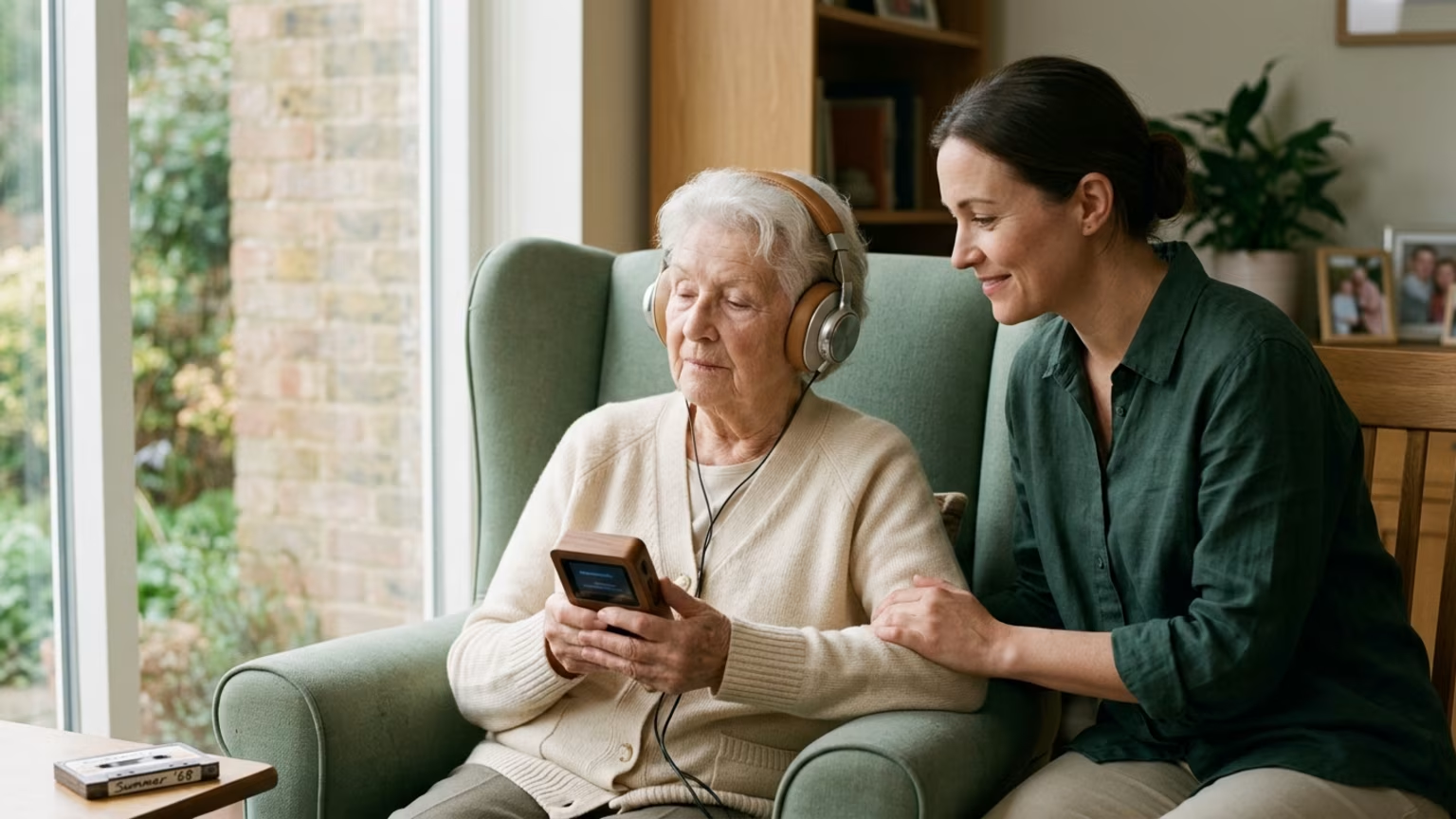

A 2026 study found personally meaningful music produces distinct brain activity in adults with dementia. Learn how to apply these neuroimaging observations.





In 2026, researchers published a functional MRI study showing that personally meaningful music produced greater brain activity than neutral music in adults with dementia. The findings were reported by Medical Xpress. The participants included healthy individuals alongside people diagnosed with Alzheimer’s disease and frontotemporal dementia.
Measuring brain activity during auditory tasks presents unique logistical challenges. The study required participants to listen to music while inside an active functional MRI scanner. The researchers compared the neurological reactions to songs the participants found meaningful against their reactions to completely neutral tracks. The resulting data provided a clear contrast in how the brain processes familiar sounds compared to unfamiliar auditory input.
The research was published in Brain Communications under the DOI 10.1093/braincomms/fcag196. The team included scientists from the Alzheimer Center Amsterdam and the Netherlands Institute for Neuroscience. Their collaborative effort focused strictly on mapping brain responses rather than testing a clinical therapy.
The study highlighted the profound difference between simply hearing sound and processing a familiar song. Jochum J. van ’t Hooft is a researcher at the Alzheimer Center Amsterdam and a lead author of the study. He clarified the importance of this distinction by stating that the stimulus is not merely background noise. As he explained to Medical Xpress, "It's not just music, it's your music."
This focus on personal relevance was central to the experimental design. The researchers did not use standard clinical playlists. They relied on tracks that held specific historical or emotional weight for each individual participant. This methodology demonstrated that familiar auditory cues could still register strongly in aging brains. The resulting functional MRI scans showed elevated activity levels when participants heard their selected tracks.
Conducting this specific type of measurement required careful technical adjustments. Wietske van der Zwaag is a researcher at the Netherlands Institute for Neuroscience who worked on the project. She explained that standard functional MRI scanners are notoriously loud environments, and music relies heavily on precise sound frequencies and timing. The team used alternating scan and listening periods to prevent the machine's noise from masking the musical stimulus.
The functional MRI scans revealed that the brain's reaction to music is not uniform across all types of cognitive decline. The researchers documented distinct biological patterns based on the specific dementia diagnosis. Participants with Alzheimer’s disease showed brain responses that were quite similar to those of the healthy control group. Their neural activity increased predictably when the familiar music began playing.
Individuals diagnosed with frontotemporal dementia exhibited a different pattern of brain activity. The Medical Xpress report detailed that this group showed noticeably less activity in the supplementary motor area. This particular finding highlights how distinct neurological conditions alter the way sensory information moves through the brain. A disease affecting the frontal and temporal lobes changes the fundamental processing of sound.
The supplementary motor area serves several critical functions in human cognition. It is heavily involved in the planning and coordination of movement. The Medical Xpress report notes that this brain region also plays a role in musical processing and memory retrieval. The reduced activity in this area among frontotemporal dementia patients suggests a structural shift in how they experience familiar songs.
The observations from this study offer practical guidance for families navigating cognitive care. When trying to connect with a relative experiencing dementia, selecting generic music might not yield the desired response. The research provides a biological rationale for choosing tracks that the individual identifies with strongly. Caregivers can prioritize songs from a person's youth or major life events.
Finding the right auditory stimulus can be a simple and low-pressure activity. You can start by asking the person what music they enjoy or recall fondly. Families can then offer a specific song and quietly observe the person's reaction. This approach focuses on personal meaning rather than forcing a structured therapeutic exercise.
This strategy also shifts the focus away from generic entertainment toward individualized engagement. A personally curated playlist respects the individual's unique history and preferences. Many adults find that revisiting familiar cultural touchstones provides a sense of grounding. You can read more about supportive practices in our collection of dementia and cognitive protection materials.
Families do not need specialized equipment to apply these insights. The research highlights the value of straightforward, accessible methods of engagement. A simple digital music player or a collection of old records is sufficient to test this approach. The primary task is to curate the audio based on the listener's specific historical preferences.
Caregivers should focus on the quality of the listening environment rather than the duration. The Netherlands Institute for Neuroscience researchers noted how background noise interferes with musical processing. Families can apply this logic by reducing household distractions before playing a meaningful song. Turning off the television and minimizing loud conversations can help the individual focus on the audio.
Observation is just as important as the music selection itself. Caregivers should watch for subtle signs of engagement like toe-tapping, changes in breathing or eye contact. If the individual seems overwhelmed or disinterested, it is perfectly acceptable to stop the music. Find more strategies for organizing daily activities in our guides on retirement and mental fitness.
While the findings offer interesting neuroimaging data, it is critical to separate observation from clinical intervention. The study simply measured brain activity while participants listened to music. It was not designed to test a structured music therapy program. The researchers did not evaluate whether this listening activity improved daily symptoms or altered the disease progression.
Families must avoid the trap of viewing familiar music as a cure for cognitive decline. The published paper does not prove that music reverses the effects of dementia. It also does not establish that a regular listening habit prevents future cognitive deterioration. Medical professionals still recommend comprehensive care plans that include proper nutrition, medical supervision and physical activity.
The limitations of the available reporting also warrant caution. The Medical Xpress article omitted several key methodological details. It did not report the study’s total sample size or the specific ages of the participants. The news summary also lacked quantitative activity values and statistical results.
Without exact figures, readers cannot accurately assess the strength or scale of the reported neurological changes. Relying on calm, objective analysis helps older adults make informed decisions about their care strategies. You can read more about evaluating health claims in our analysis of brain aging research.
Understanding the difference between an observational study and a clinical trial is necessary. A functional MRI scan simply captures a snapshot of blood flow in the brain at a specific moment. It identifies which neural pathways activate when a stimulus is introduced. This type of research helps scientists map the brain's internal architecture during cognitive decline.
Mapping a reaction is completely different from proving a health benefit. A rigorous clinical trial would need to track patients over months or years. It would have to measure whether regular music listening actually slowed the progression of dementia symptoms. The Brain Communications study did not attempt to measure these long-term practical outcomes.
A documented brain response does not automatically translate into improved daily function. The fact that a brain scan shows activity does not prove that the person will experience better memory recall. It also does not guarantee improvements in mood, communication skills or independent living capabilities. The researchers explicitly stated that the implications for music-based interventions require much more study.
The differing responses between the Alzheimer’s and frontotemporal dementia groups reinforce the need for realistic expectations. It would be entirely misleading to assume that familiar music will activate every patient's brain in the same way. Some individuals may show a robust reaction to a classic song. Others might demonstrate a much weaker response or no noticeable reaction at all.
Caregivers should view these listening sessions as optional tools rather than guaranteed solutions. If a particular song does not elicit a response, it is not a failure of care. The goal is to provide supportive and familiar environments without demanding specific behavioral outcomes. For more guidance on managing daily routines, you can review our cognitive protection articles.
The study published in Brain Communications reinforces a fundamental principle of dementia care. Personal relevance remains a powerful variable even as cognitive function changes. The brain's ability to differentiate between meaningful music and neutral sound highlights the durability of personal history. This neuroimaging data validates the instinct to treat individuals according to their unique pasts.
While the study does not offer a medical breakthrough, it provides a biological explanation for familiar care strategies. It confirms that the aging brain can still process and react to highly specific stimuli. Families can take comfort in knowing that their efforts to personalize an environment may actually register on a neurological level. Selecting familiar music is a gentle, accessible way to support an adult navigating cognitive decline.
Selecting familiar music to engage a loved one requires understanding what these auditory responses actually mean for daily interactions. Loss of structure, learning opportunities or purpose after retirement often complicates how families organize their days, but FitBrainLab translates these neurological findings into clear guidance you can apply immediately. Explore Resources

Follow FitBrainLab for research-led insights on memory, focus, brain aging, nutrition and mental fitness after 60. Stay connected for new articles, practical guidance and ideas for a sharper, more engaged life.






Build habits that support memory, focus and a curious, connected life.
Read the Blog