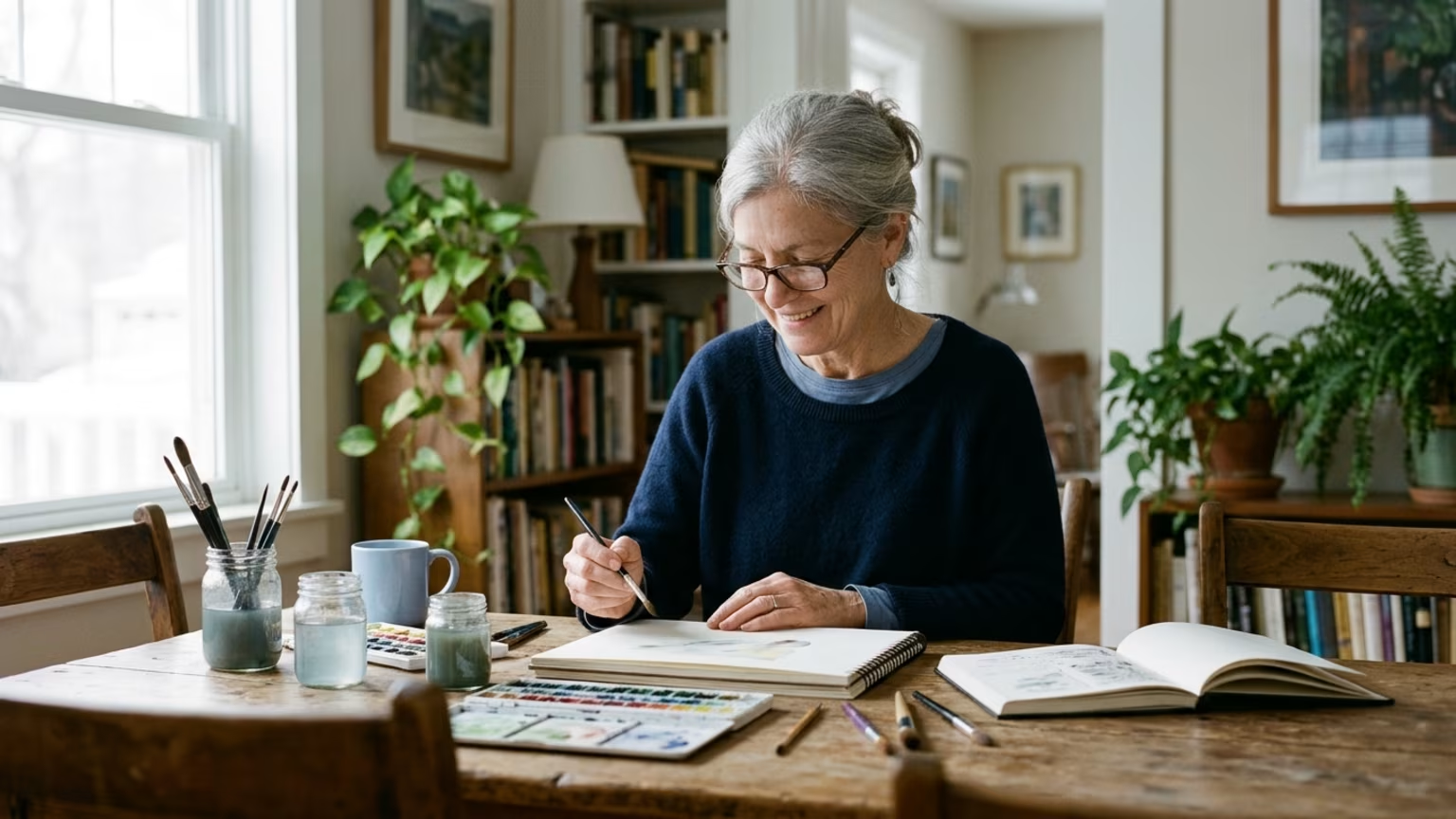

A calmer look at learning after 60, with research on skill retention and practical ideas for small steps, repeated practice and rest.





Learning a new skill after 60 does not have to earn its place by promising a healthier brain. Photography or quilting can be worth your time because you want to learn it. Turning every attempt into a test of future memory asks more of learning than the evidence supports.
The pressure often comes from an unreasonable standard: a worthwhile activity should produce visible progress and a lasting health benefit. Under that standard, an awkward practice session can feel like a poor investment. But learning something and proving that it protects long-term cognitive health are different goals.
A calmer approach takes the task seriously without treating every difficulty as a verdict. Choose something meaningful. Give its unfamiliar parts room to become familiar. The research offers a reason for that openness without requiring a grand promise about your future.
A laboratory study of procedural motor learning found that older participants learned and retained a button-press task. The task involved carrying out a particular movement sequence. This is a concrete example of later-life learning rather than a claim based only on enthusiasm about staying mentally active.
A separate research example comes from a secondary account of the Synapse Project. It describes older adults learning unfamiliar activities such as digital photography or quilting while comparison groups did other activities. The account reports a modest and uneven signal of improvement in episodic memory among participants doing demanding learning activities.
The boundaries belong beside those findings. The motor-learning study had a small final sample of healthy participants, used a specific feedback-supported task, and tested retention the next day. The Synapse information comes from a secondary account rather than the study paper itself. Some comparisons in that account did not remain statistically significant after adjustment for multiple testing.
Neither example establishes that learning prevents dementia or guarantees better everyday independence. They also do not establish long-term effects or show that older adults learn every skill as quickly as younger people. Nor do they set a timetable for any individual's progress.
The useful conclusion is modest but meaningful: older participants could acquire and retain a particular practiced skill. That result deserves attention on its own terms. There is no need to stretch it into a larger medical claim for it to matter.
Think of the distinction as a question of scale. Evidence about learning a task answers a question about that task. A claim about lifelong cognitive protection requires different evidence. Keeping those questions separate lets us take practice seriously without making it carry an unsupported promise.
When learning is sold as a way to keep the brain young, an ordinary hard lesson can start to look like a warning. That is an unfair interpretation of the evidence above. Difficulty with a new activity does not provide the missing information about someone's long-term health.
The hype also places a second job on every activity. There is the skill itself, then the demand to decide whether it is protecting future memory. A practice session becomes both a lesson and an imagined health assessment. That is a heavy burden to put on a camera or a piece of fabric.
Under that standard, repeating a basic step may feel like falling behind. Rest may feel like wasted time. A costly course may seem more responsible than a modest project that fits your interests. None of those judgments follows from these findings.
The possible cost is not only money. Attention and patience are resources too. It is reasonable to reject a learning plan built around fear rather than interest. An activity does not need a cognitive-health sales pitch to deserve a place in your life.
A more sustainable goal is to become more comfortable with something you value doing. Start with a challenge you want to return to, not an activity chosen mainly for its health claims. The point is engagement with the skill rather than proof that you are aging correctly.
The suggestions below are practical ways to organize learning, not a tested clinical program. The assembled evidence does not establish an ideal practice schedule or an amount of rest that produces better results. Use these ideas as a flexible framework rather than another standard to meet.
Break a chosen skill into manageable parts. “Learn photography” is a broad ambition. Getting comfortable with a camera function is a clearer practice target. A small target gives the session a purpose without requiring a finished product that shows everything you hope to learn.
The same principle applies to quilting: a particular step can be the focus rather than the whole project. This is not an instruction to lower your ambitions. It is a way to separate the larger goal from what you are working on now.
Ask what part of the activity you would like to understand better. Let that question define the attempt. There is no need to make every session cover the full skill or produce something ready to show other people.
Revisit the part you have been practicing. Repetition need not be treated as evidence that the previous attempt was wasted. It can simply be part of how you approach an unfamiliar task.
Keep the distinction between returning and testing yourself. Returning means giving the activity another place in your life. Testing yourself adds a judgment about whether today's performance meets an expected rate of progress. The research here supplies no personal benchmark for that judgment.
A workable approach can remain modest: come back to the skill and repeat the parts that still feel unfamiliar. The aim is continued contact with the activity. There is no requirement to turn each return into a harder challenge.
Allow room for rest rather than filling every available moment with practice. A pause does not need to be earned by reaching a certain level. Learning can have a place in your life without taking charge of your entire calendar.
This is a choice about making the activity manageable. It does not require treating rest as another performance tool or judging whether each break was productive enough.
A plan that leaves room to stop can still be a serious learning plan. Your commitment is not measured by how thoroughly the activity occupies your time. Curiosity does not come with an attendance requirement.
Choose a measure that belongs to the skill. Perhaps you understand a step that previously seemed confusing. Perhaps you can carry out part of the task with less guidance. Those are reasonable things to value without translating them into claims about your future memory.
Enjoyment and willingness to return can also be part of your definition of a worthwhile activity. You do not have to demand constant improvement to justify continuing. Nor do you have to keep an activity simply because it has acquired a brain-health reputation.
Questions about learning with a class or on your own can be kept separate from health promises too. The useful question is which format fits the learning you want to do. Neither choice needs to become a statement about how responsibly you are aging.
Your interests can guide the learning without every practice session becoming a verdict on your future.
Practice can be worthwhile without a measurable memory gain, and FitBrainLab approaches that distinction through research-led explanations of learning and cognitive aging. For adults 60+ weighing which everyday habits merit their time, the publication separates established evidence from uncertain claims so choices about cognitive health need not rest on fear or product promises.

Follow FitBrainLab for research-led insights on memory, focus, brain aging, nutrition and mental fitness after 60. Stay connected for new articles, practical guidance and ideas for a sharper, more engaged life.



Build habits that support memory, focus and a curious, connected life.
Read the Blog

