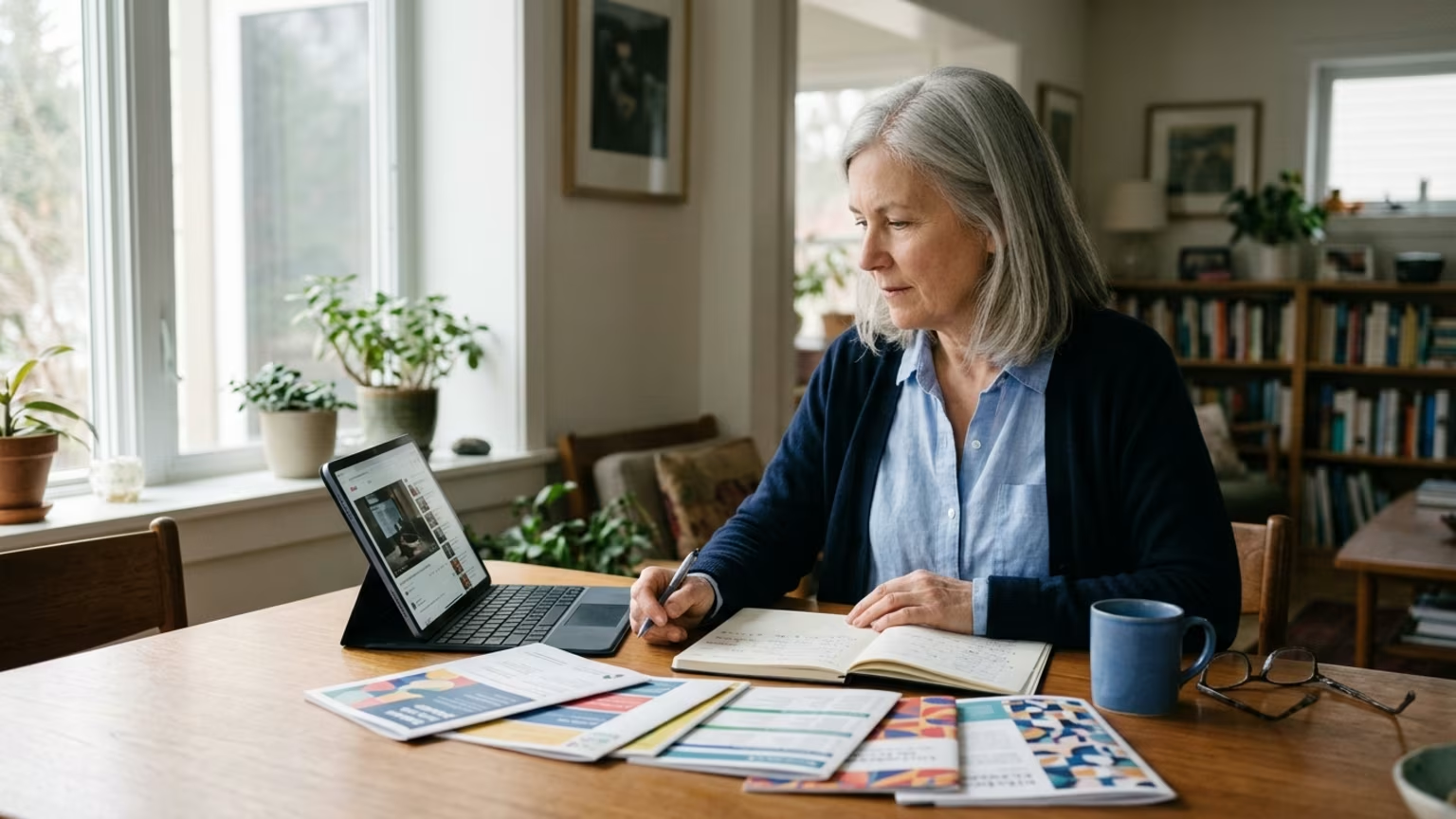

Compare classes and self-directed learning after 60, including creative and technology skills, with a clear look at memory research and practical fit.





Choosing between classes and self-directed learning after 60 means weighing instruction against flexibility, whether the new skill is creative or technology-based.
A class offers instruction. That makes it a reasonable choice when the main appeal is having someone explain unfamiliar material rather than deciding alone what to learn next. The practical benefit is access to teaching, not a proven cognitive advantage over independent study.
The subject and the format are separate choices. A creative skill involves making or performing something. Technology learning offers a practical task to master. Either can be approached through instruction or self-directed study, so there is no need to treat creativity and technology as competing routes to brain health.
The most relevant learning experiment in the supplied evidence is the Synapse Project. A secondary account of that study describes research involving 221 adults ages 60 to 90. Participants learned unfamiliar activities such as digital photography or quilting. Comparison groups took part in social or less demanding activities.
After about three months, the demanding-learning groups showed an advantage in episodic memory over some comparison groups. The account also describes uneven results, with some outcomes not improving. This was one study of particular activities and outcomes, so it does not establish that every class or creative project improves memory. Nor does it isolate challenge alone as the cause of the reported difference.
The useful lesson for evaluating a class is to look beyond its subject label. “Photography” might describe an unfamiliar skill to master or something already well known to the learner. What matters for this choice is whether the course involves learning something genuinely new rather than simply being occupied.
A practical question is: Would instruction help me take on a skill I actually want to learn? That keeps interest and the learning task at the center of the decision. FitBrainLab’s guide to recognizing a meaningful mental challenge offers another way to think about that distinction.
Self-directed study offers flexibility. It gives the learner more control over what to pursue and how to approach it. This is a reasonable fit when that freedom is appealing, rather than when independent learning merely sounds like the more demanding or more impressive option.
The same subject can support different choices. Someone interested in digital photography might value instruction through a class. Another person might prefer working independently on the unfamiliar parts of the skill. These are questions of personal fit, not evidence that either person has chosen the better route for memory.
Technology learning also needs to be separated from computerized cognitive training. Learning to use technology is a real-world skill. A program designed to train a specific cognitive process is a different kind of activity, with its own evidence. The presence of a screen does not make the two equivalent.
A 2026 systematic review examined eight independent trials involving 722 participants with mild cognitive impairment. It found no convincing evidence of durable cognitive transfer beyond the processes participants trained. Here, transfer means benefits extending beyond the trained processes. The review also noted methodological limitations and few trials.
A separate 2026 randomized trial tested chatbot-based cognitive training in 72 cognitively unimpaired older adults over 12 weeks. It reported improvement on one episodic-memory measure and differences in selected white-matter measures. There were no significant intervention-related changes in attention, processing speed, executive function, or visuospatial recognition memory. Those selective findings do not establish broad cognitive improvement from chatbot training.
These studies help evaluate claims about particular digital programs. They are not direct tests of independent hobby learning. For an ordinary self-directed project, the clearer question is whether the activity offers an appealing task to master rather than whether its marketing borrows the language of cognitive science.
Classes and independent study can both be organized around unfamiliar material and sustained skill learning. That is the useful overlap with the Synapse Project. The format describes how learning is arranged; the learning task describes what the person is trying to master.
Both formats can offer opportunities to practise attention and memory. The research assembled here does not show that they produce the same biological changes or rank one above the other. The shared opportunity is engagement with a demanding skill, not an established shared effect on the brain.
A useful editorial framework is to ask about three features:
These are criteria for personal fit, not a tested prescription. They help separate the choice of a worthwhile activity from the much larger question of long-term cognitive protection. No particular balance of novelty and enjoyment was established as a universal formula in these sources.
Creative and technology skills can overlap within this framework. Digital photography is a useful example from the Synapse study because it does not fit neatly into only one category. The relevant question is what remains unfamiliar and requires practice, not which label sounds most beneficial.
Enjoyment also belongs in the decision without needing to be presented as a measured brain outcome. An activity can be worth doing because learning it is satisfying. For a closer look at the role of familiarity, see this discussion of balancing a fresh challenge with an existing interest.
The clearest practical difference is access to instruction versus freedom in how to proceed. Rather than assuming one format is easier, it helps to identify which part of learning needs support. The answer may differ between skills.
For a class, useful questions include:
For self-directed study, the questions shift:
These questions are not entry requirements. They are ways to identify a mismatch before treating difficulty as a personal failing. Early awkwardness need not be taken as proof that an activity is unsuitable; that is practical editorial advice rather than a finding tested in the cited studies.
The aim is a workable learning choice, not the hardest possible task. Thinking about how an activity fits into everyday life can keep the decision grounded in participation rather than ambition alone.
Choose a class when instruction is the main support that would make an appealing skill approachable. Choose self-directed study when flexibility is the stronger attraction. Creative work and technology learning belong within either route, rather than standing as separate contenders for the best brain-health activity.
For long-term cognitive health, the evidence supports a measured judgment. Demanding unfamiliar learning has shown a possible memory benefit in the reported Synapse study. Digital training findings are specific to the programs and outcomes studied. None of these sources establishes a hobby as a universal safeguard against cognitive decline or dementia.
The editorial verdict is therefore to put interest first, manageable novelty next, and format in service of both. There is no need to select the activity with the strongest health claim. A meaningful skill can justify the effort through what it lets a person learn or create.
That is a sounder basis for a lasting choice than trying to identify a single winning hobby. The goal is an engaged learning experience, with any cognitive benefit understood in proportion to the evidence.
Memory-test gains are specific outcomes, not a complete picture of cognitive aging; FitBrainLab translates research on those differences for adults 60+. When class descriptions or digital programs blur early findings with established benefits, its clear reporting helps readers judge the evidence behind a learning choice without relying on exaggerated health claims.

Follow FitBrainLab for research-led insights on memory, focus, brain aging, nutrition and mental fitness after 60. Stay connected for new articles, practical guidance and ideas for a sharper, more engaged life.



Build habits that support memory, focus and a curious, connected life.
Read the Blog
