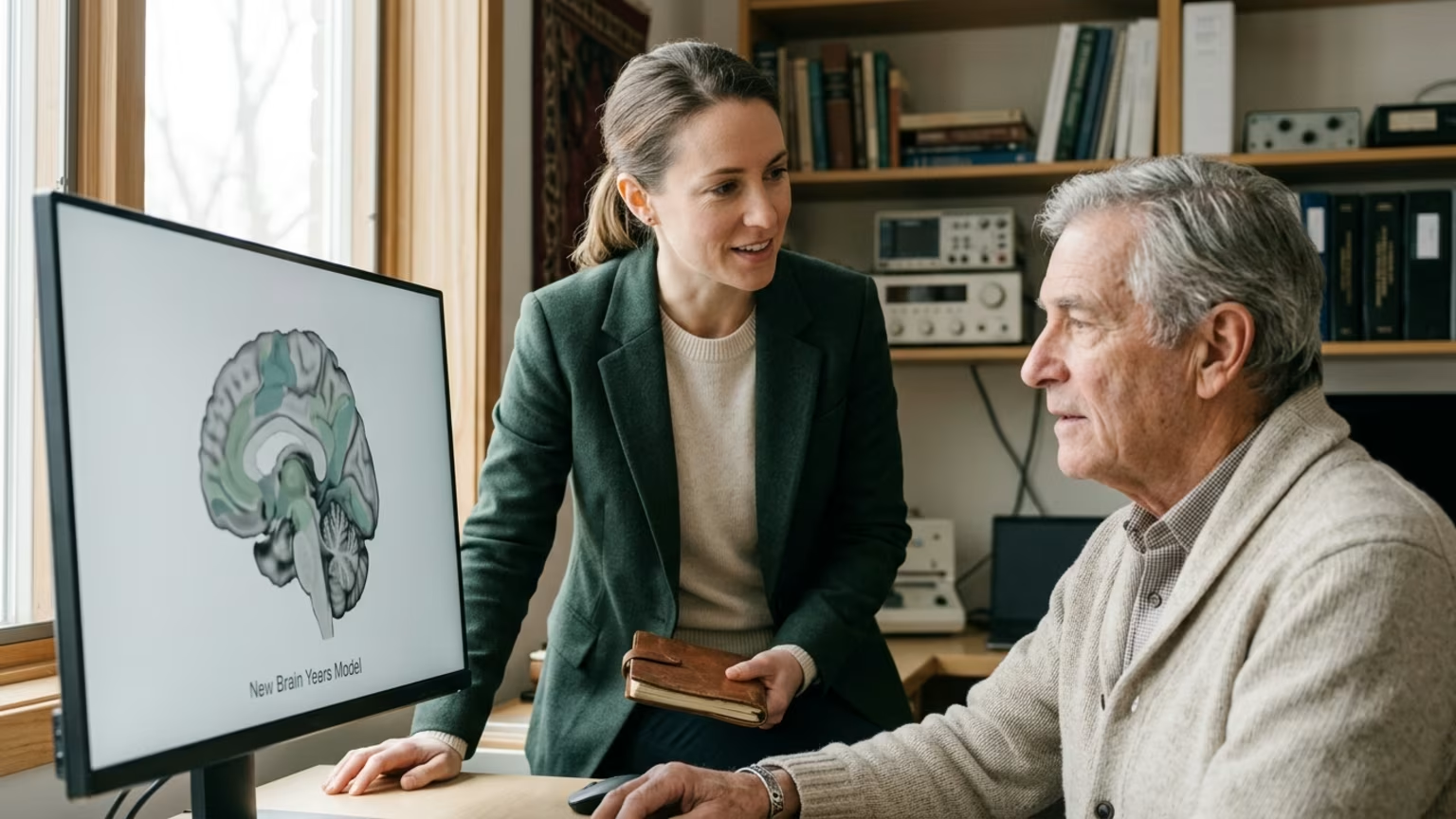

Read how the Brain Years model measures functional brain aging. Learn why researchers caution against using preliminary biomarker scores as clinical advice.





Longevity.Technology reports that neurotechnology company Sens.ai and the Buck Institute for Research on Aging have developed Brain Years, a new functional brain-age model. The project aims to track how well a person’s brain is functioning relative to their chronological age.
Most traditional brain-age measurements rely on magnetic resonance imaging to assess physical brain structure. Structural scans provide excellent detailed views of brain anatomy, showing issues like tissue volume loss or vascular damage. The Brain Years model takes a different approach by focusing on functional capacity instead of anatomy. It attempts to measure how the brain actually performs during active processing.
The model draws on hundreds of variables derived from electroencephalography, event-related potentials and standardized task performance. Electroencephalography measures the electrical activity of the brain in real time. Event-related potentials track how the brain’s electrical signals respond to specific sensory or cognitive events. Sens.ai used machine learning to identify combinations of these signals that associate strongly with chronological age.
The dataset behind this model relies on real-world recordings rather than controlled clinical settings. Sens.ai says its underlying data includes participants ranging from their early teens to their late 80s. Testing in real-world environments can improve the ecological relevance of the recorded health data. Traditional laboratory measurements sometimes fail to reflect how a person functions in their daily routine.
Moving from a controlled clinic to a home environment makes signal-quality safeguards completely necessary. Real-world testing can introduce severe variability in equipment, behavior and measurement conditions. To counter this, Sens.ai developed custom sensors and signal safeguards intended to identify compromised recordings. These technical safeguards attempt to filter out signal noise created by movement, talking, chewing gum or excessive blinking.
Data quality remains a central focus for the researchers managing this project. Sens.ai CEO Paola Telfer stated that artificial intelligence trained on unreliable measurements leads to poor output. She emphasized that the “garbage in, garbage out” principle applies heavily to functional brain tracking. High-quality raw data is required before any machine learning algorithm can generate an accurate age estimate.
The initial report included a specific result from early testing. Telfer reported 5.18 years of apparent reversal on the Brain Years measure after a two-month intervention. This figure reflects a change in the calculated score rather than a proven biological change in the brain. The publication notes that the model identifies combinations of signals linked to functional capacity.
The broader research plan includes comparing Brain Years with MRI-based clocks and blood-based proteomic measures. Buck Institute CEO Eric Verdin framed the project within the concept of scientific wellness. This concept involves subjecting consumer wellness tools to a strict level of scientific scrutiny. The goal is to bring the rigorous testing standards of clinical medicine into the commercial longevity market.
Eric Verdin noted that the collaboration aims to bring medical rigor to consumer wellness. By focusing on scientific wellness, the researchers want to bridge the gap between commercial health tools and validated clinical science. Aging research increasingly asks about a person’s trajectory over time. This approach attempts to identify subtle shifts in brain function before they cross the threshold into abnormal clinical territory.
This focus on functional measurement shifts how researchers evaluate cognitive health. For adults over 60, a functional score could theoretically capture aspects of attention, response speed or task performance. These functional changes are not always visible from chronological age alone. The long-term goal is to make brain function trackable over time.
The health sector is showing growing interest in intervention-sensitive biomarkers. These are specific measurements that can be repeated before and after a lifestyle change. The goal is to determine whether a measurable signal responds to a specific health intervention. Currently, Brain Years is an attempt to develop this tracking capacity rather than an established diagnostic tool.
The early intervention data reported by Sens.ai remains highly preliminary. The report does not disclose the intervention protocol, participant count, demographics or control conditions. It omits basic trial details like randomization and blinding. The report also lacks baseline scores, follow-up scores and statistical uncertainty. Without independent replication, this finding represents a vendor-reported result rather than an established clinical outcome.
The lack of methodological transparency makes the current intervention claims difficult to evaluate. Clinical science relies on placebo-controlled trials to isolate the true effect of any new treatment. Since the report does not provide the intervention type, independent scientists cannot assess the methodology. This missing detail leaves major questions about how the initial participants were selected and evaluated.
The reported result does not establish that the intervention made participants biologically younger. It does not prove any improvements in long-term memory, independence or lifespan. A change in a biomarker score is never automatically evidence of improved underlying health. A separate report on biological-age clocks noted that short-term interventions can temporarily alter measured biomarkers.
The report concluded that altered biomarkers do not prove a fundamental slowing of biological aging. When researchers attempt to measure brain function, temporary lifestyle factors heavily influence the results. Sleep quality, hydration, mood and daily fatigue can all alter EEG readings and task performance. A two-month intervention might simply optimize these temporary variables rather than changing structural brain health.
Eric Verdin strongly cautioned against interpreting the preliminary results as proof of rejuvenation. He specifically stated, “You’ll never hear me claiming that we’ve reverted aging.” He emphasized the difference between measuring a temporary functional improvement and reversing biological time. The aging process is permanent, but temporary behavioral factors can heavily influence functional performance testing.
Verdin pointed out that practice effects provide a highly likely explanation for the improved scores. When participants repeat standardized tasks over time, they often perform better simply by learning the process. Familiarity with the testing format can artificially inflate scores on subsequent attempts. This means the 5.18-year reversal might just measure how well participants learned the assessment.
To rule out practice effects, Verdin said a prospective, placebo-controlled trial is necessary. This kind of trial would determine whether score changes reflect genuine brain aging alteration. Without controlled testing, a lower score might just indicate improved attention, motivation or testing conditions. A model built on standardized performance tasks is highly susceptible to these behavioral variables.
Independent research highlights significant technical challenges with EEG-based brain-age models. A recent study warned that EEG models trained on healthy populations can systematically underpredict age in people with neurological conditions. This pattern of error challenges their use as clinical neurodegeneration biomarkers. It limits their immediate usefulness for adults dealing with complex memory symptoms.
The study noted that these age-prediction errors specifically appear in patients with Alzheimer’s disease. The researchers warned that the direction of an EEG brain-age gap may not have a straightforward individual interpretation. A measured gap between biological age and functional age does not cleanly map to disease severity. This is especially true for patients experiencing mild cognitive impairment.
Real-world implementation requires external validation and testing in representative older populations. Models may perform completely differently when applied to populations or devices that differ from their original training data. Independent calibration is required before these experimental tools can enter mainstream medical clinics. Until this independent testing occurs, the scores remain interesting research data points rather than medical evidence.
A younger score on a functional model is never the same as a biologically younger brain. The Brain Years tool estimates functional age based on electrical signals and behavioral tasks. A lower score indicates that measured signals resemble those associated with younger participants. It does not demonstrate that neurons, blood vessels or memory systems are actually younger.
Older adults should treat any preliminary brain-age result strictly as an experimental measurement. A Brain Years score does not provide a complete assessment of memory, vascular health or neurological disease. It cannot diagnose dementia or predict an individual’s future cognitive decline. Anyone experiencing new cognitive symptoms should seek professional medical evaluation rather than relying on commercial biomarker tracking.
Patients should always ask how new diagnostic tests are validated before drawing conclusions about their health. It is critical to know whether a model was independently tested in older populations. Researchers need to prove that these scores actually predict meaningful outcomes like sustained memory and cognitive performance. The available Brain Years report does not yet answer these fundamental clinical questions.
Do not overinterpret short-term changes in commercial health metrics. The reported 5.18-year improvement occurred over a brief two-month window. The publication provides insufficient data to classify this shift as biological, behavioral or merely statistical. Medical professionals consistently advise against using short-term biomarker fluctuations to guide serious healthcare decisions.
Brain-age models represent an interesting development in the field of longevity research. They offer a potential new way to track how lifestyle changes impact functional capacity. However, these tools are not ready to replace a clinician’s assessment or standard preventive care. The most defensible promise is that researchers are slowly learning how to detect functional changes earlier in life.
Until controlled trials prove otherwise, established habits for cognitive health protection remain the standard for healthy aging. A preliminary biomarker score should never replace ordinary preventive healthcare. Managing cardiovascular risk, maintaining physical activity and treating hearing loss remain the most reliable ways to support long-term brain health. Adults over 60 can focus on these proven lifestyle factors using proven clinical resources without reacting to experimental testing tools.
Older adults and their healthcare teams face the ongoing task of evaluating new longevity tools, and FitBrainLab translates these early biomarker reports so you can prioritize established evidence. Confusion about what normal brain aging looks like makes commercial claims difficult to assess, but our objective guidance helps you build lasting resilience without chasing unproven metrics.

Follow FitBrainLab for research-led insights on memory, focus, brain aging, nutrition and mental fitness after 60. Stay connected for new articles, practical guidance and ideas for a sharper, more engaged life.





Build habits that support memory, focus and a curious, connected life.
Read the Blog