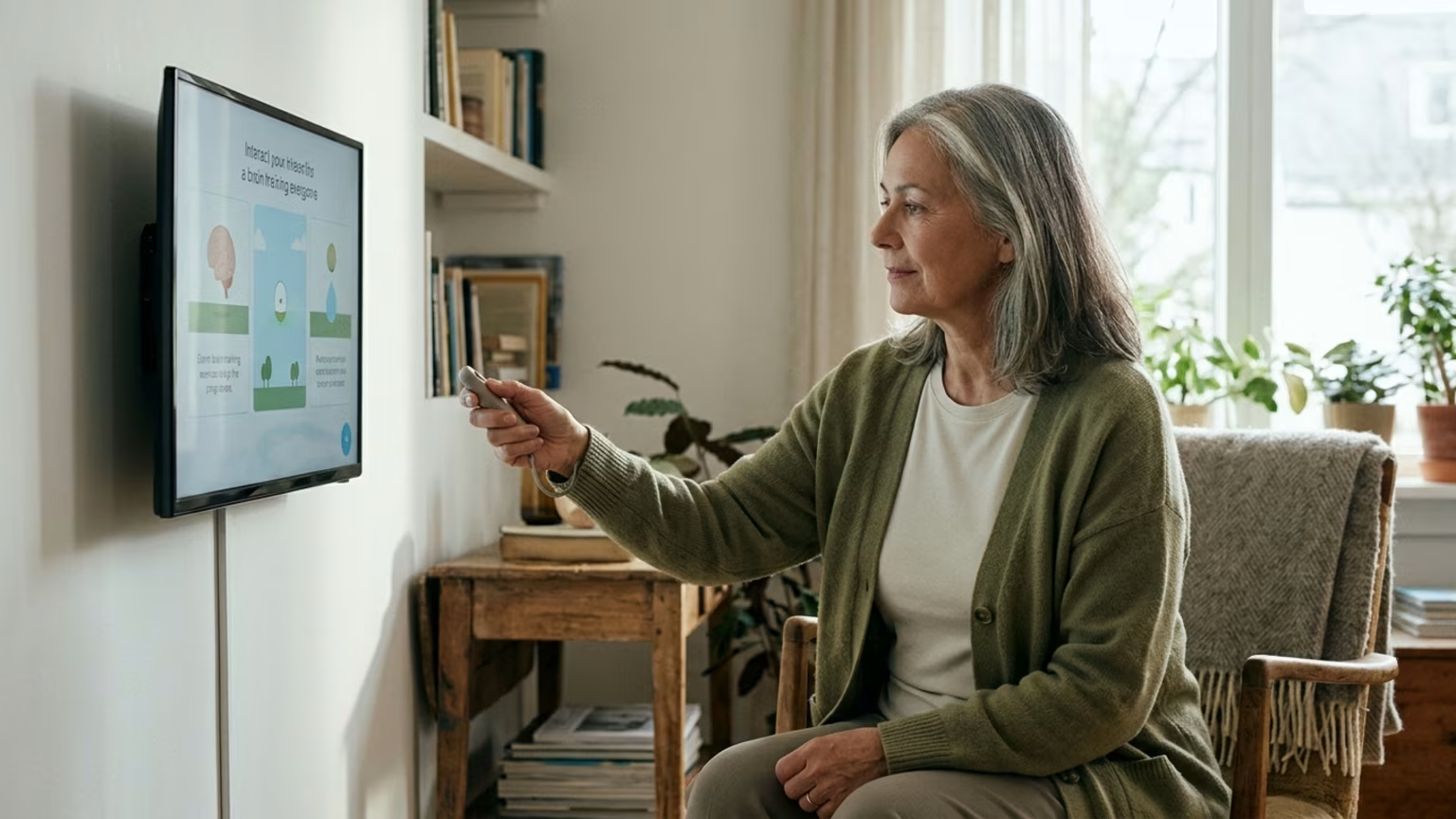

A 12-week exploratory trial suggests the Brain-IT exergame is associated with functional brain changes in adults with mild neurocognitive disorder.





In a 2026 paper published in GeroScience, researchers reported that a 12-week personalized home-based exergame called Brain-IT was associated with functional brain changes in adults with mild neurocognitive disorder. The exploratory randomized controlled trial was conducted in Switzerland between May 2022 and February 2024.
The intervention combined physical training with motor and cognitive challenges alongside biofeedback-guided breathing. Participants received prescriptions for at least 120 minutes of moderate-intensity training per week. This physical activity was spread across at least five weekly sessions. Exercise intensity targeted 40 to 60 percent of the individual heart-rate reserve.
The trial used a pressure-sensitive platform featuring nine serious games. These interactive games involved reactive stepping and complex motor-cognitive tasks. These motor-cognitive challenges required participants to adapt physically and mentally in real time. Training content was highly personalized around learning, memory, executive function and visuospatial skills.
Participants completed an average of 71.5 training sessions during the 12-week intervention. This high level of engagement amounted to approximately 1689 minutes of training for the average participant. Between 19 and 24 sessions were supervised in person by an exercise instructor. A cloud-based system supported remote monitoring of adherence during home sessions. Researchers reported no intervention-related serious adverse events during the study period.
The imaging substudy included 32 participants with a mean age of 71.9 years. The trial recruitment took place from May 2022 through October 2023 across two locations in Zurich and St. Gallen. Women made up 28 percent of this specific group. Eighteen individuals were assigned to Brain-IT plus usual care, and 14 received usual care alone.
Resting-state functional MRI revealed a reduction in connectivity between the hippocampus and the left middle cingulate gyrus in the Brain-IT group. This group-by-time effect was quite large for an exploratory trial. The researchers reported a Cohen's d of -1.74 for the relevant post-hoc comparison. Task-based MRI analysis utilized a face-occupation matching task designed to assess episodic-memory encoding and retrieval.
The Brain-IT intervention was associated with reduced right-hippocampal activation during memory encoding. This reduction in activation showed a partial eta-squared of 0.19 and a significance level of p < 0.0001. The group-by-time interaction reached family-wise-error-corrected significance. Researchers also documented increased activation in the right precuneus and middle cingulate gyrus.
Greater increases in right-precuneus activation correlated with changes in episodic-memory task performance. This association with task performance yielded a reported Cohen's d of 0.76. Changes in middle-cingulate activation were similarly associated with memory-retrieval accuracy. This presented a smaller statistical effect with a Cohen's d of 0.26.
Previous 2024 analyses from this exact same trial noted clinically meaningful improvements in global cognition and verbal recall. A subsequent 2025 structural-imaging analysis reported gray-matter changes that correlated with cognitive gains. These collective findings represent a single developing research program rather than multiple independent verifications.
These findings offer a concrete example of behavioral training coinciding with measurable neural change. A structured program combining physical movement and cognitive challenge might produce detectable functional brain adaptations. This aligns with broader shifts toward multidomain approaches to cognitive health. The medical community increasingly supports combining physical activity with cognitive engagement rather than treating brain training as an isolated habit.
The World Health Organization provides specific dementia-risk-reduction guidance for adults without dementia. This public health framework includes people with normal cognition or mild cognitive impairment. The WHO guidance addresses healthy behaviors, management of health conditions and tailored multidomain interventions. Environmental risks are also a key component of this holistic risk management strategy.
The WHO does not endorse this specific video game, but the Brain-IT trial fits within this larger behavioral framework. For older adults managing mild neurocognitive disorder, these digital tools might eventually become an adjunct to standard clinical care. Those seeking context often review articles on brain aging and neuroplasticity to understand how medical science evaluates these novel tools. Patients and doctors can view programs like Brain-IT as a possible research-informed supplement to comprehensive medical evaluation.
The technology sector is rapidly moving toward highly personalized systems that integrate human supervision with remote monitoring. Future versions of these digital interventions could use artificial intelligence to adjust training difficulty automatically. This potential for adaptive learning makes the integration of physical and cognitive training an exciting area of study. Medical professionals point out the importance of managing vascular risk factors alongside any new cognitive training regimen.
The authors explicitly frame their findings as exploratory and call for adequately powered replication studies. The imaging analysis involved only 32 participants total. A sample of this small size can produce unstable estimates when multiple brain regions and connectivity measures are analyzed. Researchers acknowledge that baseline imbalances across imaging markers could either conceal or inflate the observed effects.
Brain change is not automatically beneficial or absolute proof of disease reversal. Reduced hippocampal activation might represent improved neural efficiency, but the study cannot establish that interpretation conclusively. Longer-term research is necessary to determine whether these connectivity changes represent a beneficial adaptation or pathological progression. Increased activity in the precuneus is only helpful if it remains reliably associated with better cognitive performance across independent studies.
The behavioral memory results from the primary trial task were not definitive. In the fMRI task, 68 percent of trials achieved both correct cued recall and correct recognition in the Brain-IT group. The usual-care group achieved a rate of 52 percent after the intervention. The adjusted group-by-time interaction for this behavioral measure was not statistically significant.
The statistical analysis returned an odds ratio of 1.18 and a 95 percent interval of 0.71 to 1.95. The chi-squared value for this specific measurement was 0.42. This statistical distinction matters greatly when evaluating new medical interventions. The strongest findings were changes in brain activity and brain-behavior correlations rather than definitive proof of improved memory performance.
The trial compared Brain-IT plus usual care directly with usual care alone. It did not establish that the exergame was superior to walking, resistance training or conventional physiotherapy. Because Brain-IT included physical, motor and breathing components, researchers cannot isolate which specific element produced the observed changes. Usual care was provided through recruiting memory clinics, and the study could not standardize the amount or content of that care.
This lack of standardization makes the comparison more clinically realistic but complicates the attribution of results specifically to the exergame. Generalizability remains highly limited for the broader public. Participants were recruited through memory clinics in Switzerland, and most had biomarker-supported Alzheimer's-related disease. About 87 percent of the cohort had biomarker-supported information about the likely cause of their condition.
The paper reports slightly different figures regarding etiology in different sections. The abstract reports 57 percent had an Alzheimer's-related etiology, and the baseline results section cites 62 percent based on cerebrospinal-fluid amyloid-beta ratios. These highly specific findings should not be automatically applied to healthy adults or individuals with advanced dementia. The task-fMRI paradigm was also quite demanding for the participants.
Thirteen percent of potential participants had insufficient task comprehension even after receiving extensive instructions. These individuals were subsequently excluded from the task-fMRI data collection.
This Swiss study demonstrates that personalized exergame training can correlate with functional brain adaptations in people with early cognitive decline. The authors do not claim that Brain-IT reverses Alzheimer's disease or prevents dementia. The study lasted only 12 weeks and was not designed to track long-term clinical progression. There were no results demonstrating reduced dementia incidence or slower disease progression.
The authors recommend hybrid implementation-effectiveness research to determine whether such programs can be delivered safely through healthcare systems. The practical message is to view movement-plus-cognitive training as a promising research direction rather than a guaranteed cure. If older adults want to try active digital programs, they must prioritize physical safety and professional supervision. Reading lifestyle and brain resilience resources can help individuals ask their doctors the right practical questions.
Key considerations include whether a program adjusts to the user's abilities and whether it encourages sustained learning over fast reactions. Patients should confirm that the difficulty can be scaled safely to their individual cardiovascular status and fall risk. A clinician-led assessment remains vital because cognitive symptoms can stem from treatable contributors like medication effects, sleep disorders or vascular disease. Those interested in further reading may find our memory and focus articles helpful for navigating these daily decisions.
Evaluating digital interventions for memory preservation frequently falls to independent older adults and their personal medical teams. Access to transparent, calm research changes how you approach these clinical options. Uncertainty about which everyday habits may support cognitive health can make lifestyle planning difficult, but FitBrainLab translates complex evidence on brain aging to help you organize a sensible daily routine. Explore Resources

Follow FitBrainLab for research-led insights on memory, focus, brain aging, nutrition and mental fitness after 60. Stay connected for new articles, practical guidance and ideas for a sharper, more engaged life.






Build habits that support memory, focus and a curious, connected life.
Read the Blog