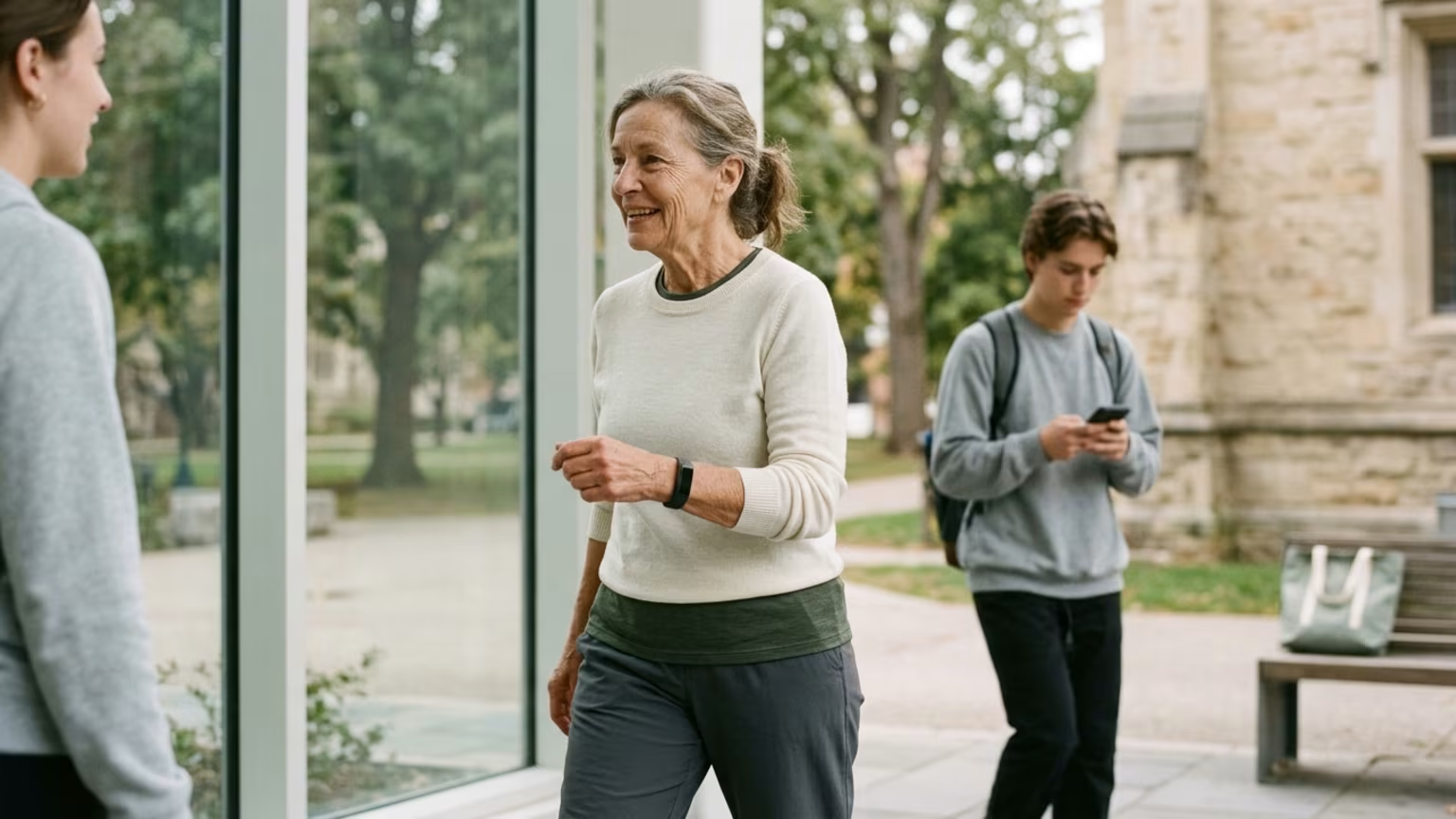

A 2026 wearable study found adults in their 70s accumulated more daily physical activity than university students, reinforcing the value of regular movement.





On 29 August 2026, researchers at the National University of Singapore’s Centre for Sleep and Cognition published a study in BMC Medicine showing that community-dwelling adults in their 70s accumulated more physical activity and less sedentary time than university students.
The study analyzed four weeks of continuous Oura Ring recordings from 1,967 Singapore-based participants. The researchers divided the participants into three distinct age cohorts to compare daily habits. This included 500 university students with a mean age of 19.9 years. It also featured 437 working-age adults averaging 41.1 years and 1,030 older adults averaging 74.0 years.
Rather than isolating single exercise sessions, the research team treated each day as a 24-hour composition. They measured how participants distributed their time across physical activity, sedentary behavior and sleep. Participants contributed 48,535 valid movement-behavior days to the comprehensive analysis. This compositional approach treats daily behaviors as interrelated parts of a whole day, rather than analyzing any single action in isolation.
The results challenge common assumptions about aging and physical capability. Older adults recorded roughly 100 more minutes of physical activity per day than the university students. They also recorded approximately 133 fewer minutes of sedentary time.
Adults in their 70s averaged 420.28 minutes of physical activity and 500.86 minutes of sedentary behavior daily. In contrast, university students averaged only 320.28 minutes of physical activity and 633.89 minutes of sedentary time. Working-age adults averaged 346.55 minutes of physical activity and 581.28 minutes of sedentary behavior daily. The older adult group also recorded the highest sleep allocation among all three cohorts.
The physical activity category included both light movement and moderate-to-vigorous exertion. The research team defined sedentary behavior using wearable-derived five-minute metabolic-equivalent epochs. These figures represent total daily movement allocation rather than just scheduled fitness routines. Adding ten minutes of walking requires subtracting ten minutes from either sitting or sleeping, making this a zero-sum measurement of daily life.
Student activity was concentrated around transitions between classes and fell by approximately 30 minutes on weekends. Working-age adults showed activity peaks around commuting and lunchtime. Their weekend activity duration was largely preserved, but their activity began later in the day. Older adults maintained their activity levels across both weekdays and weekends, showing only a minor afternoon dip.
This research illustrates a shift from asking whether someone exercises to asking how they distribute all 24 hours. That distinction matters significantly for older adults building consistent daily routines. A person can easily finish a scheduled morning walk and then remain seated for the next ten hours. The findings indicate that replacing sitting time with light activity matters just as much as formal workouts.
Older adults showed the greatest stability in movement and sleep across the week. This consistency offers a strong model for healthy aging. Keeping up with regular social visits, shopping or gardening prevents weekends from becoming highly sedentary. Recognizing the value of continuous daily movement provides a realistic path to maintaining independence.
The researchers conducted cardiometabolic analyses on the working-age and older-adult groups. They found that movement profiles favoring physical activity correlated with better adiposity and vascular-health measures. Replacing sedentary time with physical activity was linked to a lower body mass index and better vascular scores.
A hypothetical reallocation of 30 minutes per day toward physical activity produced notable modeled differences. This shift was associated with a body-mass-index difference of −0.13 kg/m² and a pulse-wave-velocity difference of −0.05 m/s. It was also associated with a body-roundness-index difference of −0.04 and a composite vascular-health difference of −0.01. These metrics provide a clear window into how daily habits support broader metabolic health.
Managing these vascular risk factors plays a major role in cognitive protection. World Health Organization guidance takes a life-course approach to reducing cognitive-decline and dementia risk in adults without dementia. The framework identifies physical inactivity, hypertension and diabetes as shared risks for noncommunicable diseases. Movement supports brain health indirectly by keeping the vascular system strong.
While the data is encouraging, this was an observational study and not a clinical trial. The research does not prove that reallocating time directly causes better vascular health. The 30-minute reallocations are mathematical models rather than proven outcomes of a specific behavioral intervention. Experimental research is still needed to establish whether such specific changes produce guaranteed health benefits.
The project relied on convenience samples of volunteers using consumer technology in Singapore. The older-adult cohort was restricted to ethnic Chinese participants by design. The researchers noted that differences in socioeconomic factors or digital-device use could not be completely excluded as explanations for the group differences. The self-selection of participants might also mean the group was more health-conscious than the general population.
The student group did not receive the same cardiometabolic assessments as the working-age and older-adult groups. It is therefore not valid to claim from this study that the university students had worse vascular health than the older adults. The comparison focuses purely on the time allocated to movement and sitting.
The researchers did not directly test memory or cognitive performance during the study. The cardiometabolic analysis focused on physical markers rather than tracking long-term dementia incidence. Connecting these physical activity patterns to brain health requires looking at indirect vascular pathways.
The participants used Oura Rings that estimate movement and sleep using accelerometry and proprietary algorithms. These devices do not directly observe every action or measure exact energy expenditure with clinical instruments. The researchers also treated non-wear time as sedentary to maintain a complete 24-hour profile.
These methodological choices mean the data works well for comparing large populations. The study does not establish that any individual wearable reading represents a strict medical measurement. Wearables provide useful personal feedback and make resting patterns visible, but they do not replace standard medical evaluations.
The goal for adults in their 60s and 70s is not to compete with younger generations or pursue athletic performance. The objective is to preserve regular movement and avoid letting prolonged sitting dominate the day. This study validates that older adults can successfully maintain highly active and consistent habits.
Viewing physical activity within a complete 24-hour framework makes movement feel highly achievable. Light household tasks, moving between seated activities and running errands all count toward the daily total. Small, manageable substitutions help build a sustainable physical foundation over time.
Physical activity is just one piece of a broader cognitive resilience strategy. A thorough approach also includes managing blood pressure, staying socially active, sleeping well and protecting hearing. Maintaining steady movement habits remains a practical way to support the body systems that nourish the aging brain.
Conflicting advice about nutrition, exercise, sleep, supplements and brain performance often complicates how we view daily activity, and FitBrainLab translates this complex research so you can prioritize evidence over noise. Sorting through observational data demands careful reading, and our editorial guidance helps you build sustainable habits for cognitive longevity without the hype.

Follow FitBrainLab for research-led insights on memory, focus, brain aging, nutrition and mental fitness after 60. Stay connected for new articles, practical guidance and ideas for a sharper, more engaged life.





Build habits that support memory, focus and a curious, connected life.
Read the Blog