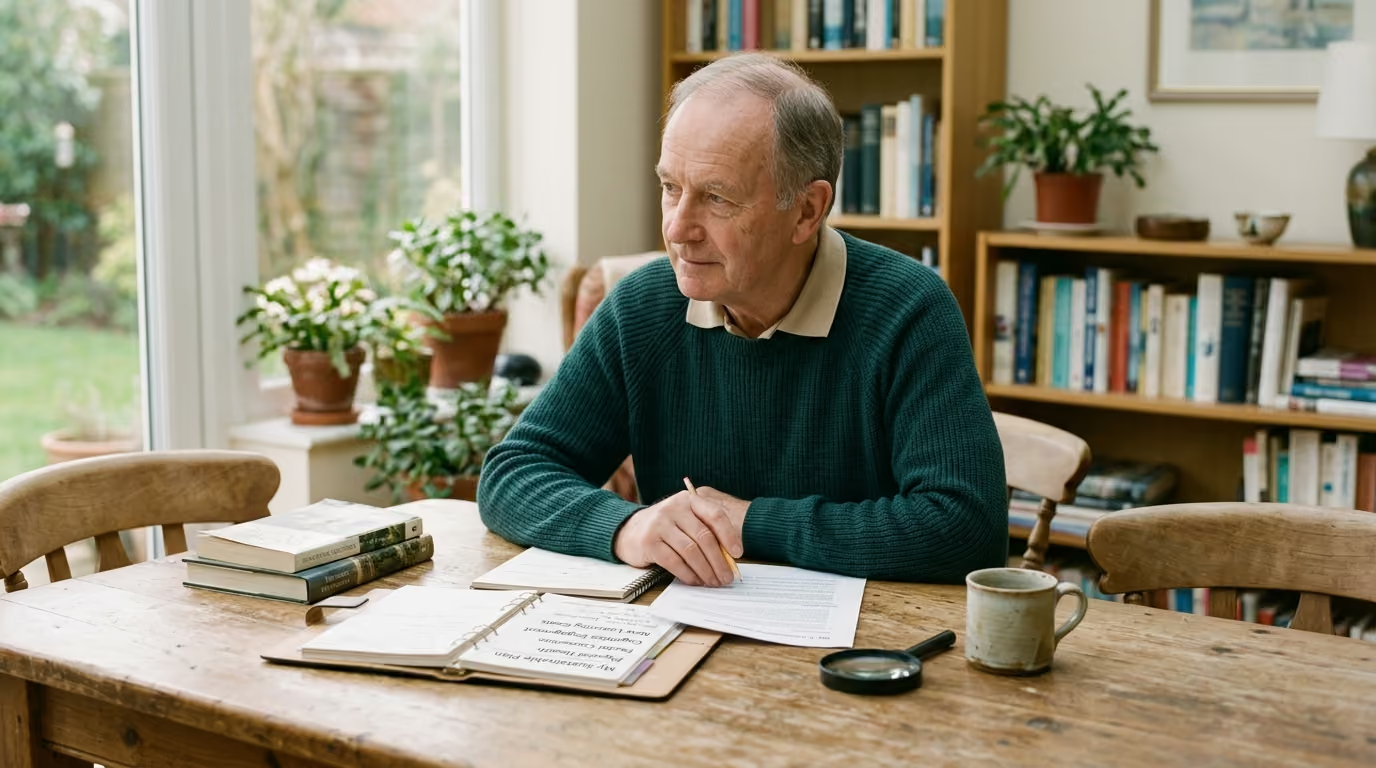

Waking up to an empty daily schedule after leaving your career creates the perfect opportunity to build authentic meaning through personal connection and curiosity.





Retirement is not a permanent holiday that requires endless consumption. It is also not the end of personal achievement or useful contribution. Retirement is a significant life transition where you renegotiate your time, your relationships, your identity, and your personal standards of worth.
For decades, work defines success through paychecks, job titles, and measurable productivity. When employment stops, relying on those old markers leaves many adults feeling adrift. This guide presents a balanced framework for evaluating your post-work years across six distinct dimensions: meaning, connection, curiosity, contribution, independence, and contentment.
The neurological and psychological basis of human motivation does not vanish when you leave a career. In behavioral psychology, healthy cognitive aging relies on maintaining self-directed goals, social integration, and mental engagement. Self-Determination Theory shows that human wellbeing rests on three fundamental psychological needs: autonomy, competence, and relatedness.
Autonomy means feeling that your daily actions are chosen by you rather than forced upon you. Competence means feeling capable and effective in the activities you undertake. Relatedness means feeling cared for by others and experiencing a sense of belonging in a community.
During your working years, employment often provided artificial scaffolding for these needs. Your job gave you structured tasks that exercised competence. It supplied a built-in network of colleagues for relatedness. It gave you daily routines that organized your cognitive attention.
When you retire, that external scaffolding disappears. Your brain must transition from externally directed demands to self-directed engagement. If you do not replace that structure, you risk experiencing cognitive drift and emotional isolation.
Redefining success means replacing external corporate metrics with internal psychological health. Success is living in a way that expresses your values, preserves your agency, supports your cognitive health, and nurtures your relationships. It is a continuous process of living well rather than a final destination.
Research in retirement and mental fitness shows that individuals who construct intentional daily routines maintain higher cognitive clarity and emotional stability over time. Success is not about proving your worth through frantic activity. It is about establishing sustainable patterns that keep your mind active, your body moving, and your social ties strong.
Scientific research shows that retirement does not affect everyone in the same way. The U.S. Health and Retirement Study tracked adults over a ten-year period from 2006 to 2016. The findings revealed that retirement was associated with a clear increase in a person's sense of purpose, particularly for people leaving stressful or low-control jobs.
When workers leave burdensome occupations, they gain the freedom to direct their attention toward activities they find genuinely meaningful. Freedom from rigid schedules allows people to invest more time in their health, family relationships, and personal interests. For these individuals, retirement acts as a positive catalyst for life satisfaction.
Other studies present a more complex picture. Fully retired adults sometimes report a lower sense of purpose than peers who continue working part-time. Leaving a career for involuntary reasons, such as job elimination, acute illness, or sudden family caregiving needs, is frequently linked with lower purpose and higher emotional distress.
The difference comes down to personal agency and replacement structures. When work provided your primary source of status, social connection, and intellectual stimulation, losing that environment creates a temporary void. Purpose does not depend on having a single grand mission. It is built through daily activities that feel coherent, significant, and directed toward worthwhile aims.
Longitudinal studies indicate that having a clear sense of direction predicts higher subjective wellbeing in older adults. A strong sense of purpose correlates with positive emotional states and better functional independence. Purpose does not prevent every negative emotion, but it provides a psychological anchor during major life transitions.
Evidence also shows that older adults place a higher value on purposeful living than younger demographics do. As time becomes more precious, people naturally seek experiences that carry real emotional and social weight. Understanding how brain aging and neuroplasticity interact with daily engagement can help you design a post-work life that supports cognitive longevity.
To measure your life without relying on old corporate metrics, you can use a multidimensional model. A healthy retirement balances six distinct areas of human experience. These areas work together to support overall wellbeing.
Meaning is the feeling that your life makes sense, holds significance, and aligns with your core values. It involves understanding your personal narrative and believing that your daily choices matter.
Meaning differs from momentary pleasure. Pleasure is short-term and focuses on immediate comfort, such as watching a movie or enjoying a good meal. Meaning is long-term and focuses on what is worthwhile, such as supporting a family member through a hardship or completing a challenging community project.
Connection includes both the objective size of your social network and your subjective feeling of belonging. It means having people in your life with whom you can share honest conversations, mutual support, and regular companionship.
Research from health agencies worldwide shows that human beings need dependable social bonds to thrive. Social connection is not merely a pleasant pastime. It is a fundamental biological need that influences cardiovascular health, immune function, and cognitive resilience.
Curiosity is an active orientation toward learning, questioning, and mental exploration. In later life, curiosity keeps your brain adaptable by encouraging you to master new skills and acquire fresh knowledge.
Curiosity supports your need for competence. When you learn how to propagate plants, play a musical piece, or understand local history, you prove to yourself that your intellectual growth remains ongoing. You do not need to master these skills for a commercial market; the value lies in the process of learning itself.
Contribution means directing your attention, skills, or resources toward something outside yourself. This includes mentoring younger people, volunteering for local organizations, caring for relatives, or maintaining community spaces.
Contribution shifts your focus away from self-absorption and isolation. It reminds you that your accumulated life experience has practical value for other people. Healthy contribution always respects personal boundaries and does not require endless self-sacrifice.
Independence is the ability to make authentic choices, direct your daily routine, and participate in activities you value. It does not mean isolating yourself or refusing assistance when you need it.
The World Health Organization defines healthy aging as developing and maintaining the functional ability that enables wellbeing. True independence works alongside interdependence. Using assistive tools, accepting help with heavy household tasks, or arranging reliable transportation allows you to preserve your agency while staying safe and engaged.
Contentment is the capacity to appreciate ordinary days without demanding constant excitement, consumption, or external applause. It is an emotional state of sufficiency and peace with your current circumstances.
Contentment is not passive resignation. You can pursue meaningful goals while remaining content with where you are today. Contentment allows you to enjoy a quiet morning, an unhurried walk, or a simple conversation without feeling that you are falling behind.
Your professional career likely shaped how you introduced yourself for thirty or forty years. When someone asked what you did, you answered with your job title. That title communicated your training, your social role, and your area of expertise.
Leaving that title behind can cause an identity disruption. Many retirees experience a quiet period of mourning for their former professional roles. Acknowledging this loss is a normal part of adjusting to a new phase of life.
To reconstruct an authentic identity, you can conduct a personal identity inventory. This exercise helps you separate your true personal strengths from the external requirements of your former workplace.
Identify the underlying skills that made you effective at your work. If you were an accountant, your true strength might be analytical problem-solving, organizing complex systems, or helping people feel secure about their futures. Those core strengths belong to you, not your former employer, and they can be applied to new activities.
Reflect on the behaviors you adopted solely to survive in your corporate environment. These might include working at an exhausting pace, managing workplace politics, or constantly monitoring email. Recognize that you can let these habits go without losing your competence.
Think about the parts of yourself that were sidelined during your peak earning years. You might have neglected your artistic interests, your role as an attentive neighbor, or your desire for outdoor physical activity. Retirement creates the time and space to bring these neglected roles back to the surface.
Practice describing yourself without mentioning your former occupation. You might define yourself as a student of history, an active community volunteer, a committed grandparent, or an amateur woodworker. Framing your identity around current values keeps your focus on what you are building today.
Social isolation is one of the most significant health risks facing older adults. The Centers for Disease Control and Prevention reports that roughly one in four adults aged 65 and older are socially isolated. More than one in three adults aged 45 and older report persistent feelings of loneliness.
The biological consequences of prolonged isolation are substantial. The CDC notes that social isolation is associated with a 50 percent higher risk of dementia, a 29 percent higher risk of heart disease, and a 32 percent higher risk of stroke. Chronic loneliness triggers physical stress pathways, elevates systemic inflammation, and reduces restorative sleep.
The National Institute on Aging highlights research showing that high levels of social engagement are associated with better cognitive health in later life. Participating in group activities, visiting neighbors, and staying involved with friends helps maintain cognitive processing speed and memory retention. Social interactions challenge your brain to process verbal cues, interpret emotions, and retrieve shared memories in real time.
To protect your cognitive wellbeing, build a balanced connection portfolio rather than relying on a single relationship:
This portfolio approach protects you if circumstances change. If a friend moves away or a spouse develops an illness, you still have other channels of human interaction. Integrating these connections with broader lifestyle habits for brain resilience creates a strong defense against isolation.
Contributing your time to civic or charitable causes provides a proven sense of agency. In the United States, civic engagement among older adults represents a major social and economic force. Data indicates that millions of older adults contribute billions of volunteer hours annually, providing substantial economic value to their communities.
A study analyzing data from the Health and Retirement Study followed older adults over four years. The researchers found that adults who volunteered at least 100 hours per year, which is about two hours per week, showed lower risks of mortality and physical limitations compared to non-volunteers. They also reported higher levels of physical activity, optimism, and daily purpose.
These observational findings show an association between regular civic contribution and sustained wellbeing. Volunteering gives you a reason to get moving, interact with diverse groups of people, and solve practical problems.
Volunteering must remain balanced to be beneficial. Some older adults fall into the trap of over-committing. When service becomes exhausting, it creates resentment and physical fatigue.
To keep your contribution healthy and sustainable, apply these practical guidelines:
Mental fitness is far broader than solving digital puzzles on a screen. True cognitive fitness involves learning new information, regulating your emotions, adapting to novel situations, and maintaining focused attention. Engaging your mind in complex tasks encourages your brain to form new synaptic connections throughout your life.
Physical activity plays a central role in supporting this cognitive machinery. The National Institute on Aging recommends that adults aim for at least 150 minutes of moderate-intensity physical activity each week. Regular aerobic movement, such as brisk walking, swimming, or cycling, improves cerebral blood flow and supports brain volume in regions associated with memory.
Learning projects work best when they combine intellectual challenge with personal relevance. The goal is not to prove your intelligence to others, but to experience the satisfaction of gradual mastery.
When designing a learning project, pick topics that require you to acquire real-world skills:
Allow yourself to be a complete beginner. In your career, you were expected to be an expert. In retirement, the cognitive and emotional benefit comes from being curious, making mistakes, and slowly building competence without performance pressure. You can find detailed strategies for supporting daily cognitive stamina in our guide to memory and attention strategies.
Navigating retirement requires unlearning cultural myths about aging. Many popular narratives portray retirement either as a permanent vacation or as a steep, unavoidable decline. Avoiding these oversimplified extremes helps you make grounded, realistic decisions.
Translating these concepts into daily habits requires an intentional approach. Rather than overhauling your entire schedule overnight, you can run small, structured lifestyle experiments. This process helps you test what activities bring genuine energy without locking you into rigid obligations.
Write down how you measured success during your career. Look closely at markers like income, job rank, public recognition, and the sheer volume of hours worked. Ask yourself which of these measures were genuinely fulfilling and which were driven by workplace competition. Consciously decide to set aside the metrics that no longer serve your life.
Create two simple lists on a piece of paper:
Acknowledging both lists helps you address genuine losses while making full use of your new freedoms.
Vague intentions rarely lead to satisfying routines. Translate your abstract personal values into specific, observable actions on your calendar:
A sustainable weekly schedule provides an organizing rhythm without overcrowding your calendar. Aim to include these baseline elements each week:
When trying a new club, class, or volunteer position, commit to it for exactly 30 days. Treat it as a low-pressure trial. At the end of the month, evaluate how the activity affected your energy:
If the activity was not a good fit, release it without guilt and choose another experiment.
Every three months, take an hour to reflect on how your time is allocated across the six dimensions: meaning, connection, curiosity, contribution, independence, and contentment. Consider whether temporary life events, such as health changes or family obligations, require you to adjust your routine. Exploring resources on retirement purpose and cognitive vitality can provide fresh ideas as your needs evolve.
Your annual wellness visit is a valuable opportunity to discuss how your post-work lifestyle supports your physical and cognitive longevity. Consider bringing these specific questions to your next medical appointment:
An involuntary exit often brings real feelings of shock, anger, and grief. The first priority is to stabilize your emotional health and your daily finances rather than rushing to find immediate purpose. Give yourself permission to mourn the sudden loss of your career.
Once your routine stabilizes, focus on small areas where you still have agency. Even if your physical stamina or finances are constrained, you can make meaningful choices about how you spend your mornings, which books you read, and how you maintain contact with friends.
A meaningful retirement does not require expensive travel, private clubs, or paid entertainment. Many of the most powerful sources of purpose and connection are free or low-cost:
Caregiving is one of the most profound and demanding forms of human contribution. If you spend your days caring for an ill partner or relative, you already have a clear, vital purpose. Your main challenge is avoiding exhaustion.
Success for a caregiver means setting clear boundaries, seeking community respite support, and protecting small pockets of time for your own physical health and mental rest. You do not need to add hobbies to your schedule; you need rest, steady support, and recognition for the meaningful work you are already doing.
Continuing to work in some capacity is a perfectly valid retirement choice. Many older adults find that part-time consulting, bridge employment, or running a small business provides the exact balance of structure, income, and social contact they desire. Working on your own terms can be an excellent expression of autonomy and competence, provided it leaves adequate room for rest and personal relationships.

Follow FitBrainLab for research-led insights on memory, focus, brain aging, nutrition and mental fitness after 60. Stay connected for new articles, practical guidance and ideas for a sharper, more engaged life.


Build habits that support memory, focus and a curious, connected life.
Read the Blog