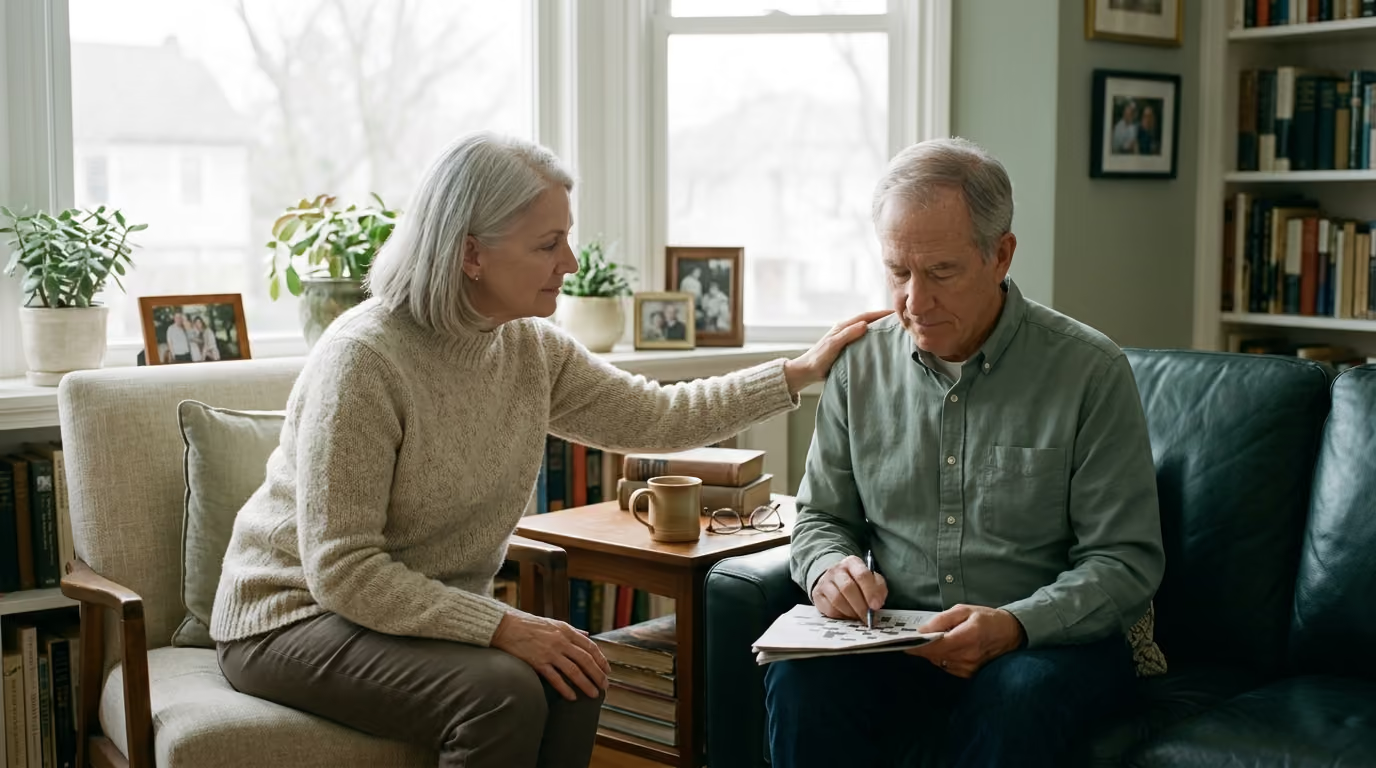

Spending quiet days alone after sixty can silently impact your memory, but practical assessment tools and structured reconnection routines help protect your cognitive resilience.





Many people find themselves typing a specific question into search engines late at night: "Is living alone making my memory worse?"
Retirement, the loss of lifelong partners, moving to a new home, and changing health conditions can quietly shrink daily contact. You might notice that days go by with very little conversation. You might worry that feeling disconnected or spending too much time alone is harming your mental sharpness.
This guide provides clear, evidence-based answers. It explains the biological mechanisms linking social connection to brain health, details what modern research does and does not prove, and outlines an adaptable six-phase action plan to protect your cognitive vitality as you age.
To understand why human contact matters for memory, it helps to examine how the nervous system responds to social relationships. The human brain evolved in cooperative groups. It interprets persistent, unwanted isolation as a state of vulnerability.
When a person feels persistently lonely, the brain activates the sympathetic nervous system. This activation raises baseline levels of cortisol, a primary stress hormone. Short bursts of cortisol help us respond to immediate physical danger. Long-term elevation of cortisol, however, can damage the hippocampus. The hippocampus is the brain structure responsible for forming new memories and retrieving stored information.
Social interaction also acts as a natural exercise session for neural networks. When you participate in a dialogue, your brain simultaneously manages multiple complex tasks. You interpret vocal inflection, track subtle facial expressions, remember shared history, choose appropriate language, and inhibit irrelevant thoughts.
These tasks engage the prefrontal cortex, which governs executive function, planning, and focus. Engaging with other people activates the same neural mechanisms that build neuroplasticity and brain aging resources across your lifespan.
Disconnection also disrupts restorative rest. Chronic social distress interferes with sleep architecture, leading to micro-awakenings throughout the night. Deep sleep is the physiological window during which the brain clears metabolic waste products and consolidates memories from the previous day.
When sleep is fragmented by loneliness, the brain misses this essential maintenance window. Over time, poor sleep produces noticeable mental fatigue, slowed information processing, and short-term forgetfulness.
Before taking action, you must distinguish between two concepts that are frequently confused: social isolation and loneliness. While they often occur together, they represent distinct human experiences with different solutions.
Social isolation refers to an objective physical state. It measures how many social ties, conversations, and community interactions a person actually has. An isolated individual may live alone, speak to others only rarely, lack reliable transportation, or have few living friends or relatives.
Loneliness is entirely subjective. It is the painful feeling that your existing relationships do not meet your emotional needs. A person can live in a busy household or attend weekly community events and still feel profoundly lonely if they feel misunderstood or unvalued.
Conversely, an older adult who lives alone and enjoys peaceful solitude may have high objective isolation but zero loneliness. Solitude is chosen, restorative, and satisfying. It does not produce the chronic stress response triggered by unwanted loneliness.
The remedies for these two states are fundamentally different:
Confusing these two states can lead to frustrating mistakes. An older adult experiencing emotional loneliness after the death of a spouse is often told to join a local social club. If the person attends but finds only superficial small talk, they may feel more alienated than before. Identifying your specific challenge helps you select the right response.
Scientific research on social connection and brain health has expanded significantly in recent years. Major global health organizations now treat social connection as a significant health factor for older adults.
The World Health Organization reports that roughly one in four older adults worldwide experiences social isolation. Studies in the United States indicate that approximately one-quarter of adults aged 65 and older are socially isolated, and about one-third report feeling lonely. Loneliness is not unique to later life, as global surveys show that roughly 16 percent of people across all age groups experience it.
Epidemiological research consistently identifies associations between chronic social disconnection and poorer cognitive function. Large observational studies show that isolated or persistently lonely individuals tend to perform worse on assessments of working memory, executive function, and verbal processing.
The 2024 Lancet Commission on dementia prevention, intervention, and care identifies social isolation as one of the key modifiable risk factors for dementia. Alongside managing high blood pressure, physical inactivity, depression, and hearing loss, staying socially engaged is recognized as an evidence-based method for protecting mental performance.
Research highlights three primary mechanisms through which social connection supports cognitive longevity:
You should view this evidence with scientific balance. Observational studies demonstrate strong statistical links, but they do not prove that isolation alone causes dementia.
Early, subtle cognitive changes can cause a person to withdraw from social situations because noisy environments become confusing or tiring. Furthermore, factors like depression, untreated hearing loss, vascular disease, and economic hardship can cause both social withdrawal and mental decline simultaneously.
Social connection should not be viewed as an absolute guarantee against cognitive decline. Rather, it is a modifiable lifestyle factor that shifts the probabilities in your favor. It works best when combined with comprehensive lifestyle strategies for cognitive resilience, including regular movement, balanced nutrition, and good sleep habits.
Social disconnection rarely occurs in isolation. It typically develops as a self-reinforcing downward loop that affects body, mood, and mind simultaneously.
The cycle often begins with an external life change. You might retire from a long career, lose a partner, develop mobility problems, or lose your ability to drive at night. These practical changes reduce your daily contact with the outside world.
With fewer appointments and casual interactions, your daily routine loses its predictable structure. The brain receives less sensory and cognitive stimulation. Days begin to blur together, which can weaken your time orientation and focus.
Persistent loneliness then triggers an increase in threat sensitivity. The nervous system becomes more guarded. A person in this state may interpret ambiguous social interactions as rejections. A friend who does not return a phone call immediately is assumed to be uninterested, leading to hurt feelings and further withdrawal.
This emotional distress disrupts sleep and lowers baseline mood. Low energy makes initiating contact feel exhausting. The thought of getting dressed, driving across town, and making conversation feels overwhelming.
As social interactions drop toward zero, the individual misses out on physical movement, intellectual discussion, and emotional reassurance. Memory concerns can worsen under these conditions, leading to fears of permanent mental decline. Recognizing this cycle is the first step toward reversing it.
Before attempting to change your daily routine, it helps to conduct an objective self-audit. This assessment examines four distinct areas of daily life to clarify where your challenges lie.
Begin by examining the factual reality of your weekly schedule:
Next, look at the emotional quality of your existing connections:
Identify physical or logistical obstacles preventing you from engaging with your community:
Examine your current emotional baseline and thinking patterns:
If your review reveals significant hearing issues, chronic low mood, or new daily memory errors, schedule an evaluation with a primary care clinician. These issues can often be treated directly.
Rebuilding social connection requires a steady, structured approach. Demanding that an isolated individual immediately join several clubs or volunteer groups can cause overwhelming anxiety.
The six-phase framework below uses small, progressive steps. It helps re-establish social rhythm while protecting your cognitive energy.
The first two weeks focus on creating internal stability and physical energy. You cannot build a vibrant social life if you are exhausted, sleeping poorly, or feeling physically depleted.
Human relationships develop most naturally through predictable, repeated exposure. During weeks three and four, introduce a single recurring social touchpoint into your weekly calendar.
During weeks five and six, combine social interaction with physical activity. Physical exercise increases blood flow to the brain and stimulates the release of growth factors that protect neurons.
Once a single weekly rhythm feels natural, begin introducing variety. Scientific research indicates that maintaining diverse types of social relationships provides broader cognitive stimulation than relying solely on one family member.
A powerful antidote to emotional loneliness is feeling useful. Many older adults experience a drop in life satisfaction after leaving the workforce because they miss feeling needed.
After completing two months of intentional reconnection, evaluate your progress honestly:
Drop activities that cause constant strain and double down on the relationships that bring mutual respect, humor, and intellectual engagement.
General advice on staying connected often ignores the practical realities of chronic illness, bereavement, and sensory changes. Adapting your strategy to match your specific life circumstances makes long-term success possible.
Hearing loss makes group conversations exhausting. In a noisy restaurant, an older adult with mild hearing loss must expend significant cognitive effort just to decode words. This leaves little mental capacity to actually enjoy the conversation.
Spousal caregivers are at high risk for both social isolation and chronic stress. A caregiver may spend all day with their partner yet lack reciprocal adult conversation.
Losing a spouse or close friend alters your daily social landscape instantly. Grief can cause profound mental fog, forgetfulness, and physical fatigue.
Individuals diagnosed with mild cognitive impairment often withdraw from social life due to anxiety about forgetting names or repeating stories in public.
Understanding cognitive health requires clearing away common myths that create unnecessary worry.
Living alone is a physical arrangement, not a medical condition. Millions of older adults live alone successfully while maintaining sharp mental faculties and rich social lives. What affects the brain is persistent, distressing loneliness or total social deprivation, not independent living.
Quality consistently matters more than quantity. Having one or two dependable relationships where you can speak honestly provides far more emotional and neurological protection than having twenty casual acquaintances.
While video calls and messaging do not entirely replace physical presence, they provide real social and cognitive benefits. For individuals with limited mobility or those living far from family, structured online interactions stimulate language processing and maintain emotional bonds effectively.
When an older adult becomes withdrawn, family members often assume they have simply become an introverted homebody. In many cases, the withdrawal is driven by treatable factors like hearing loss, low-grade depression, mobility fears, or dental discomfort. Addressing the root cause often restores social interest.
While lifestyle changes are powerful, some situations require direct medical or psychological intervention. Social disconnection can be a symptom of underlying clinical conditions that cannot be solved by social clubs alone.
Consult a healthcare professional if you or a loved one experience any of the following symptoms:
A primary care physician can evaluate whether your symptoms stem from reversible medical issues. Thyroid imbalances, vitamin B12 deficiencies, medication side effects, urinary tract infections, and untreated depression can all mimic cognitive impairment.
If you are struggling after a major life transition, reading our memory and focus guidance and reviewing maintaining mental fitness after retirement can provide additional clarity on how cognitive changes unfold over time.
Take these specific questions to your next medical appointment to start a productive conversation about your social and cognitive well-being:
You do not need to rebuild your entire social life today. Choose two or three manageable tasks from this checklist to complete over the coming week:

Follow FitBrainLab for research-led insights on memory, focus, brain aging, nutrition and mental fitness after 60. Stay connected for new articles, practical guidance and ideas for a sharper, more engaged life.


Build habits that support memory, focus and a curious, connected life.
Read the Blog