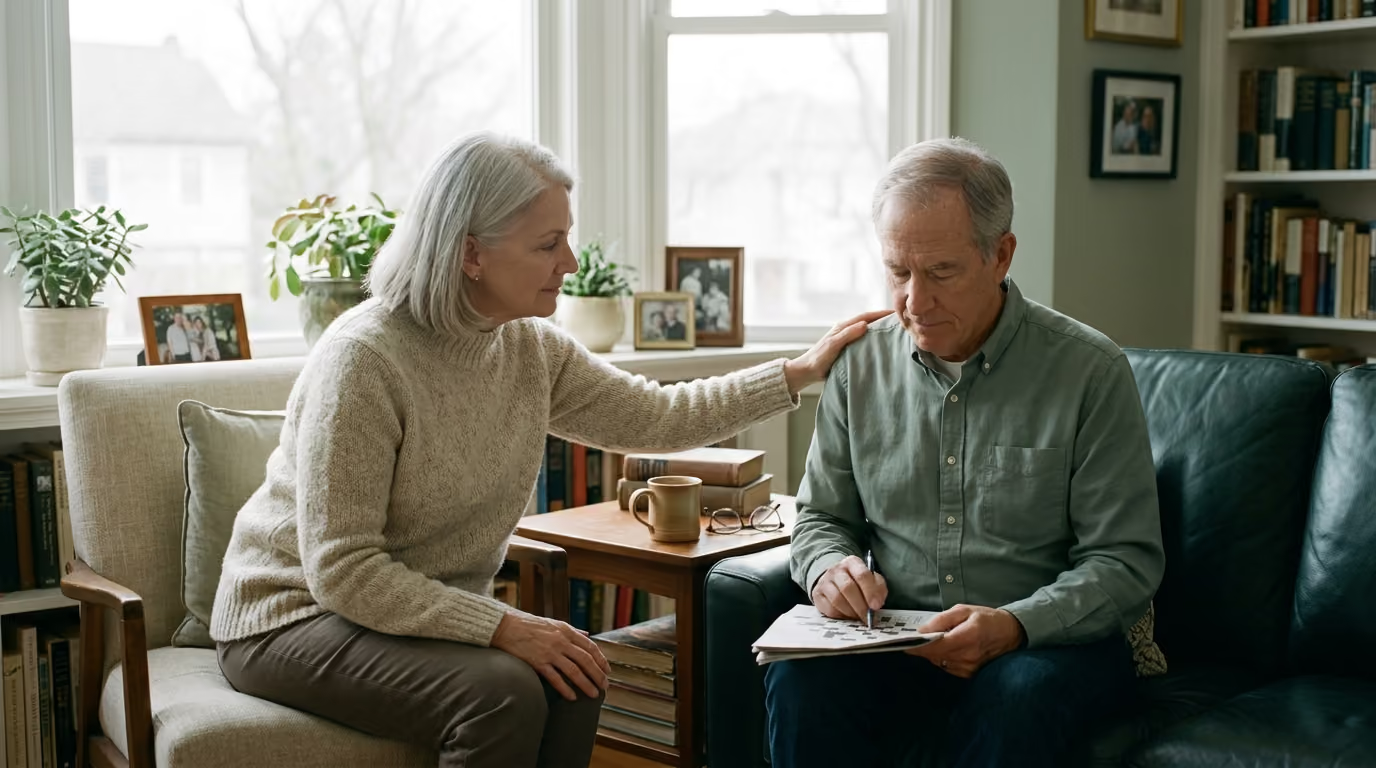

Targeted learning strategies and challenging new activities help older adults maintain cognitive reserve, master demanding skills, and support long-term brain health.





Lifelong learning after 60 is the deliberate, continuous acquisition of new skills, knowledge, and practical capabilities throughout later adulthood. It is not a guaranteed shield against dementia, nor is it a collection of quick mental exercises designed to reverse biological aging. Instead, genuine learning involves structured effort, novelty, active practice, and personal purpose.
This guide examines how the brain changes with age, what clinical research confirms about cognitive stimulation, and how you can acquire demanding abilities such as languages, musical instruments, crafts, or digital tools with methods supported by cognitive science.
The adult brain retains the ability to adapt, reorganize, and build new neural pathways throughout life. This biological capacity is known as neuroplasticity. When you practice a novel task, groups of neurons communicate more efficiently, strengthening their connections through repeated activation.
At the same time, normal cognitive aging brings measurable changes in how quickly the brain processes unfamiliar information. The National Institute on Aging notes that older adults can continue learning new skills, forming fresh memories, and expanding their vocabulary, even if the initial acquisition of new material requires more time and focused attention.
A helpful way to understand this process is through the concept of cognitive reserve. Cognitive reserve refers to the brain's capacity to navigate age-related structural changes by drawing on flexible, well-developed networks and problem-solving strategies. Building reserve does not mean filling an isolated storage tank in the brain. Rather, sustained intellectual engagement helps you develop alternative ways to solve problems and manage daily tasks.
Neuroplasticity in later life operates under specific constraints:
When you learn to read sheet music or operate complex software, your brain builds targeted circuits for those tasks. Understanding these biological principles prevents unrealistic expectations while confirming that your capacity to master demanding subjects remains intact. Readers interested in the biological foundations of brain change can review our brain aging and neuroplasticity articles for deeper scientific context.
Scientific research on cognitive training in older adults provides clear, encouraging findings, alongside clear boundaries about what learning can and cannot accomplish. Broadly, research supports three distinct conclusions.
First, learning produces clear, measurable gains in the specific skill being practiced. When older adults receive structured instruction in reasoning, spatial orientation, or memory techniques, their performance on those specific tasks improves substantially.
Second, the transfer of those gains to unrelated cognitive domains is limited. Mastering a logic puzzle makes you better at logic puzzles, but it rarely improves your ability to recall names or navigate an unfamiliar city.
Third, current clinical evidence does not support claims that mental training alone can completely prevent dementia. Systematic reviews, including evaluations by the World Health Organization and the National Academies of Sciences, Engineering, and Medicine, show that while mentally engaging environments support overall cognitive health, structured brain training has not been proven to prevent underlying neurodegenerative diseases for every individual.
One of the largest studies on this topic is the Advanced Cognitive Training for Independent and Vital Elderly (ACTIVE) trial. The trial enrolled thousands of healthy older adults to test training programs in memory, reasoning, and processing speed. Long-term follow-up assessments at ten years revealed meaningful patterns:
Another landmark study, the Synapse Project, examined the impact of real-world skill acquisition. Researchers assigned older adults to learn demanding new skills, such as digital photography or quilting, for fifteen hours per week over three months. Other groups participated in low-demand social activities or passive tasks like listening to classical music.
The participants assigned to high-effort, novel skills showed significant improvements in episodic memory and processing speed compared to those in low-effort groups. The researchers concluded that novelty, sustained effort, and active production are the critical ingredients that make an activity cognitively valuable.
Finally, a systematic review published in 2024 emphasized that participant engagement, persistence, and adherence are the primary factors determining whether any cognitive intervention succeeds. A challenging task only provides benefits if you find it meaningful enough to practice consistently over months and years. For related evidence on maintaining mental fitness throughout retirement, explore our collection of retirement and mental fitness articles.
Many adults over 60 rely on learning habits formed in school, such as reading a textbook repeatedly, highlighting passages, or reviewing notes passively. Modern cognitive science shows that these passive approaches create an illusion of mastery without producing lasting memory.
To acquire complex material effectively, you can apply an evidence-based framework built around six core mechanics.
Learning requires mental effort, and effort requires motivation. Choose projects that connect directly with your values, personal history, or daily life. Learning conversational Italian to communicate with relatives abroad provides far stronger motivation than memorizing random word lists.
For learning to stimulate neural adaptation, the task must present a productive challenge. If an activity is completely automatic, it provides little cognitive stimulation. If it is overwhelmingly difficult, it causes frustration and abandonment. Seek the middle zone where you must concentrate fully to succeed.
Retrieval practice means pulling information out of your memory instead of looking at the answer. When you review a vocabulary term, close your notebook and state the definition aloud before checking. Studies confirm that repeated retrieval strengthens memory pathways far more than passive re-reading for both younger and older adults.
Spreading your practice across multiple short sessions produces stronger retention than cramming all your practice into a single day. For example, practicing an instrument for twenty minutes five days a week creates more durable learning than practicing for two hours once a week. Research shows that spaced practice benefits learners across all age groups over extended retention intervals.
Making errors is a normal part of skill acquisition. The danger lies in repeating errors until they become ingrained habits. Check your work immediately against a reference model, an instructor's demonstration, or an answer key. Prompt correction allows your brain to adjust its motor or conceptual plans before errors take root.
Practice a skill under different conditions to make your knowledge flexible. If you are learning a new digital photography technique, practice indoors, outdoors, in low light, and with different subjects. Applying knowledge in diverse settings helps you transfer what you have learned from the practice desk to real life.
Different learning activities place distinct demands on your attention, sensory processing, physical coordination, and memory systems. Choosing the right activity depends on your personal interests, physical capabilities, and functional goals.
Acquiring a new language engages working memory, listening comprehension, speech production, and grammatical rule integration. A 2025 study evaluating older adults found that foreign-language learners demonstrated measurable gains in episodic memory and cognitive flexibility.
Language study is particularly valuable because it combines individual study with social communication. To study a language effectively after 60:
Learning to play an instrument requires rapid coordination between vision, hearing, and fine motor control. You must read notation, translate symbols into precise finger movements, evaluate timing, and listen to tonal accuracy simultaneously. Systematic reviews indicate that active instrumental training supports global cognitive function and executive control in older adults.
Listening to music is relaxing, but it does not produce the same cognitive demands as playing an instrument. When beginning an instrument:
Creative crafts such as woodworking, pottery, complex knitting, and quilting demand spatial reasoning, fine motor planning, and sustained attention. The Synapse Project demonstrated that learning structured, novel crafts led to measurable gains in episodic memory among older adults.
The cognitive value of craft work depends heavily on whether you are learning new techniques or simply repeating familiar patterns. To gain the greatest cognitive benefit:
Learning modern technology provides both mental stimulation and immediate practical benefits. Mastering online banking portals, medical patient portals, digital photo management, or video communication helps you preserve your independence.
Technology instruction is most effective when it focuses on real-world procedures:
Studying history or engaging in structured non-fiction writing trains critical thinking, reading comprehension, and long-term memory integration. Watching historical documentaries provides passive enjoyment, but active historical research requires evaluating conflicting accounts, creating timelines, and synthesizing evidence.
To transform reading into an active cognitive task:
Practical skills such as gourmet cooking, organic gardening, home maintenance, or basic automotive care combine physical movement with cognitive planning. Cooking a complex new recipe requires executive functioning: organizing ingredients, timing multiple dishes, adjusting measurements, and monitoring sensory feedback.
These practical tasks keep you physically active while exercising your problem-solving abilities. They offer clear, immediate feedback: the meal either tastes right or it does not, and the repaired appliance either runs or it remains broken. Readers seeking practical strategies for everyday mental clarity can browse our memory and focus guidance.
Consistency matters far more than intensity when acquiring new skills in later adulthood. Setting aside twenty to thirty minutes each day creates more reliable progress than attempting marathon study sessions that cause mental fatigue.
A well-structured weekly schedule might look like this:
Learning does not happen in isolation from your physical health. The National Institute on Aging emphasizes that cognitive wellness relies on broader lifestyle supports. Adults over 60 should aim for at least 150 minutes of moderate physical activity per week, seven to nine hours of quality sleep each night, and balanced nutrition.
Unaddressed hearing or vision changes can also make learning unnecessarily difficult. If you struggle to hear an instructor or read small notation, your working memory becomes overwhelmed by basic sensory processing. Getting regular hearing and vision screenings protects your ability to engage with educational materials comfortably. To explore broader lifestyle factors that support long-term brain health, visit our collection of lifestyle habits for brain resilience.
Public discussions about aging and brain health often contain misleading claims, marketing hype, or overly pessimistic assumptions. Clarifying these misconceptions helps you invest your time in learning activities that genuinely support your cognitive health.
Many commercial digital applications claim that playing short mini-games on a smartphone will make your entire mind sharper. Clinical research from the National Academies shows that while users improve on the specific mini-games they practice, these gains rarely transfer to real-world memory, financial reasoning, or everyday decision-making. Demanding real-world projects like learning a language or craft provide broader practical value.
Continuing to learn is a valuable habit that supports cognitive reserve and daily functioning, but it is not an absolute preventative measure against neurological disease. Dementia is driven by complex genetic, vascular, and environmental factors. Framing learning as a guaranteed cure creates unrealistic expectations and places unfair blame on individuals who develop cognitive disorders despite an active intellectual life.
Processing speed naturally declines as we age, which means mastering new concepts may take longer than it did at age twenty. However, semantic memory, vocabulary, and accumulated life experience remain strong or even improve. Slower learning simply requires paced instruction and structured repetition, not lower intellectual ambitions.
Watching educational television shows or listening to audiobooks is an enjoyable leisure activity, but it requires minimal cognitive effort. True learning requires active generation: testing your memory, practicing a physical technique, taking notes, and solving problems independently. Without active effort, information is quickly forgotten.
Social engagement is vital for emotional well-being and overall health. However, the Synapse Project proved that older adults who engaged in demanding new learning experienced significantly greater memory gains than those who only participated in low-demand social gatherings. Combining social connection with structured learning provides the strongest combination of benefits.
Your primary healthcare provider is an essential partner in supporting your cognitive health and identifying physical barriers that could interfere with learning. Here are specific, practical questions to bring to your next medical appointment:
Reviewing these questions with your physician ensures that your brain has the physiological foundation necessary to support focused learning. For additional curated reading and checklists, browse our dedicated cognitive longevity resources.
Individuals with Mild Cognitive Impairment can still learn new routines and information, but the instruction must be adapted. Use spaced retrieval with short initial intervals, expanding the time between tests as the memory stabilizes. Focus on one single task at a time, provide immediate corrective feedback to prevent error learning, and rely on written checklists, calendars, and external reminders to support daily performance.
Physical limitations should not prevent you from pursuing creative and musical skills. Choose instruments that require less grip strength, such as lightweight electronic keyboards, or use ergonomic adaptive grips on paintbrushes, wood-carving tools, and sewing needles. Shorten your practice sessions to ten-minute intervals to avoid joint fatigue, and focus your attention on rhythm, musical theory, or design planning when physical hands-on practice feels uncomfortable.
Online courses offer flexibility, accessibility, and a vast selection of topics, which is especially helpful if transportation is difficult. However, online learning requires greater self-discipline to prevent passive viewing. To make online study effective, take handwritten notes, complete all assigned exercises, pause the video to test your recall, and seek out online discussion groups or local study partners to maintain accountability.
If a project causes severe frustration or anxiety, the challenge level is set too high. Break the skill down into smaller micro-steps. Instead of trying to learn an entire computer program, master one single menu command or workflow until it feels comfortable. Reducing the scope of your immediate goal lowers cognitive fatigue, restores your confidence, and allows you to build competence steadily.

Follow FitBrainLab for research-led insights on memory, focus, brain aging, nutrition and mental fitness after 60. Stay connected for new articles, practical guidance and ideas for a sharper, more engaged life.


Build habits that support memory, focus and a curious, connected life.
Read the Blog