
Stronger memory retention and real-world communication skills emerge when older adults combine spaced retrieval techniques with low-pressure speaking practice and sustainable study habits.





Many older adults search online to ask whether it is realistic to learn a foreign language after 60, and whether doing so protects the brain against dementia. The short answer is that you can acquire practical language skills at any age, but language study is not a guaranteed shield against cognitive decline. This guide provides an honest, evidence-based roadmap for learning a new language, focusing on functional communication, memory retention, and sustainable mental engagement.
The adult brain retains neuroplasticity, which is the capacity to modify its functional organization through experience and learning. Acquiring a new language engages multiple mental systems at the same time. You must hear unfamiliar sounds, decode grammar, remember vocabulary, and select correct phrases under time pressure.
When you practice a language, your brain relies heavily on executive functions. Executive functions are high-level control processes managed largely by the frontal networks of the brain. They include the ability to switch between tasks, hold information in mind while using it, and suppress automatic habits.
When speaking a new language, you must actively inhibit your native tongue. If you want to say "the red car" in Spanish, your brain must suppress the English word order and select "el coche rojo." This process of active inhibition and rule switching creates continuous mental activity.
Language practice also stimulates working memory. Working memory holds fragments of a sentence while you figure out how to finish your thought. This complex network activity helps explain why language study is frequently explored in brain aging and neuroplasticity research.
Another relevant concept is cognitive reserve. Cognitive reserve refers to the brain's ability to cope with age-related changes or physical pathology by using alternative mental strategies and networks. Complex mental activities throughout life contribute to this resilience.
Language learning offers an accessible way to keep mental pathways active. It does not rebuild brain tissue overnight, but it exercises the neural pathways responsible for attention, memory search, and behavioral control.
Scientific studies on language learning in older adults show promising results, but the findings require careful interpretation. A systematic review of second-language training in older adults found that research in this area is still emerging. The strongest positive signals appear in attentional switching and cognitive inhibition. Evidence for gains in working memory and general cognitive performance remains moderate, while studies show no consistent evidence that language learning improves raw intelligence, verbal episodic memory, or native verbal fluency.
The central question in cognitive science is transfer. Near transfer happens when practicing a task makes you better at closely related tasks, such as memorizing words or recognizing foreign speech sounds. Far transfer happens when practicing a specific skill improves unrelated mental abilities, such as spatial reasoning or abstract problem-solving.
Evidence for broad far transfer from language learning is inconsistent. In a randomized controlled study of 160 healthy adults aged 65 to 75, participants completed 11 weeks of introductory Italian or a structured relaxation program. Both groups showed expected learning in their respective tasks. The language learners acquired basic Italian, but they showed no meaningful cognitive advantage over the relaxation group in working memory, associative memory, spatial intelligence, or verbal intelligence.
Other randomized trials report selective cognitive benefits. One study found that older adults who completed foreign-language training or cognitive games showed improvements in overall cognitive measures that persisted for three months, whereas a music appreciation group did not show those gains. Another trial observed improvements in episodic memory and mental flexibility among language learners, though the magnitude of change was similar to that produced by music instruction.
These mixed results suggest that the novelty, structured effort, and sustained attention involved in language study may drive the observed benefits rather than any unique mechanism exclusive to foreign vocabulary.
Imaging research provides a similar, nuanced view. One study tracked older adults during a short entry-level language course and found no detectable structural changes in brain regions linked to memory and language, regardless of vocabulary gains. A separate preliminary study reported changes in white-matter tracts alongside executive function improvements after four months of study, but these findings remain early and unconfirmed by broader replications.
Researchers also note that individual differences play a role in how readily older adults pick up new vocabulary. Baseline memory capacity and hippocampal volume correlate with initial learning speed.
These findings do not mean that individuals with lower baseline memory cannot learn. They simply indicate that people require different amounts of repetition, external cueing, and time to achieve their communication goals.
The 2024 Lancet Commission report on dementia prevention emphasizes that cognitive stimulation throughout life is valuable as part of a total lifestyle approach. That broader approach includes managing blood pressure, staying active, treating sensory loss, and remaining socially connected. Language study fits into this picture as a stimulating, structured hobby, not as a standalone medical intervention.
Learning vocabulary after 60 requires strategies that work with the natural properties of the mature memory system. Passive exposure, such as reading vocabulary lists or letting audio play in the background, produces weak retention. Durable learning requires active retrieval and strategic spacing.
Spaced retrieval is a method where you test your recall of a word or phrase across gradually expanding time intervals. Instead of cramming twenty repetitions into one afternoon, you space those repetitions over days and weeks. Research demonstrates that spaced practice leads to superior long-term retention compared to massed practice for both younger and older adults.
When you allow a brief period of forgetting to occur before trying to recall an item, your brain must work harder to reconstruct the memory trace. This effort strengthens the retrieval pathway.
A standard spaced retrieval cycle for a new phrase follows a clear progression:
If you fail to retrieve the word at any step, reset the interval. Provide yourself with a prompt, say the correct phrase aloud, and test it again after a short delay.
Many digital language apps rely heavily on multiple-choice questions. Seeing a word and recognizing its meaning among four choices is passive recognition. Speaking or writing that word from scratch is active recall.
Recognition creates an illusion of mastery. You might feel that you know a word because it looks familiar on a screen, but you may still struggle to produce it during an actual conversation.
To build reliable recall, structure your self-testing to move from your native language into your target language. Looking at an English prompt and producing the foreign equivalent forces your brain to execute a full memory search. This practice mirrors the real-world demands of conversational speech and builds stronger retention through focused memory practice.
Adult brains remember connected concepts far better than isolated lists of arbitrary terms. Instead of memorizing twenty unrelated nouns, group words into functional conversational clusters.
For example, a cluster centered on ordering a morning coffee might include:
Elaboration strengthens these connections further. Connect new vocabulary to personal memories, sensory details, or visual images.
If you are learning the Italian word for butter, burro, you might visualize a stick of butter melting over a warm dish you enjoyed in Florence. The richer the mental association, the easier the retrieval pathway becomes.
When you cannot remember a word, avoid looking at the answer immediately. Give yourself graduated hints to see if you can trigger the memory with minimal help.
Use this step-by-step cueing sequence:
This technique reduces frustration while still requiring mental effort from your memory circuits.
Speaking a foreign language can feel intimidating, especially if you worry about making mistakes in front of others. A practical learning plan breaks speaking down into progressive steps that build confidence without overwhelming your working memory.
Spontaneous conversation requires your brain to manage grammar, vocabulary, pronunciation, and social cues at the same time. You can lower this cognitive load by practicing scripted dialogues for predictable daily situations.
Draft simple scripts for interactions you anticipate having. These might include checking into a hotel, ordering food at a market, introducing yourself at a club, or asking for directions.
Read the script aloud several times until your pronunciation feels smooth. Next, remove the foreign text and try to produce each line using only your native language notes as prompts. Finally, practice the dialogue with a partner or an audio recorder without looking at any notes.
Real conversations rarely follow a perfect script. Native speakers talk fast, use slang, and drop syllables. The most valuable phrases you can learn early are communication repair tools.
Learn how to say these phrases fluently within your first week of study:
Having these repair phrases ready reduces conversational anxiety. When you hit an unfamiliar word, you do not need to freeze. You can use your repair tools to keep the interaction going smoothly.
You do not need an immersion trip to practice spoken language. Many low-pressure exercises allow you to practice verbal output on your own terms:
When practicing speech, divide your sessions into fluency practice and accuracy practice. Trying to maintain perfect grammar while speaking fluidly causes cognitive overload.
During a fluency session, your single objective is continuous communication. Keep speaking, use gestures if you forget a word, and do not stop to correct your verb endings.
During an accuracy session, slow down and focus on a specific grammatical rule, such as past-tense endings or correct gender agreements. Separating these two modes builds conversational confidence alongside grammatical understanding.
Consistency matters more than total hours spent in a single day. Short, frequent sessions distributed across the week yield better retention than an exhausting weekend study marathon. Building language study into an enduring habit requires clear structure and realistic goals.
Motivation naturally fluctuates. On busy or low-energy days, a demanding study goal often leads to skipped sessions. Establish a minimum daily routine that takes only ten to fifteen minutes to complete.
A basic daily routine might look like this:
This routine is small enough to complete even when you feel tired or travel away from home. When you have more time and energy, you can expand the session to thirty or forty-five minutes.
The goal is to maintain the daily habit loop without interruption. Consistency over months produces reliable progress, which aligns with principles of mental fitness and active living.
Many learners lose motivation because they measure themselves against an unrealistic standard of native fluency. Tracking functional, real-world milestones provides clear evidence of your actual progress.
Instead of measuring hours logged, track concrete achievements:
These functional goals ground your study in practical utility. They remind you that language is a tool for human connection, not an academic exam.
Every language learner encounters plateaus where progress seems to stall. You may feel that you are forgetting old words as fast as you learn new ones. This plateau is a normal phase of memory consolidation.
When you hit a plateau, adjust your study format instead of quitting:
Changing the sensory input refreshes your interest while your brain consolidates previously learned material.
Aging introduces physical and sensory changes that can affect how you study. Making practical adjustments to your learning environment removes unnecessary friction.
Accurate speech perception is the foundation of language learning. If your brain struggles to distinguish foreign vowels and consonants, memorizing vocabulary becomes significantly harder. The 2024 Lancet Commission identifies midlife and late-life hearing loss as a major modifiable risk factor for cognitive decline, making hearing health a top priority for overall brain wellness.
If you use hearing aids, ensure they are calibrated before beginning an audio-heavy language course. When listening to study materials, use over-ear headphones that deliver balanced sound without background interference.
Choose audio programs that allow you to slow playback speed to 0.75x or 0.8x. This slight reduction gives your central auditory pathways more time to separate individual sounds and identify word boundaries.
Visual fatigue can cut study sessions short. Optimize your visual materials to support comfortable, extended practice:
Writing by hand can help reinforce memory traces, but conditions like arthritis, hand tremors, or joint stiffness can make prolonged handwriting painful. Adapt your study methods to protect your physical comfort:
These adaptations allow you to keep your mental focus entirely on language acquisition without physical distraction or discomfort.
Public discussions around brain health and aging are filled with oversimplified claims. Examining these misconceptions helps set realistic expectations for your study.
A widespread myth claims that learning a second language acts as a proven cure or shield against Alzheimer's disease and other forms of dementia. As shown by systematic reviews and randomized controlled trials, this claim overstates the evidence.
Language learning provides rich cognitive stimulation, but it does not make anyone immune to neurodegenerative diseases. Framing language study as an enjoyable lifestyle habit keeps your expectations realistic and healthy.
Many adults hesitate to learn a language because they believe they will never speak with a native accent. While adult learners rarely eliminate all traces of their native accent, an accent does not prevent successful communication.
The goal of pronunciation practice is intelligibility, not perfection. If a listener understands your meaning without confusion, your pronunciation has succeeded. Native speakers generally appreciate the effort you make to speak their language, regardless of your accent.
Marketing campaigns often suggest that spending five minutes a day on a single gamified smartphone app is all you need to achieve fluency. Apps can provide helpful introductory vocabulary and structured repetition, but they rarely develop true conversational ability on their own.
Apps tend to emphasize recognition over recall, and they cannot replicate the dynamic, unpredictable nature of real human conversation. A well-rounded practice routine combines digital review tools with listening to natural speech, reading connected text, and speaking with other people.
Some people believe that only children have the neural flexibility needed to learn a new language. While children acquire grammar and phonetics through natural immersion more easily than adults, older learners bring distinct advantages to the table.
Adults possess richer life experience, broader vocabularies in their native tongue, and a deeper understanding of conceptual frameworks. You know how you learn best, you can organize a daily schedule, and you can understand complex cultural context. When supported by effective memory strategies, mature learners acquire practical language skills very effectively.
Language learning takes place within the context of your overall physical and neurological health. Bringing specific observations to your healthcare provider helps you address sensory or cognitive factors that might influence your learning journey.
Because language acquisition relies on sound discrimination, schedule a comprehensive hearing test if you have not had one recently. Untreated hearing loss increases the cognitive effort required to follow conversations, leaving fewer mental resources available for memory consolidation and comprehension.
Discuss any difficulty hearing conversations in noisy environments with an audiologist. Addressing auditory deficits through properly fitted hearing aids supports your language study and contributes to long-term cognitive wellness, as noted in the cognitive health and protection research.
Regular eye examinations ensure that your corrective prescriptions match your current reading and digital display needs. Tell your optometrist or ophthalmologist if you experience eye fatigue, headaches, or blurred vision during close-up reading sessions.
It is normal to experience occasional word-finding delays or slower recall as you age. However, if you notice persistent, progressive memory difficulties that interfere with your daily routine, talk to your doctor.
Consider bringing these questions to your next appointment:
To see how these principles work in daily life, consider these four realistic learning scenarios. These examples illustrate how different older adults adapt language practice to fit their personal goals and health profiles.
Profile: Robert, age 67, is planning a two-week trip through southern France next summer. He has never studied French and wants to navigate local markets and train stations comfortably.
Strategy: Robert ignores complex historical literature and formal grammar conjugations. He focuses entirely on forty high-frequency phrases related to transit, dining, directions, and emergency assistance.
He builds a physical flashcard deck and uses spaced retrieval each morning over coffee. He spends fifteen minutes three days a week shadowing audio recordings of train station announcements and café dialogues.
Outcome Measure: Robert measures success by his ability to purchase train tickets, order meals, and ask for directions during his trip without immediately defaulting to English.
Profile: Maria, age 72, wants to speak basic German with her new son-in-law and his visiting parents.
Strategy: Maria focuses on conversational vocabulary surrounding family meals, gardening, personal interests, and local community events. She writes short scripts for common social interactions and practices them aloud with a voice recorder.
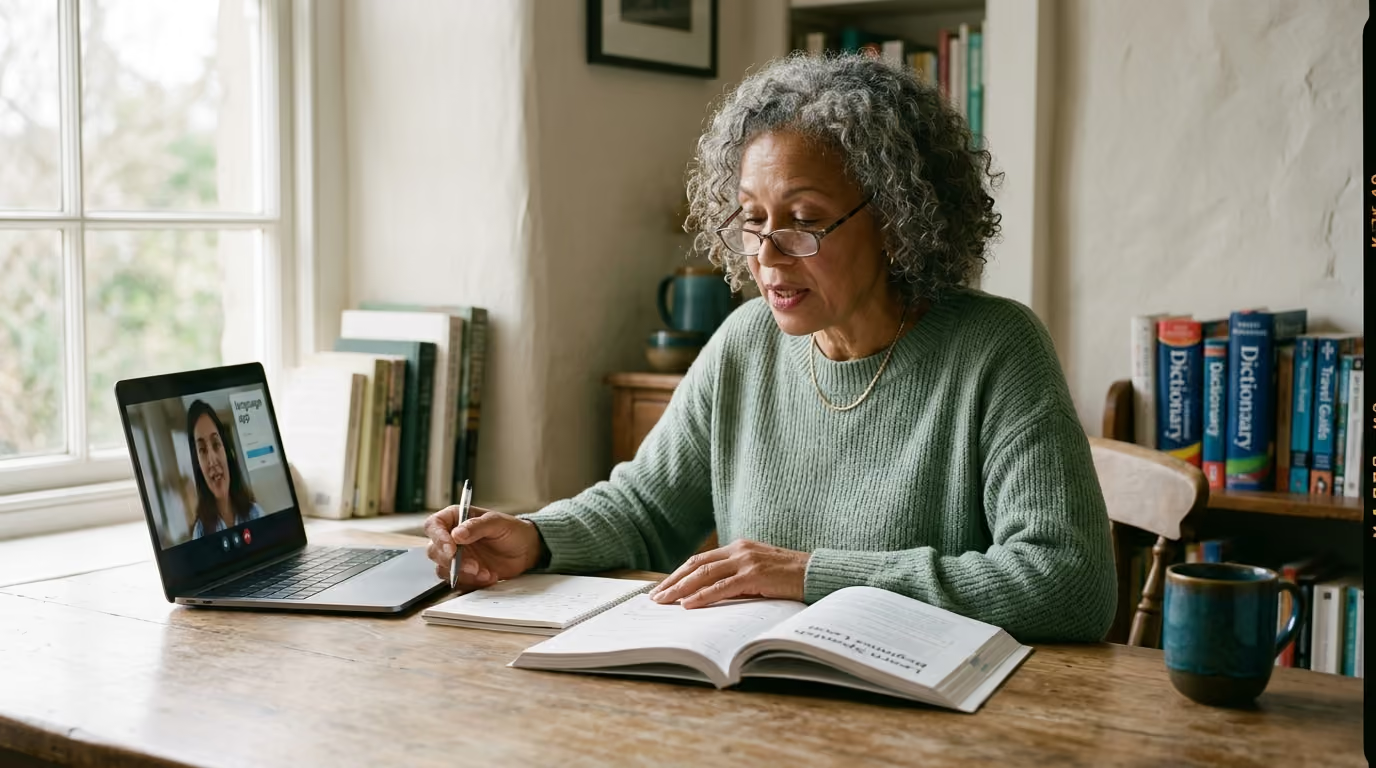
She schedules a weekly twenty-minute video chat with a patient online tutor, focusing entirely on low-pressure conversational practice. She keeps a list of communication repair phrases right beside her computer screen.
Outcome Measure: Maria measures success by her ability to participate in casual dinner table conversations and ask about her family's daily activities, even if she speaks with pauses and simple sentences.
Profile: David, age 63, wants to reconnect with his grandparents' native Italian. He remembers hearing phrases as a child but never learned to speak the language formally.
Strategy: David incorporates cultural materials directly into his routine. He listens to classic Italian songs, reads simple recipes in Italian, and translates family letters with the help of a dictionary.
He pairs his vocabulary practice with elaboration techniques, linking new words to family stories and childhood memories. He joins a local Italian-American cultural club where he practices listening to native speakers in a relaxed environment.
Outcome Measure: David measures success by his ability to read family recipes, understand the general meaning of traditional songs, and exchange warm greetings with fellow community members.
Profile: Susan, age 70, wants to maintain an active, intellectually stimulating retirement routine. She chooses to study Japanese for the pure novelty of learning an unfamiliar writing system and sound structure.
Strategy: Susan approaches her study as part of a complete lifestyle and brain resilience plan. She studies Japanese characters for twenty minutes after completing her morning walk.
She tracks her practice consistency on a wall calendar rather than stressing over how many characters she masters each week. When a lesson feels difficult, she reduces the session length and reviews previously learned characters to maintain her confidence.
Outcome Measure: Susan measures success by her daily study consistency, her enjoyment of the mental challenge, and the satisfaction of recognizing characters in art and literature.
Starting a language habit is easiest when you have a clear, realistic schedule for your first week. Use this structured weekly template to establish a balanced routine without cognitive overload.
To begin your language practice this week, follow these practical steps:

Follow FitBrainLab for research-led insights on memory, focus, brain aging, nutrition and mental fitness after 60. Stay connected for new articles, practical guidance and ideas for a sharper, more engaged life.


Build habits that support memory, focus and a curious, connected life.
Read the Blog