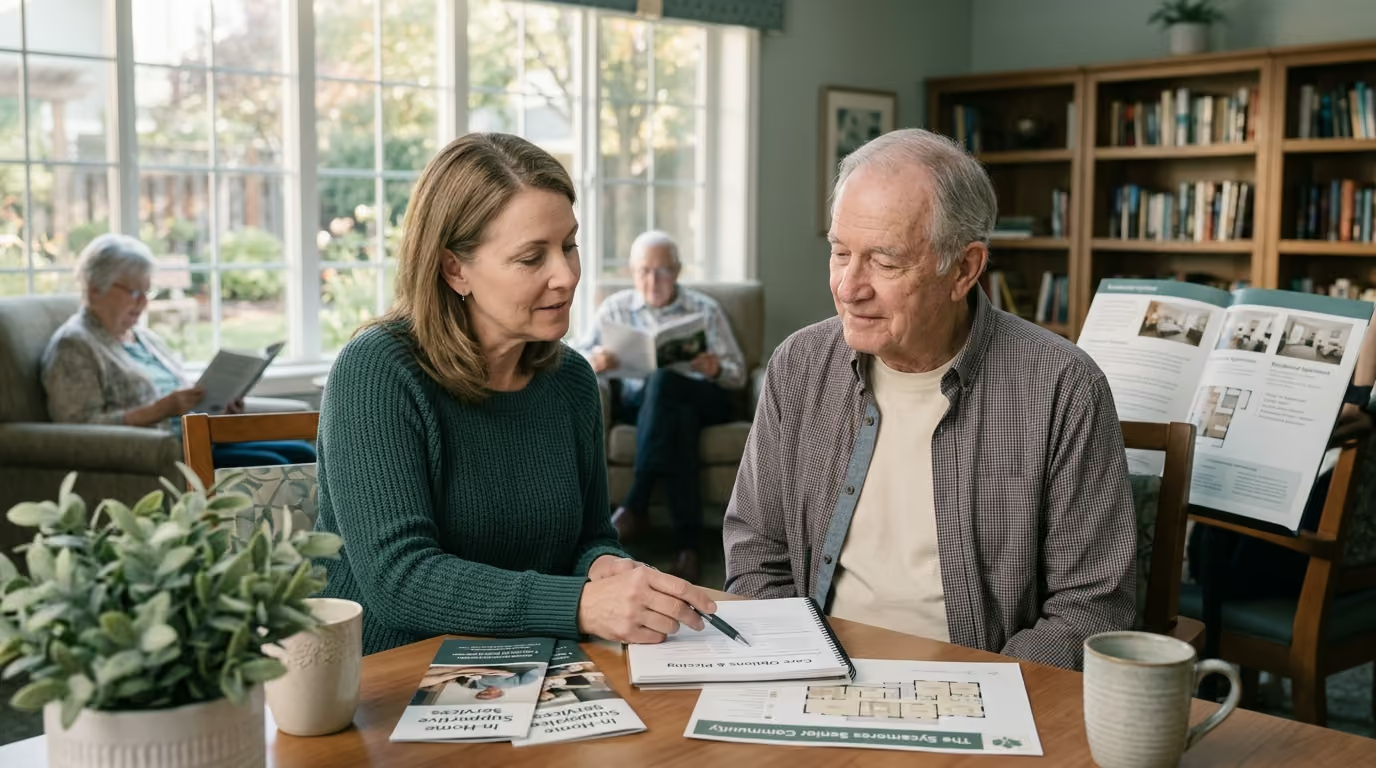

Home care appears cheapest at first, but escalating supervision needs require families to compare residential options, safety factors, and total costs.





Families often assume that selecting dementia care means finding one permanent location. In reality, dementia care is an ongoing process of adjusting support over time. A living situation that works well today may fail to provide adequate safety next year. Conversely, moving someone to a restrictive setting too early can reduce physical mobility and daily autonomy.
Choosing the right setting requires balancing safety, personal dignity, medical needs, and family stamina. The goal is always to match a person's abilities to the least restrictive setting that keeps them safe.
Dementia is not a normal part of aging. It is caused by progressive damage to brain cells across interconnected networks. In conditions like Alzheimer's disease, vascular dementia, and Lewy body dementia, cellular injury begins long before severe symptoms appear.
As damage spreads across the cerebral cortex and deeper brain structures, different cognitive domains decline. Executive function, managed largely by the frontal lobes, regulates judgment, planning, problem-solving, and financial management. When frontal lobe pathways deteriorate, a person loses the ability to manage complex schedules, pay bills, or operate household appliances safely.
Memory systems supported by the hippocampus and temporal lobes handle new information. Damage here causes repeated questions, misplacement of critical items, and disorientation in familiar neighborhoods. When damage reaches parietal and occipital networks, visual-spatial perception weakens. This increases fall risks, disrupts spatial navigation, and makes everyday environments confusing.
Eventually, progressive neurodegeneration affects motor pathways, communication centers, and basic physiological regulation. The brain loses its capacity to coordinate swallowing, maintain balance, and control continence. Behavioral shifts like agitation or nighttime restlessness often stem from neurological misperceptions or unmet physical needs that the person can no longer express in words.
Clinical research confirms that cognitive decline follows an uneven trajectory. Studies cataloged by the National Institute on Aging highlight that loss of instrumental activities of daily living occurs first. These tasks include balancing bank accounts, managing complex medication schedules, driving, and cooking. Basic activities of daily living, such as bathing, dressing, and eating, remain intact longer.
Research published by the Alzheimer's Association indicates that living alone with cognitive impairment significantly increases safety risks. Individuals living alone face higher rates of medication errors, accidental burns, financial exploitation, and malnutrition. When clinicians evaluate these risks, they focus on insight and judgment rather than simple recall tests. A person may pass a short memory test yet fail to recognize a kitchen fire or call emergency services during a crisis.
Studies on care models reveal that no single setting is universally superior for every stage. Research indicates that familiar environments can reduce disorientation in the early stages of disease. However, as supervision needs expand to twenty-four hours per day, the strain on unpaid family caregivers escalates dramatically. According to data from the Centers for Disease Control and Prevention, millions of family members provide billions of hours of unpaid care each year. This level of sustained physical and emotional stress often leads to caregiver health decline.
Research also shows that the phrase "memory care" lacks a uniform federal definition. State regulations govern staffing ratios, staff training requirements, and physical building designs. Some facilities offer enriched, person-centered programs with high staff retention. Other facilities rely primarily on locked doors without adequate interactive programming. Families must evaluate the specific operational practices of each community rather than trusting marketing terms.
To determine the right level of care, you must separate what a person can do independently from where they struggle. Medical professionals divide daily functioning into two distinct categories.
Instrumental activities require complex planning, working memory, and abstract thinking. Problems in these areas usually provide the first clear signal that outside help is necessary:
As dementia advances, damage reaches motor and sensory networks. The individual then requires direct physical assistance with basic self-care:
Tracking these functional stages helps families determine whether nonmedical assistance, home adaptations, or residential placement will best support their loved one. You can read more about tracking changes across our cognitive health and protection resources.
Selecting care requires understanding the structural differences between service options. Each model offers different levels of supervision, medical capability, and independence.
It is critical to distinguish between nonmedical home care and skilled home health services.
Nonmedical home care provides personal aides who assist with bathing, dressing, meal preparation, companionship, and housekeeping. These aides charge by the hour or through flat overnight rates. They provide custodial support but cannot perform medical assessments or administer injections.
Skilled home health care involves intermittent visits from licensed professionals. This includes registered nurses, physical therapists, occupational therapists, and speech-language pathologists. As Medicare guidelines outline, home health care requires a physician order and a qualifying skilled need. Medicare covers home health aides only while the patient receives active skilled therapy or nursing. It does not pay for twenty-four-hour custodial home aides.
Adult day centers offer structured daytime supervision outside the home. These programs provide cognitive stimulation, gentle physical exercise, hot meals, and social contact.
Social adult day programs focus on recreation, crafts, music, and group meals. Medical adult day programs include licensed nurses who can dispense medications, monitor blood pressure, and perform basic physical therapies. Both types give family caregivers predictable blocks of time to work, manage errands, or rest.
Assisted living facilities provide private or semiprivate apartments with centralized services. Residents receive three meals daily, housekeeping, laundry, social activities, and transportation to local appointments.
Staff members are on-site twenty-four hours a day to assist with medication reminders, bathing, and dressing. However, traditional assisted living is designed for individuals who can find their way to the dining room and call for help when needed. If a resident begins wandering or exhibits significant confusion, standard assisted living may no longer be a safe match.
Memory care communities are specialized residential environments built specifically for individuals with moderate to advanced dementia. These settings are typically secure to prevent unsafe wandering.
Staff members in quality memory care communities receive specific training in dementia communication, cueing techniques, and de-escalation strategies. Daily schedules are tightly structured to reduce anxiety and disorientation. Physical layouts often feature circular hallways without dead ends, secure outdoor courtyards, and clear visual cues on doors and common rooms.
Nursing homes provide the highest level of ongoing clinical care outside a hospital. These facilities employ registered nurses, licensed practical nurses, and certified nursing assistants around the clock.
Skilled nursing facilities handle complex medical needs. These include feeding tubes, stage three or four pressure injuries, complex wound dressings, intravenous medications, and mechanical lift transfers. Nursing homes provide both short-term rehabilitation after hospital stays and long-term custodial care for individuals with severe physical dependency.
You can learn more about assessing different living environments through our detailed dementia and cognitive protection articles.
Comparing the financial realities of dementia care requires looking beyond base monthly rates. Families must calculate the complete cost of care, including hidden fees, supplies, and lost family wages.
According to data compiled by the Alzheimer's Association, national median costs provide a baseline for comparison. Nonmedical home health aides average approximately $35 per hour. Adult day services average $95 per day. Assisted living averages $6,200 per month, while memory care typically adds an additional $1,500 to $3,000 per month to that baseline. A semiprivate room in a nursing home averages $9,581 per month, and a private room averages $10,798 per month.
Families often believe remaining at home is automatically the most economical choice. Consider the math when a person can no longer stay alone safely:
Even with flat overnight rates, continuous twenty-four-hour in-home care quickly surpasses the cost of high-tier memory care or private nursing facilities.
When building a financial comparison, include every line item:
According to research published by the Alzheimer's Association, the estimated lifetime cost of care for someone with dementia exceeds $400,000. Family caregivers bear roughly 70 percent of this total through unpaid labor and direct out-of-pocket expenses.
Many families misunderstand how long-term care is funded.
Medicare does not pay for long-term custodial care in any setting. It pays only for acute medical treatments, doctor visits, hospitalizations, and short-term rehabilitative stays following an inpatient hospital admission.
Medicaid covers long-term nursing home care and certain home-based services, but only for individuals who meet strict state income and asset limits. Long-term care insurance policies may pay for home care, adult day programs, assisted living, and nursing facilities. However, benefits depend entirely on the specific policy triggers, elimination periods, and daily maximum caps.
For more insights into managing life transitions and support systems, browse our brain health and memory resources.
Maintaining physical safety is critical, but excessive restrictions harm emotional health and accelerate physical decline. Overly restrictive environments lead to frustration, rapid muscle loss, and worsening behavioral agitation. Proportionate risk management focuses on adapting physical surroundings before restricting personal movement.
Wandering is among the most concerning safety challenges in dementia care. It occurs when a person searches for something familiar, attempts to fulfill a past routine, or responds to an uncomfortable physical environment.
The Alzheimer's Association explicitly warns against locking a person with dementia inside a room alone. Locking someone in creates severe panic and presents an extreme fire hazard. Instead, implement layered, gentle safeguards:
Before concluding that living at home is impossible, evaluate simple physical modifications:
Sudden agitation, shouting, or refusal of care is rarely intentional disobedience. In dementia, behavioral shifts are frequently the only way a person can express unmet physical or emotional needs.
When an individual exhibits distress, investigate underlying causes before considering heavy sedation or immediate institutional moves:
Medical evaluation must always precede major placement decisions when behavioral shifts occur suddenly. You can read more about memory and cognitive processing in our memory and focus articles.
Families often navigate care choices surrounded by misleading advice and outdated assumptions. Clarifying these myths helps you make realistic, compassionate decisions.
Reality: Remaining in a private home can preserve comfort, but it is not automatically safer. A person who wanders at night, forgets medications, or experiences severe social isolation may face significant dangers at home. When family caregivers become exhausted or physically ill, home safety deteriorates rapidly.
Reality: Memory care is primarily a residential and behavioral model, not a medical hospital. Many memory care units operate under assisted living licenses. They provide personal aides, medication reminders, and secure perimeters, but they may lack registered nurses overnight. If an individual needs continuous clinical care, a skilled nursing facility may be required.
Reality: The Centers for Medicare and Medicaid Services rating system offers valuable data on health inspections, staffing ratios, and quality metrics. However, an overall high rating does not guarantee that staff excel at dementia-specific communication. Families must combine published data with unannounced personal visits across different shifts.
Reality: Transitioning a loved one to residential care is often the most loving, protective choice possible. Handing over bathing, medication schedules, and meal preparation to professional staff allows family members to return to their primary roles as loving spouses, daughters, and sons.
Every family dynamic and clinical presentation brings distinct challenges. Navigating these edge cases requires clear thinking and objective assessment.
When someone with cognitive decline lives alone, the central concern is emergency response. Can the person recognize a burst water pipe, respond to a smoke alarm, or detect a predatory scam?
A practical plan for solo living requires designated check-in schedules, automated medication dispensers, and neighbor contact protocols. Families must establish concrete, pre-planned trigger points. If the person has two unexplained falls, wanders outside, or misses critical medications twice in a month, immediate residential transition plans must begin.
An aging spouse often resists outside caregivers due to privacy concerns, guilt, or fear of losing independence. However, caregiver stamina is a critical safety factor.
Introduce outside support gradually rather than proposing total residential placement all at once:
with a professional cleaning service or meal delivery to reduce physical burdens.
Resistance to moving often stems from fear, grief, and feeling left out of decisions. Avoid arguing about cognitive deficits or diagnosis labels.
Instead, involve the person in choices they can still control. Let them select room decorations, choose which armchair to bring, and decide on clothing. When possible, frame the move around specific practical reasons, such as a temporary recovery period, a trial stay for physical therapy, or downsizing to reduce household maintenance.
In rural areas, specialized memory care or dependable home-care agencies may be located hours away. Family members must weigh travel time for regular visits against the clinical sophistication of a distant community.
A well-run, smaller assisted living facility close to family may provide a better outcome than a specialized memory community three hours away. Frequent visits from family members often improve the daily care provided by community staff.
To understand our editorial approach to healthy aging and cognitive support, visit our about page.
Selecting providers requires asking precise questions about operations, emergency protocols, and clinical abilities. Do not accept broad marketing statements. Request specific numbers and written policies.
Take these questions to your next medical appointment:
Interview home care agencies with these direct questions:
Evaluate assisted living and memory care facilities with these essential questions:
Waiting for a major medical crisis to force a placement decision creates panic and limits your choices. Proactive planning allows families to tour options calmly, organize finances, and make decisions with clear minds.
Establish objective safety triggers with your family:
Revisiting these benchmarks every three months ensures your care strategy adapts as your loved one's needs change over time.
Choosing dementia care is ultimately an expression of ongoing protection, ensuring safety, dignity, and personal comfort across every stage of life.

Follow FitBrainLab for research-led insights on memory, focus, brain aging, nutrition and mental fitness after 60. Stay connected for new articles, practical guidance and ideas for a sharper, more engaged life.


Build habits that support memory, focus and a curious, connected life.
Read the Blog