
A comparison of targeted brain puzzles and complex skill learning for older adults. Learn why unfamiliar hobbies provide different mental stimulation than apps.





Older adults evaluating daily cognitive habits must decide whether to rely on targeted brain puzzles or to invest time in learning complex and unfamiliar new skills.
Structured cognitive training uses specific puzzles to isolate different mental functions. Researchers have studied these targeted activities to see if they offer long-term protective value. A major source of data on this approach is the ACTIVE trial. This research followed 2,021 participants aged 65 to 94 for up to 20 years using Medicare claims records.
The ACTIVE follow-up provides concrete numbers on the long-term outcomes of targeted practice. During the observational period, Alzheimer’s disease or related dementia diagnoses occurred in 48.7% of the control group. In comparison, diagnoses occurred in 43.6% of the speed-training group and 44.8% of the memory-training group. The reasoning-training group showed a diagnosis rate of 44.4%.
Processing-speed training showed the most notable advantage in these records. Participants who received speed training with booster sessions had approximately a 25% lower rate of diagnosis than controls. This indicates that specific forms of practice might help support memory and focus over time. These results apply to the specific processing-speed program tested rather than every commercial app.
Familiar puzzles allow individuals to practice working memory in a highly controlled environment. Doing a crossword or Sudoku daily provides predictable mental engagement. These activities focus on single domains like vocabulary retrieval or basic logic. They do not require the learner to navigate physical space or coordinate complex hand movements.
While these focused drills are useful, their benefits rarely transfer to unrelated tasks. Improving at a specific app does not mean a person will become better at managing medications or making financial decisions. The mental gains remain largely confined to the type of puzzle being practiced. This limitation is why scientists increasingly study broader learning interventions.
Learning a genuinely unfamiliar skill requires a wider mix of attention, working memory, and problem-solving. This approach mimics real-world demands better than a single-function memory drill. The Synapse Project offers the strongest directly relevant evidence for this type of mental stimulation. This trial randomly assigned healthy adults aged 60 to 90 to demanding activities including digital photography and quilting.
The study compared these complex tasks alongside comparison activities such as social engagement and relatively easy word games. Participants in the demanding learning groups spent approximately 15 hours per week for three months learning their assigned activities. This schedule represents a significant commitment of time and mental energy. The central finding was that these demanding learning groups improved on measures of episodic memory.
The social activity and easy word game comparison groups did not show the same measurable improvement. This suggests that casual pastimes might not offer the same level of mental stimulation. Photography was described as the most novel and difficult of the main activities. This specific condition showed the largest improvements in the available summary of the study.
A new skill like photography requires learners to remember instructions, correct mistakes, and make active decisions. These requirements demand constant mental adaptation. The brain must process visual information, manage manual controls, and apply new rules simultaneously. This heavy cognitive load forces the mind to work harder than it would during a familiar puzzle.
Technology training can serve as another demanding pursuit for older adults. Navigating unfamiliar interfaces requires learners to troubleshoot errors and remember new sequences. The digital photography condition in the Synapse Project provides the closest relevant evidence for this type of learning. The evidence does not establish that generic technology classes automatically improve memory.
The mental work of applying technical knowledge to meaningful goals creates the primary challenge. A beginner might learn basic camera controls before progressing to manual exposure and visual storytelling. This kind of progression requires effortful learning over an extended period. Creating a tangible output forces the learner to actively apply their new knowledge.
Watching instructional videos is not equivalent to this type of active, productive practice. Passive consumption does not require the brain to retrieve information or correct errors. A person must actively produce something, whether that is a photograph or a spoken sentence. This active production is a core feature of the demanding tasks tested in the Synapse Project.
Language learning demands active conversation, listening comprehension, and vocabulary retrieval. Adapting to another speaker imposes a heavy cognitive load. A recent exploratory study specifically examined the relationship between baseline cognitive status, adherence, and cognitive change during language learning in older adults. Some small studies report cognitive gains, but broader claims remain unsettled.
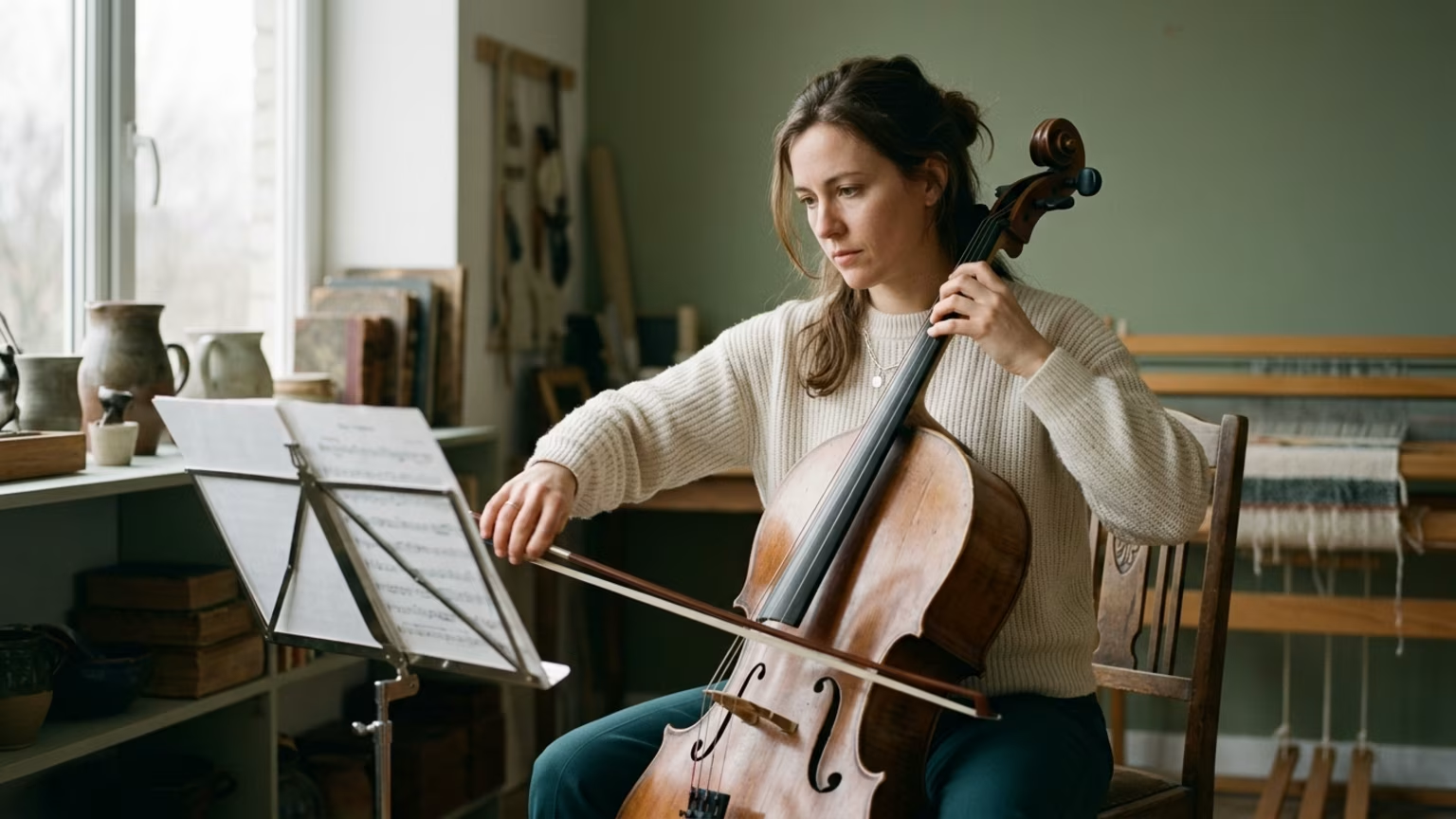
Music combines auditory discrimination, memory, timing, and fine motor control. These combined elements create a rich, multidomain experience for the learner. Playing an instrument requires the brain to read notes and translate them into physical movements instantly. This rapid processing mimics the demands of complex real-world environments.
Observational evidence links instrumental music to better executive function. A sector summary reports that older adults with a long history of instrumental music showed better non-verbal memory and executive function than matched non-musicians. Starting an instrument late in life is not a guaranteed clinical treatment. It is simply a highly demanding and potentially rewarding way to challenge the mind.
Both targeted puzzles and complex skill acquisition require sustained mental effort. Neither approach produces measurable gains without consistent, progressive difficulty. Simply buying a camera or downloading a puzzle app provides no benefit. The actual cognitive work happens when a person pushes past their current ability level.
The ACTIVE trial and the Synapse Project both tested structured, sustained routines. Participants faced active problem-solving tasks rather than passive consumption. Brain aging research increasingly evaluates multidomain experiences over isolated exercises. A person combining mental focus with hand-eye coordination recruits multiple biological networks at once.
Both methods also highlight the limits of novelty alone. An unfamiliar activity must remain learnable with practice to be useful. If a task is too easy, the brain stops adapting. If it causes extreme exhaustion, the learner will likely quit before seeing any lasting benefit.
Finding the middle ground of productive difficulty is crucial. A digital training app provides immediate scores to guide the user. Complex hobbies rely on a teacher, a practice partner, or a project deadline to maintain engagement. This external structure helps older adults stick to their chosen routines for months or years.
This consistency builds a practical foundation for aging well. Targeted cognitive training is highly accessible for most older adults. People can complete speed or memory drills at home with minimal physical mobility. These programs require only a computer or tablet, making them easy to fit into a daily routine.
They remove the barriers of travel, costly equipment, and physical strain. Complex hobbies present more significant logistical hurdles. The Synapse Project interventions required technical tools and considerable weekly time commitments. Photography demands a camera, editing software, and the physical mobility to find subjects.
Taking up a musical instrument involves buying equipment and potentially paying for lessons. Technology training can also create high levels of initial frustration. Navigating unfamiliar interfaces requires patience and a willingness to make repeated errors. Older adults must weigh these practical barriers against the potential mental benefits.
The most effective activity is one the individual can practice consistently without severe logistical strain. Social interaction adds another layer of complexity to these choices. A language class or a music group provides built-in communication and community support. Combining rigorous learning with group participation can help maintain long-term motivation.
Choosing between familiar puzzles and complex hobbies does not require an absolute choice. The ACTIVE trial data indicates that targeted processing-speed training holds measurable long-term value. Familiar puzzles can remain part of a healthy weekly routine. The goal is to avoid making them your only source of mental stimulation.
Adults looking to understand long-term cognitive protection should add one genuinely unfamiliar, progressively challenging activity. Look for a skill that requires active production, such as taking photographs or playing an instrument. Track whether the hobby remains challenging and whether you can handle increasingly complex tasks over time. This approach aligns with current cognitive research.
Begin any new pursuit just below the point of defeat. Gradually increase the complexity of the task as you become more comfortable. Move from automatic camera settings to manual controls, or from simple vocabulary recognition to active conversation. This steady progression keeps the brain engaged without causing unnecessary frustration.
Keep doing the puzzles you enjoy, but commit to learning something that feels entirely foreign. This balanced strategy helps support long-term independence while keeping daily life interesting and rewarding. Incorporating both methods provides the best foundation for daily habits and brain resilience.
Deciding whether to rely on targeted brain puzzles or to invest time in demanding new hobbies requires looking closely at the research. Fear created by alarmist memory loss and dementia coverage often makes this decision feel overwhelming, but FitBrainLab translates complex cognitive evidence into clear, objective guidance so you can build mental resilience with confidence.

Follow FitBrainLab for research-led insights on memory, focus, brain aging, nutrition and mental fitness after 60. Stay connected for new articles, practical guidance and ideas for a sharper, more engaged life.





Build habits that support memory, focus and a curious, connected life.
Read the Blog