
MIT researchers described an AI project combining lifestyle, clinical-trial and molecular data to study Alzheimer’s. Clinical benefits remain unproven.





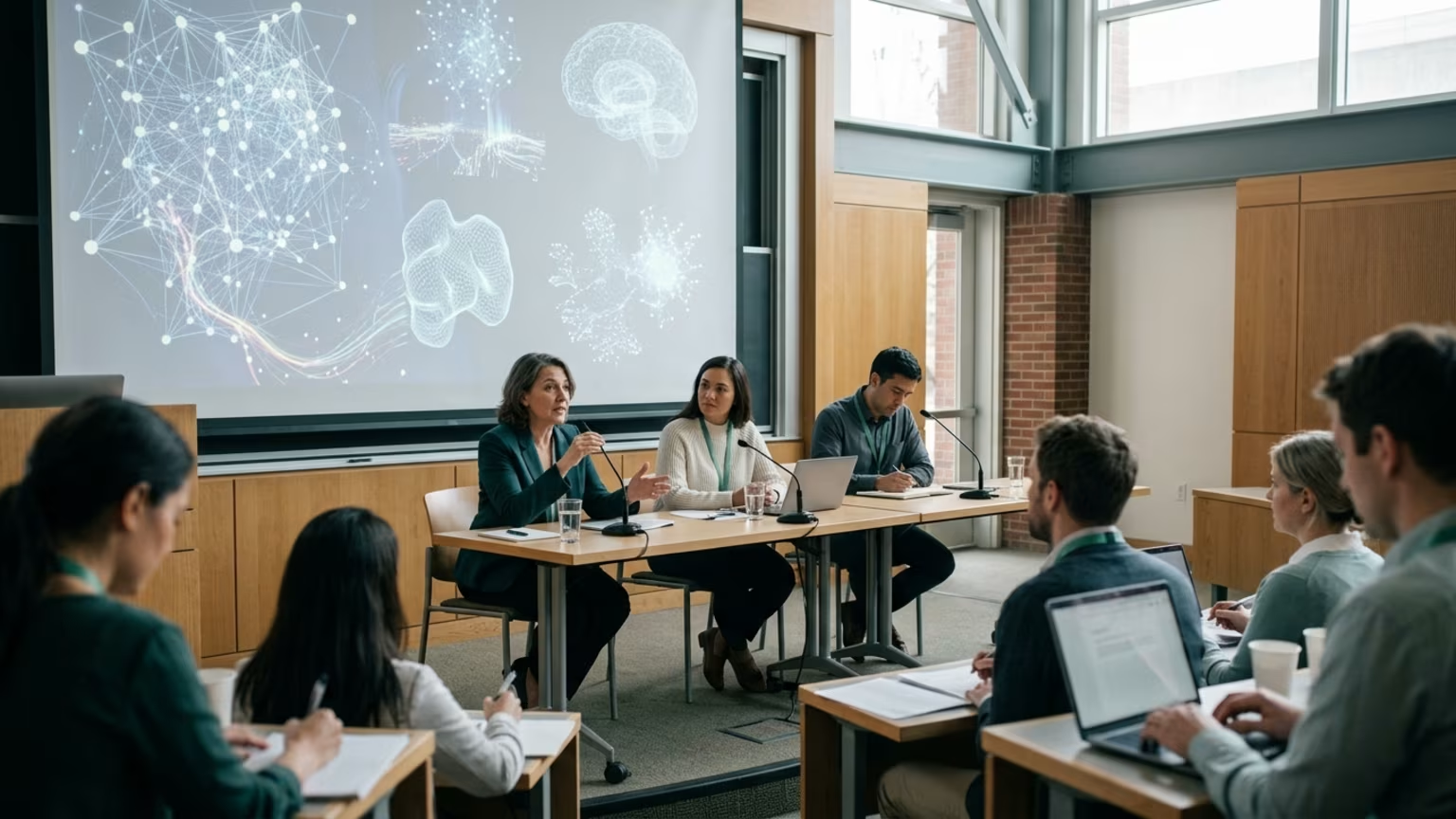
On September 25, 2026, MIT’s Aging Brain Initiative held its “Innovations for the Aging Brain” symposium. According to MIT’s event report published on September 30, researchers presented FINGERS-7B as an AI project intended to study Alzheimer’s progression and possible responses to interventions.
MIT’s report describes an effort to combine information that comes from different parts of Alzheimer’s research. The team says FINGERS-7B integrates clinical-trial data, patient lifestyle histories and multi-omics data. The last category includes genomics and proteomics, bringing information about genes and proteins into the project.
The researchers’ central question concerns individual differences. They want to investigate whether this combined information could help predict how a person’s disease might progress and how that person might respond to an intervention. Another proposed use is helping researchers identify suitable populations for future clinical trials.
The report identifies the project leads as Arvid Gollwitzer of the Broad Institute and MIT-Novo Nordisk AI Fellow Adrián Noriega de la Colina. Giovanni Traverso and Li-Huei Tsai are among the collaborators named.
Noriega de la Colina explained the rationale this way: “Every individual is very unique in their biology and that links to how we respond to those interventions.” His statement describes the question motivating the work: how researchers might account for differences between people when studying prevention and care.
The proposed applications fall into distinct areas:
These goals are related, but they are not interchangeable. A prediction about progression addresses a different question from a prediction about response to an intervention. Trial-design support has another purpose: helping researchers decide whom to study. Keeping those purposes separate makes the project easier to understand without treating “personalized research” as one broad promise.
The symposium featured six talks and a poster session with projects from more than a dozen trainees. MIT’s report describes presentations on anesthesia monitoring, laboratory disease models and protein aggregation. Other talks addressed MRI chemical probes and glycans.
One project involved a closed-loop anesthesia system that could use brain-wave measurements to help tailor dosing. Other presentations covered laboratory models for studying ALS and muscular dystrophies. Research into preventing protein aggregation and developing MRI probes added further approaches to the program.
The Picower Institute’s wider coverage also included a September 29 report on brain biomarkers. For this update, the symposium’s contribution is its account of several research approaches appearing side by side.
That breadth reflects the Aging Brain Initiative’s stated view that neurodegenerative diseases are complex, system-wide problems that benefit from work across disciplines. For readers following different strands of cognitive-health research, the useful question is what each project is designed to investigate. A laboratory model and a data-integration system contribute different kinds of information.
For adults concerned about memory and cognitive health, the practical relevance is a clearer view of what individualized research might involve. In this project, lifestyle histories sit alongside clinical-trial information and molecular data. The researchers are asking whether bringing those sources together could help them account for differences between individuals.
That framing gives readers a useful way to assess future coverage. Rather than focusing only on the label “AI,” look for the specific task a system is intended to perform. Predicting progression, studying intervention response and supporting trial design should each be described in their own terms.
Three questions help keep a report grounded:
The symposium report gives readers information about the first questions. The evidence behind the last question is the central issue addressed below.
For clinicians and researchers, the announcement identifies proposed applications worth following: predictions about progression and intervention response, plus support for identifying trial populations. Those aims provide a framework for reading later reports from the project. The useful development to watch is evidence that addresses a clearly defined task, rather than a broader claim that the system is “personalized.”
For someone making a personal health decision, the appropriate setting remains a discussion with a qualified clinician. The symposium announcement is not a reason to start, stop or change a treatment independently. It also supplies no basis for selecting a particular diet, activity pattern or other lifestyle intervention for an individual.
The main limitation is specific: MIT’s event report does not provide clinical validation results or model-performance figures for FINGERS-7B. It reports no accuracy measures or comparison showing how the system performs against another approach. It also provides no patient outcomes demonstrating better prevention or care.
The report does not describe FINGERS-7B as a diagnostic system. It does not say the model is available to consumers, approved for patient care or being used to match patients with interventions. Its language about tailoring prevention and informing trial design describes possible uses rather than established benefits.
MIT also reports that the model was trained on 8 trillion “tokens.” That is a detail about training scale. It is not a measure of clinical accuracy and does not establish that the model improves Alzheimer’s prevention or treatment. A large training figure answers a different question from whether predictions are reliable enough to guide care.
This distinction is especially relevant when lifestyle information appears in an AI project. Including a person’s history in a model does not itself demonstrate which habit would help that person. The report does not establish a personalized prevention program or identify a preferred intervention based on someone’s biological profile.
The same research-stage boundary applies to the other symposium projects. MIT presents the closed-loop anesthesia system as under development and reports no patient-outcome data for it. The laboratory disease models, protein-aggregation work and MRI probes are also described as research projects rather than routine interventions for older adults.
The practical way to manage expectations is to separate three things: the information researchers put into a system, the purpose they design it for and the results they demonstrate. Here, the announcement explains the inputs and intended purposes. Future claims about clinical usefulness would need evidence that addresses the demonstrated-results part of that picture.
The long-term significance of this symposium lies in the questions researchers are bringing together. FINGERS-7B places clinical-trial information, lifestyle histories and molecular data within one modeling effort. Its stated goals connect individual differences with questions about Alzheimer’s progression and responses to interventions.
That is a useful direction to follow because it makes the research question more specific: which information might help explain different paths through disease or different responses to care? The symposium also shows that this question sits within a wider program spanning brain signals, laboratory models and molecular research.
For readers of FitBrainLab’s brain-health reporting, the lasting takeaway is to follow the evidence attached to each proposed use. The development matters as an effort to study cognitive health with greater attention to the individual. Progress should be judged by how clearly later findings connect those research goals with meaningful results.
Combining lifestyle histories with molecular data creates a reading challenge: separating an ambitious research goal from a demonstrated health benefit. FitBrainLab helps adults 60+ make that distinction through clear explanations of brain aging and cognitive health, placing early findings beside established evidence so readers can assess claims without hype or fear.

Follow FitBrainLab for research-led insights on memory, focus, brain aging, nutrition and mental fitness after 60. Stay connected for new articles, practical guidance and ideas for a sharper, more engaged life.


Build habits that support memory, focus and a curious, connected life.
Read the Blog