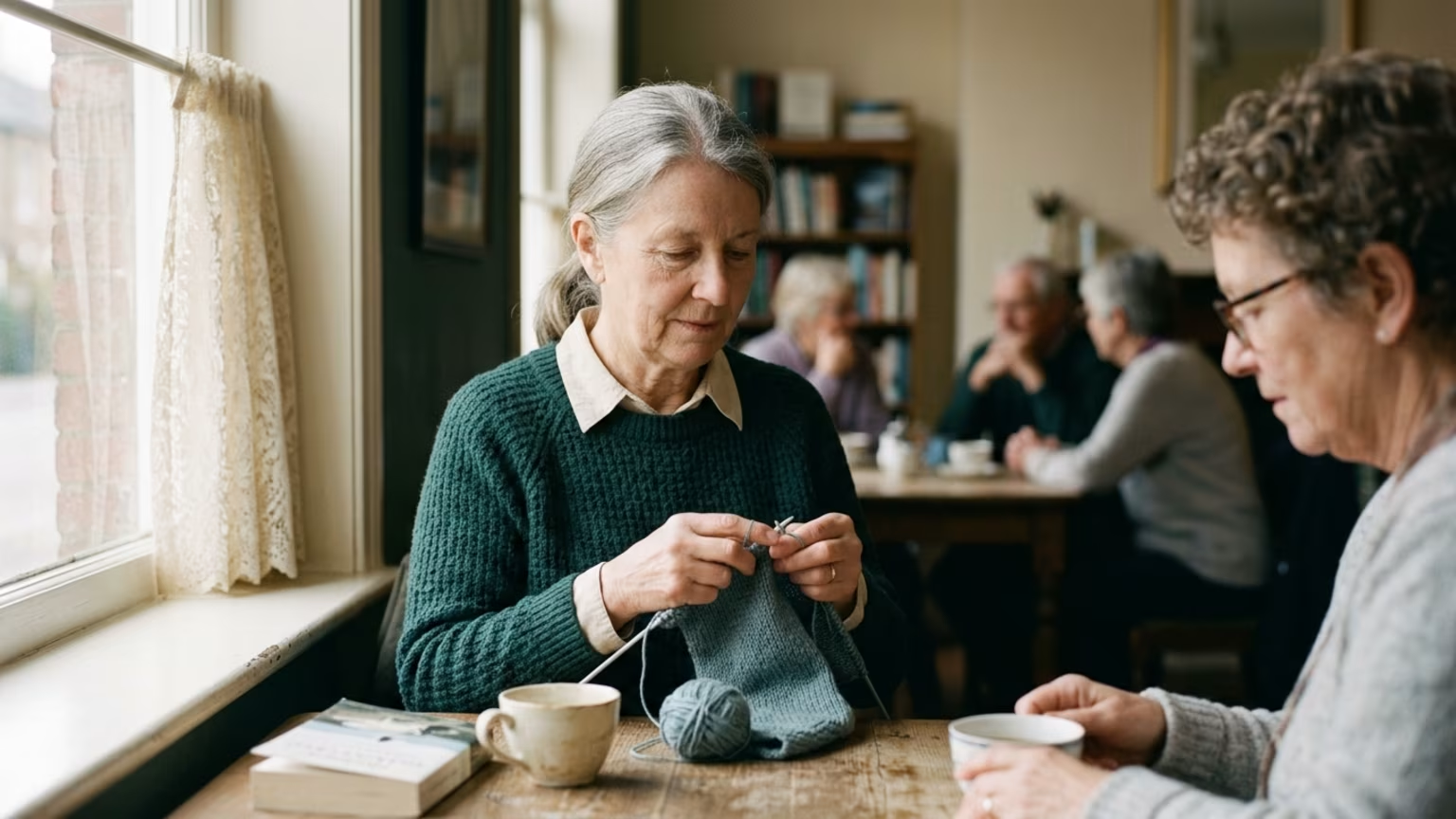

Le Figaro examines whether introverted older adults must socialize to age well. Recent data shows meaningful connection matters more than a packed schedule.





On September 19, 2026, Le Figaro published an article examining whether older adults who prefer solitude need to push themselves into more social activities to age well.
The recent French coverage evaluates whether social activity should function as a mandatory health prescription. The article contrasts highly social retirees with individuals who prefer spending quiet time at home. It cites author Susan Cain, who estimates that introverts represent approximately one-third to one-half of the population. The primary historical reference is a 2010 synthesis by psychologist Julianne Holt-Lunstad and colleagues.
That synthesis reviewed 148 studies covering nearly 309,000 people. Participants in those synthesized studies had an average age of 64 at enrollment. They were followed for an average of approximately seven and a half years. The data showed that individuals with stronger social relationships were more likely to be alive at the end of the follow-up period.
The findings present an association rather than direct proof that socializing caused longer life. The extraction does not provide an isolated analysis of introverted participants. More recent context comes from a 2026 coordinated analysis. This project combined data from 11 longitudinal studies involving roughly 175,070 participants from 18 countries.
The 2026 analysis separated the subjective feeling of loneliness from objective social isolation. It found that loneliness was consistently associated with higher risks of cognitive impairment and mortality. The analysis showed these higher risks held firm after adjustments for social isolation. A separate longitudinal analysis known as the HABS-HD study provides another layer of detail.
This study followed 3,873 adults aged 50 and older without dementia. The cohort had a mean age of 64.8 years. It included 3,008 cognitively unimpaired participants and 865 participants with mild cognitive impairment. The group included participants identifying as non-Hispanic Black, Hispanic, or non-Hispanic White.
The HABS-HD researchers used repeated cognitive testing to measure changes over time. They measured social support with the Interpersonal Support and Evaluations List. This list covers belonging, appraisal, tangible support, and self-esteem. Higher baseline social support was associated with less decline in attention in the fully adjusted model.
The researchers did not find a significant association with longitudinal change in memory, executive functioning, or language.
The distinction between loneliness and social isolation carries clear practical meaning for older adults. Loneliness represents an individual experience of lacking meaningful connection. Social isolation more closely reflects a person's actual social circumstances or network size. The 2026 coordinated analysis treated these concepts as related but distinctly different factors.
Social isolation was not consistently associated with cognitive impairment. This separation means older adults can evaluate their own needs without aiming for a packed calendar. A person might spend substantial time alone without feeling lonely. Another individual could feel lonely while attending frequent group activities.
Counting the number of daily contacts is an incomplete measure of health risk. Retirees can focus on meaningful emotional connections instead of simply increasing their event attendance. Introverted individuals can choose social formats that fit their established personalities. A small circle, a regular phone call, or a shared hobby can provide necessary support.
Volunteering or participating in a small class can also build community without overwhelming a quiet individual. The cited evidence supports meaningful connection but does not dictate one single social format. Older adults can use their daily energy levels as a practical guide. If a large gathering leaves a person depleted, they might try a shorter visit or a quieter setting.
They can build a predictable routine that offers support without exhaustion. Medical professionals and older adults should address loneliness directly when discussing lifestyle habits. A sudden reduction in social contact remains a change worth investigating. It might reflect hearing difficulty, untreated depression, sudden illness, or cognitive change.
Medical professionals frequently see patients who struggle to balance expectations with their natural energy reserves. Quiet adults often feel pressured by wellness advice that glorifies large community gatherings. This new analysis provides scientific backing for a more individualized approach to aging. Individuals can confidently prioritize the quality of their interactions over the sheer quantity.
Social connection works best when placed alongside other physical and mental routines. Retirees can protect their independence through several complementary routes. Older adults should combine meaningful social support with adequate sleep, physical activity, and careful nutrition. Maintaining these foundational habits helps build lifestyle and brain resilience over time.
The excitement surrounding social habits and healthy aging requires careful factual boundaries. The cited observational studies track relationships over time but do not establish causality. The 2010 synthesis reported better survival among socially connected individuals. The evidence does not prove that social interaction directly caused that increased survival rate.
Other underlying factors could easily influence both social activity and long-term health. Researchers acknowledge that reverse causation might explain some of these findings. Declining physical health or changing cognition could reduce a person's ability to maintain relationships. Other confounding variables might also dictate a person's social calendar.
Physical health, depression, hearing loss, and mobility issues can all limit social access. Income levels, transportation access, and caregiving demands also shape how often a person interacts with others. The current research does not test the concept of forcing introverts to socialize. None of the cited sources describes a randomized trial requiring quiet older adults to attend more events.
The observational design of these studies also means we must account for changing life circumstances. Retirement often brings natural shifts in how often a person interacts with former colleagues and acquaintances. These shifts do not automatically signal a dangerous decline in cognitive protection. They simply represent a normal transition into a different phase of life.
The evidence cannot support telling a reluctant retiree to become highly outgoing to protect their brain. The findings simply do not establish that forcing social participation prevents cognitive decline. Pushing an introverted person into unwanted group settings is not a tested clinical protocol. The cognitive benefits observed in these studies are remarkably selective.
In the HABS-HD study, social support was associated with attention preservation. It was not associated with longitudinal changes in memory, executive function, or language. This targeted result argues against broad claims that socializing universally sharpens the memory. We cannot treat social connection as a stand-alone dementia-prevention treatment.
Readers should view social support as one potentially modifiable factor in overall health. Promising that active socializing will preserve memory in every individual misrepresents the data. A quiet lifestyle remains compatible with healthy aging when it includes purposeful activity. Quiet adults who feel supported and understood can maintain their chosen routines with confidence.
Recent research increasingly positions social connection as one element within a wider health system. Meaningful relationships sit alongside physical activity, sleep, and emotional health to support healthy aging. Management of medical risk factors remains a central priority for long-term independence. Finding the right balance of interaction is just one part of a comprehensive strategy.
The Le Figaro coverage successfully places social connection within this broader context. The 2026 coordinated analysis advances our understanding of what actually matters for long-term health. It suggests that reducing the feeling of loneliness provides a more precise target than counting social interactions. This targeted approach respects individual personality differences while still prioritizing mental wellness.
Older adults who value solitude can protect their health by maintaining a few close, supportive relationships. The goal is avoiding harmful isolation without adopting a forced, exhausting social schedule. Finding quiet ways to engage the mind can help maintain focus and independence. Retirees often seek mentally stimulating routines that fit their personal comfort levels.
Developing mentally engaging routines after work supports long-term structural brain health without requiring constant socializing. Quiet reading, individual hobbies, or one-on-one conversations offer legitimate paths to sustained cognitive engagement. Readers looking for practical information can access memory and cognitive performance resources to guide their daily choices. True cognitive resilience requires a sustainable approach that respects personal boundaries.
The latest longitudinal studies confirm that emotional support matters for attention and overall health. Introverted adults do not need to rewrite their personalities to age well. They simply need to maintain access to support when they need it. A balanced, intentional approach to relationships offers the best path forward.
Families and retired professionals handle the ongoing work of adapting daily routines, and lifestyle adjustments feel much more manageable when FitBrainLab translates these social connection findings. Loss of structure, learning opportunities or purpose after retirement often complicates healthy aging. Clear editorial guidance helps readers prioritize meaningful mental engagement on their own terms. Explore Resources

Follow FitBrainLab for research-led insights on memory, focus, brain aging, nutrition and mental fitness after 60. Stay connected for new articles, practical guidance and ideas for a sharper, more engaged life.




Build habits that support memory, focus and a curious, connected life.
Read the Blog