
A supervised walking trial examined frailty, not memory. Learn why its setting matters and what to discuss with a qualified professional.





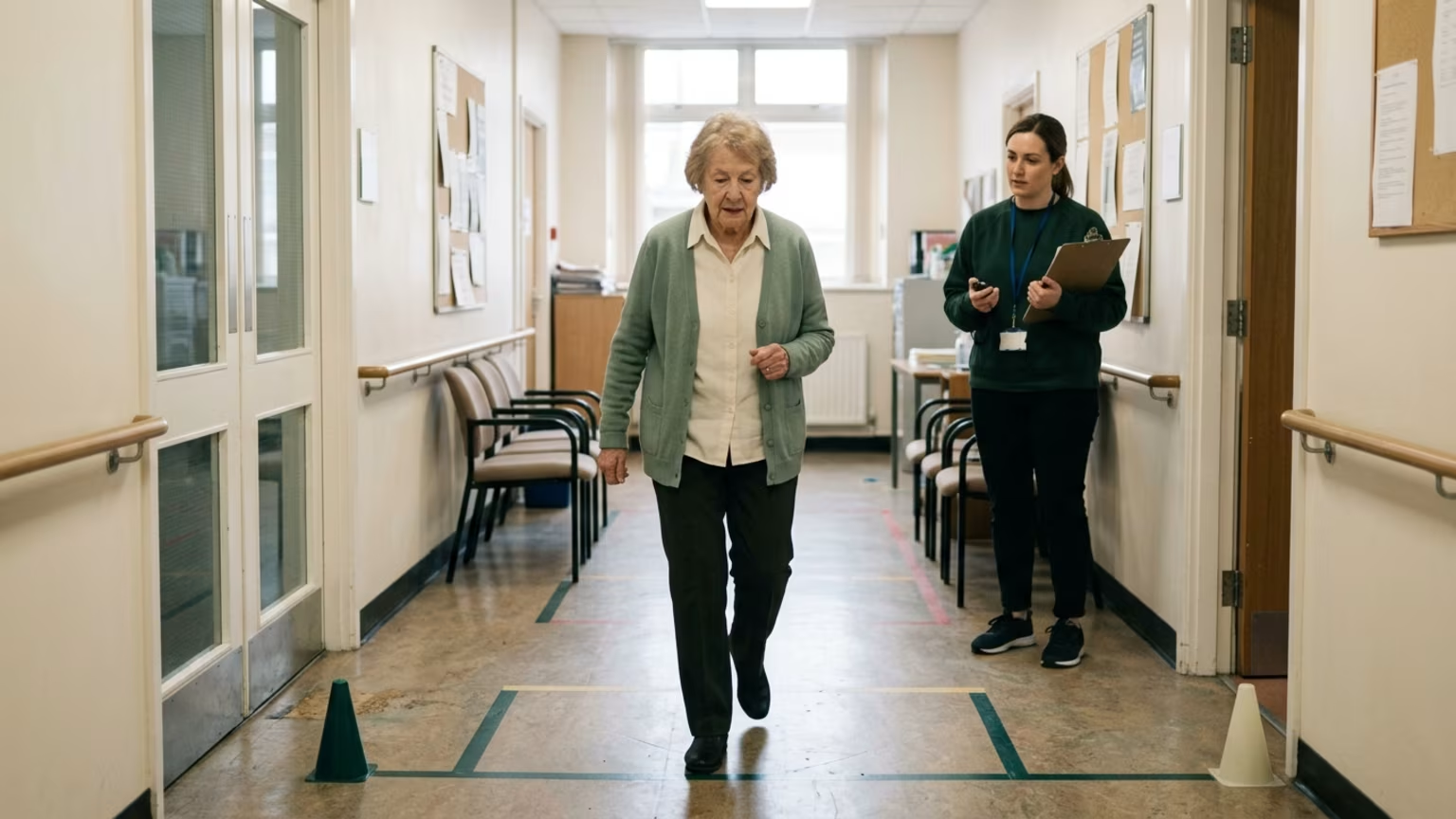
On September 30, 2026, TIME reported on a trial examining walking intensity and frailty among retirement-community participants. Researchers compared two active walking programs in a structured, supervised setting.
The report presented faster walking as a possible way to address frailty. The intervention involved more than asking people to pick up their usual pace. Researchers were studying a defined exercise program with supervision.
TIME's account, republished by Yahoo Health, quoted study author Margaret Danilovich describing the intended effort. The researchers wanted participants to reach “a vigorous level of activity, more than 70% of the heart rate maximum.”
That detail helps explain what the researchers meant by higher intensity. They were examining a demanding level of activity within the study program. The phrase “walking faster” leaves out much of that context.
The trial assessed frailty and physical-function outcomes. Those measures kept the research focused on physical performance rather than treating exercise as a single intervention with benefits across every area of health.
For readers, the distinction between the activity and the program is central. Walking was the activity. Its intensity and supervised delivery were features of the intervention being studied. A useful reading of the report keeps those features together rather than reducing the research to a slogan about speed.
For an older adult whose goal is to address frailty, this report offers a focused topic for discussion with a clinician or qualified exercise professional: whether walking pace and exercise intensity belong in an appropriate activity plan.
That is a different conversation from asking whether everyone should walk faster. It starts with the goal of the activity and the person's circumstances. Decisions about personal exercise intensity belong with qualified guidance rather than a headline.
Useful questions for that conversation include:
These are discussion questions rather than a home exercise protocol. The research gives readers a reason to ask about the design of a walking program, not just its label.
For retirement-community staff, the same distinction can help when discussing research with residents. Calling an activity “walking” does not explain its intended effort or how it is delivered. Clear descriptions make it easier to understand which parts of a study are relevant to a particular program.
Adults interested in the wider topic can also read about walking within a broader brain-health routine. Keeping the purpose of each activity clear helps prevent one study from becoming the answer to several different health questions.
For people who value learning or regular company after retirement, physical function is a worthwhile concern in its own right. The practical task is to identify a meaningful goal and discuss how an activity program might address it.
The trial compared two active walking programs. It did not compare walking with no exercise, so it cannot establish how either program performs against no intervention. The question was about the programs being compared rather than the full value of walking itself.
The setting also matters. The authors cautioned that supervision may have supported adherence. They said it remained unknown whether the protocol would produce similar results without supervision or in group settings. Retirement-community recruitment should therefore not be read as proof that an ordinary group walking session would reproduce the intervention.
Dropout raised another concern. TIME quoted outside expert Kenneth Rockwood saying that differences in dropout between the groups made the findings harder to generalize to typical older people. That concern limits how confidently readers can extend the report beyond the participants represented in its results.
The study also did not assess longer-term outcomes after the program ended. An outcome measured during a defined intervention does not establish how long any change lasts afterward.
Safety requires a separate distinction. TIME quoted geriatrician Sara Espinoza, who was not involved in the study, saying the findings were interesting because they suggested high-intensity exercise could be safe for this population. That was her interpretation of the findings. It was not proof that vigorous walking is safe for every older adult, and the research intensity quoted above is not a personal exercise target.
Finally, this was not a brain-health trial. It did not measure memory or cognition, and it did not establish dementia prevention or preservation of independent living. It also did not test whether faster walking improves social participation. Those outcomes should not be attached to the report simply because they matter to older adults.
Together, these limits support a narrow reading: the report raises a question about supervised walking intensity and frailty in a selected population. It does not provide a general prescription to increase walking speed independently.
The long-term value of this research direction is not that every exercise finding must become a claim about memory. It is that studies can examine specific parts of an active life with greater precision. Frailty and physical function deserve that attention without needing a broader promise attached.
For cognitive-health readers, the editorial lesson is to keep related goals distinct. Wanting to remain physically capable, mentally engaged and socially connected is reasonable. Evidence for one outcome should still be judged separately from evidence for another.
Our coverage of reading and other mentally engaging activities addresses a different part of that wider picture. No single walking report needs to carry the whole discussion about aging well.
The useful takeaway is a better question rather than a faster pace: which features of a structured program matter for the outcome being measured? Following that question can help research become more relevant to everyday life while keeping expectations grounded.
Better physical function is the outcome at issue here, and FitBrainLab places movement research in context for readers interested in cognitive longevity. For adults 60+ who are uncertain which everyday habits deserve attention, its research-led articles translate evidence on lifestyle and brain aging into practical guidance without promising health results.

Follow FitBrainLab for research-led insights on memory, focus, brain aging, nutrition and mental fitness after 60. Stay connected for new articles, practical guidance and ideas for a sharper, more engaged life.




Build habits that support memory, focus and a curious, connected life.
Read the Blog