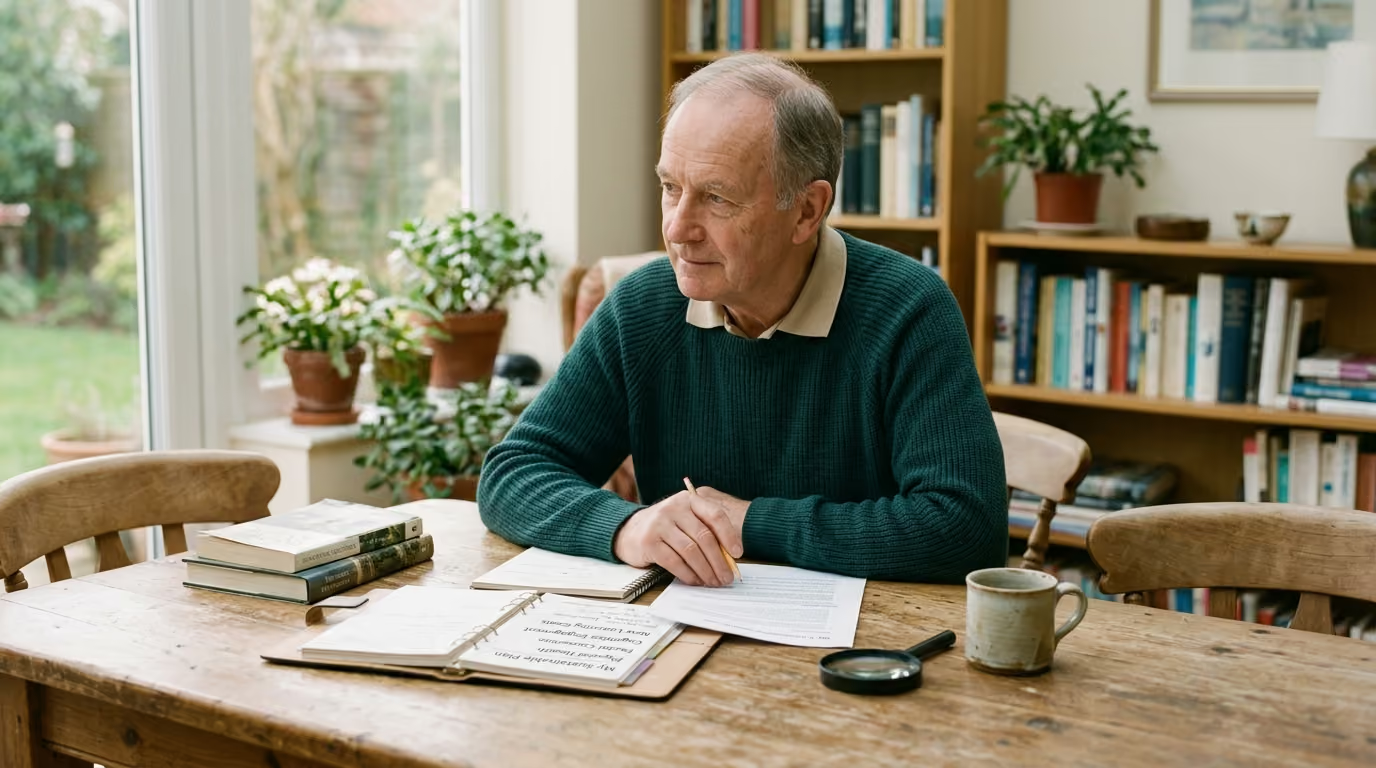

Three to four daily anchors help retirees replace workplace routines with healthy habits that protect mental focus, physical vitality, and personal independence.





Most people assume that total freedom from obligations is the ultimate reward of a long career. When every hour of the day suddenly becomes empty, attention and motivation can quickly unravel. Without the automatic prompts of a workplace, simple decisions about when to wake, move, eat, and socialize require continuous mental effort.
The transition away from full-time employment is not merely a financial milestone. It is a major shift in how the brain navigates time, initiates tasks, and maintains social connection. Managing this transition successfully requires a balance between supportive daily habits and open, unhurried time.
A standard career provides an invisible support system for daily behavior. Workplace schedules dictate when to get out of bed, when to travel, when to speak with colleagues, and when to rest. These external prompts remove the need to make hundreds of small choices every day.
When you leave the workforce, those external prompts disappear overnight. The brain must suddenly switch from externally cued behavior to self-cued behavior. This switch places a heavy burden on executive function, which is the mental system responsible for planning, initiating, and focusing on tasks.
When self-cued actions lack a clear trigger, people often experience task paralysis. You may intend to read, walk, organize the house, or learn a skill, yet find yourself sitting on the sofa wondering where the morning went. This drift is not a personal failure, nor is it a sign of laziness. It is the predictable neurological response to the sudden loss of external behavioral cues.
Behavioral scientists have found that linking intentions to specific environmental prompts reduces this mental friction. When you establish dependable anchors throughout your week, you remove the constant need to decide what to do next. The brain preserves its energy for the activity itself rather than wasting effort on task initiation.
Scientific literature on retirement presents a nuanced picture of how daily habits influence cognitive vitality and overall wellbeing. Research published through Oxford Academic examined subjective wellbeing during different types of leisure among adults aged 65 and older. The findings demonstrated that physically active leisure was associated with greater happiness, a stronger sense of meaning, and lower levels of sadness compared to passive leisure.
A comprehensive review on time use and mental health in older adults confirmed that active lifestyles, combining regular physical movement and social engagement, correlate with better cognitive functioning and fewer depressive symptoms. Researchers noted that these benefits stem from a broad definition of productive activity. This includes hobbies, home maintenance, volunteering, and structured exercise.
The relationship between retirement and long-term cognitive health is complex and varies across individuals. Meta-analyses examining cognitive changes after retirement show that global mental abilities do not automatically decline when work stops. A systematic review published in recent years indicates that cognitive outcomes depend heavily on previous job demands, educational background, socioeconomic resources, and whether the retirement was voluntary.
Involuntary retirement, often caused by unexpected health challenges or corporate downsizing, correlates with higher stress and more precarious health outcomes. Conversely, individuals who retire voluntarily and build balanced weekly routines maintain stable cognitive functioning. Staying intellectually active, socially connected, and physically mobile supports lifestyle and brain resilience across the lifespan.
The National Institute on Aging highlights that social isolation and loneliness carry distinct risks for older adults. Social isolation refers to the objective absence of contact with other people, while loneliness represents the subjective feeling of being alone. Both states correlate with higher risks of cardiovascular issues, depression, and cognitive difficulties. Regular, structured opportunities to interact with others serve as a critical defense against these risks.
Guidelines from the Centers for Disease Control and Prevention recommend that adults aged 65 and older complete at least 150 minutes of moderate aerobic activity each week. The guidelines also recommend muscle-strengthening activities on at least two days per week, along with balance training. Structuring these physical requirements into dependable weekly slots provides an ideal template for preserving physical independence and mental clarity.
Recreating a rigid corporate schedule in retirement is counterproductive and undermines the personal autonomy you have earned. A far better method is to construct your week around four distinct layers that provide stability while leaving plenty of room for spontaneity.
Anchors are recurring events that stabilize your day without dictating every passing minute. They form the foundation upon which the rest of your week rests.
Key anchors include:
When these anchors are fixed, the day retains a clear shape even if everything between them changes.
Meaningful commitments involve obligations to people, organizations, or causes outside yourself. These activities provide external accountability, social contact, and a clear reason to leave the house.
Examples include:
Limit these commitments to two or three half-days per week. This prevents your calendar from becoming overly crowded while still ensuring regular social engagement.
Project blocks are dedicated periods set aside for self-directed goals that require sustained focus across multiple sessions. These blocks allow you to make visible progress on pursuits that matter to you.
Common projects include:
Assign two or three project blocks to your week, with each block lasting between 60 and 90 minutes. Setting a clear start and end time helps prevent both procrastination and burnout.
Open space is completely unscheduled time. It is not time spent waiting for something to happen; it is time intentionally reserved for rest, reading, spontaneous outings, or simply doing nothing.
Protecting this open space on your calendar prevents the subtle creep of unnecessary obligations. True flexibility requires empty space. If every hour is claimed by an activity, your capacity to respond to sudden opportunities or personal fatigue is lost.
Organizing your time effectively requires understanding the different demands that various activities place on your energy. Treating a creative project like a quick habit, or treating physical recovery as a failure of productivity, leads to frustration.
Appointments occur at a specific time and involve other individuals or external institutions. They include doctor visits, hair appointments, contractor meetings, and scheduled group events.
Keep these commitments visible on a central physical calendar or digital app. Avoid scheduling multiple high-demand appointments on the same day whenever possible. Spacing appointments throughout the week leaves room for quiet recovery periods.
Projects have a clear beginning, middle, and end, but they lack external deadlines. Because no one is demanding their completion, they are easily delayed or abandoned.
Break large projects into the smallest visible next action. Instead of writing "work on genealogy" on your list, write "transcribe grandfather's military discharge papers for 30 minutes." Concrete tasks lower the mental resistance required to begin.
Habits are automated behaviors attached to dependable environmental cues. You can use implementation intentions to establish new habits without relying on sheer willpower.
An implementation intention uses a clear conditional format: "If situation X occurs, then I will perform action Y." For example:
Linking a desired behavior to an existing anchor makes the action automatic over time.
Rest is a physiological requirement, not an earned luxury. Sustainable cognitive health and physical energy require deliberate periods of decompression.
Schedule quiet leisure, afternoon naps, or solitary reading sessions without guilt. When you recognize rest as an active investment in your wellbeing, you eliminate the negative self-talk that often accompanies unscheduled downtime. For additional strategies on maintaining mental clarity, review our resources on retirement, purpose, and mental fitness.
A professional career often supplies identity, status, competence, and a social network in a single package. Leaving the workforce removes the job title while leaving underlying human needs for purpose and contribution entirely intact.
Developing a meaningful post-career life involves choosing how to direct your skills and interests:
Continuation involves maintaining a direct connection to your former professional field in a reduced, advisory capacity. A retired accountant might prepare tax returns for low-income families through a local non-profit. A former teacher might volunteer as an adult literacy tutor. This path leverages hard-won expertise without the administrative burdens of full-time employment.
Translation takes core skills developed over decades and applies them in an entirely new context. A former project manager might organize logistics for a regional historical society. An engineer might help design trail systems for a state park. The fundamental competence remains, but the environment is fresh and engaging.
Expansion focuses on developing interests and creative talents that were set aside during decades of full-time work. This could mean learning oil painting, studying classical guitar, cultivating an orchard, or reading deeply in philosophy. It offers an opportunity to cultivate new dimensions of your intellect.
Replacement involves building a completely new role unrelated to your previous professional life. A retired corporate executive might become an avid bird watcher, a youth sports official, or a community theater actor. This approach provides a clean psychological break from the past.
Reduction is the deliberate choice to embrace a simpler, quieter daily life focused on home, health, close family, and contemplation. It is an intentional step back from public ambition toward personal serenity.
None of these paths is superior to the others. The right choice aligns with your health, financial reality, values, and personal energy. Purpose does not require grand public recognition. It simply requires knowing that what you do on a given Tuesday matters to you or benefits someone else.
Workplaces provide incidental social contact that requires zero planning. You chat in hallways, share lunch in the breakroom, and collaborate on shared goals. When work ends, that automatic contact ceases, making social interaction something you must deliberately design.
A balanced social architecture includes several layers of connection:
Primary ties provide deep emotional safety, but relying solely on a spouse or single friend for all social stimulation places heavy strain on that relationship. Recurring groups offer belonging and predictable weekly interaction without requiring constant hosting or coordination.
Weak ties are often overlooked, yet research shows they contribute significantly to a sense of community belonging. Brief, friendly exchanges with the postal carrier, a local barista, or a neighbor walking their dog provide vital social stimulation. Maintaining these casual connections keeps you anchored in your local community.
If you are naturally introverted, building a social network does not mean attending loud parties or filling your calendar with dinners. You can join a silent book club at the library, participate in a community garden workday, or join a weekly walking group where conversation is optional. The goal is regular human connection that respects your energy limits.
A rigid daily routine breaks down the moment you experience poor sleep, joint pain, seasonal illness, or family stress. A truly resilient life framework accounts for natural fluctuations in physical and mental capacity.
Using a three-tiered planning method allows you to adapt your expectations without feeling that you have failed:
The floor plan is your baseline routine for days when energy, mood, or health is low. It contains only the absolute essentials required to keep life running smoothly:
The floor plan prevents an all-or-nothing collapse during difficult periods while honoring your physical need for rest.
The standard plan represents your normal, balanced routine on a typical week:
This plan maintains steady progress across personal goals and preserves healthy daily habits.
The ceiling plan is reserved for days when you wake up feeling energetic, motivated, and fully rested. On these days, you can choose to tackle more demanding activities:
Switching between these tiers based on daily capacity protects your mental wellbeing and keeps your habits sustainable over years.
Navigating the post-career transition involves untangling several pervasive cultural myths about aging, productivity, and rest.
Many individuals believe that setting an alarm or having a schedule ruins the spirit of retirement. Total lack of structure often produces decision fatigue, sleep disturbances, and a gradual decline in daily physical activity. Establishing three or four dependable anchors preserves freedom while protecting daily rhythm.
Packing every day with committee meetings, errands, and social dates can be a subtle form of avoidance. High activity levels often mask an underlying discomfort with stillness or an unresolved loss of professional identity. Purpose is measured by how deeply an activity connects with your personal values, not by the density of your calendar.
Watching a documentary, reading a novel, or sitting quietly on a porch is often dismissed as unproductive. Rest and passive leisure provide essential neurological and physical restoration. Passive leisure becomes problematic only when it crowds out all physical movement, meaningful projects, and personal contact with others.
Headlines frequently warn that leaving the workforce leads directly to memory loss and mental decline. Current scientific literature demonstrates that cognitive outcomes vary significantly based on lifestyle choices, mental engagement, and social habits. You can support cognitive health and protection by remaining curious, learning new skills, and maintaining regular physical exercise throughout your life.
True flexibility is the ability to adapt your plans to health changes, weather, family emergencies, and unexpected opportunities. It is not an excuse to abandon physical activity or meaningful commitments whenever you feel momentary resistance. Having clear implementation intentions helps you distinguish between legitimate fatigue and temporary hesitation.
Establishing a sustainable balance between structure and freedom is an iterative process. You can use this practical thirty-day framework to build, evaluate, and refine your daily routines.
Focus entirely on establishing your basic daily physical rhythms. Do not worry about taking on major new projects or community commitments yet.
Introduce one structured project block to your schedule to practice self-directed task initiation.
Incorporate regular, externally cued social interactions into your weekly calendar.
At the end of thirty days, set aside twenty minutes on Sunday morning to review your system.
Use these diagnostic questions to adjust your routine:
Regular, calm adjustments ensure that your routine serves your life rather than becoming a rigid standard you must live up to. To learn more about how physical habits influence focus and mental sharpness, read about memory and cognitive performance.
Different professional backgrounds and life circumstances create distinct challenges when moving into a self-directed routine. Reviewing these common patterns can help you troubleshoot your own transition.
Individuals coming from demanding corporate, medical, or legal careers often carry a high-pressure work ethic into retirement. They create elaborate task lists, join numerous non-profit boards, and turn recreational hobbies into high-stress performance goals.
For this profile, the primary challenge is learning how to stop rather than how to start. Helpful strategies include:
People who retire from busy workplaces often find that their social circles shrink rapidly within the first six months. The initial relief of having quiet days gives way to subtle feelings of isolation and disconnection.
For this profile, social connection must be intentionally built into the weekly routine:
Some retirees enter their post-career life with dozens of deferred interests. They purchase supplies for multiple crafts, enroll in multiple online courses, and start several home renovations simultaneously. The result is visual clutter, unfinished tasks, and decision paralysis.
For this profile, establishing boundaries around choices is critical:
Retirees who provide care for an aging parent, a spouse with health issues, or young grandchildren face unpredictable schedules. Rigid hourly plans quickly fail under the weight of medical appointments, unexpected care needs, and physical fatigue.
For this profile, flexible planning is essential:
A successful daily routine depends on maintaining your physical vitality and managing chronic conditions effectively. Use your regular wellness visits to discuss how your daily activity patterns support your long-term health goals.
Open conversations with your healthcare team provide the clinical clarity you need to design safe, sustainable daily routines. For broader perspectives on healthy aging, review our collection of retirement and mental fitness articles.
Creating a balanced retirement routine is an ongoing practice of self-discovery rather than a one-time scheduling exercise. By anchoring your days with healthy habits while protecting your freedom to rest and explore, you build a sustainable foundation for lasting cognitive vitality, purpose, and personal independence.

Follow FitBrainLab for research-led insights on memory, focus, brain aging, nutrition and mental fitness after 60. Stay connected for new articles, practical guidance and ideas for a sharper, more engaged life.


Build habits that support memory, focus and a curious, connected life.
Read the Blog