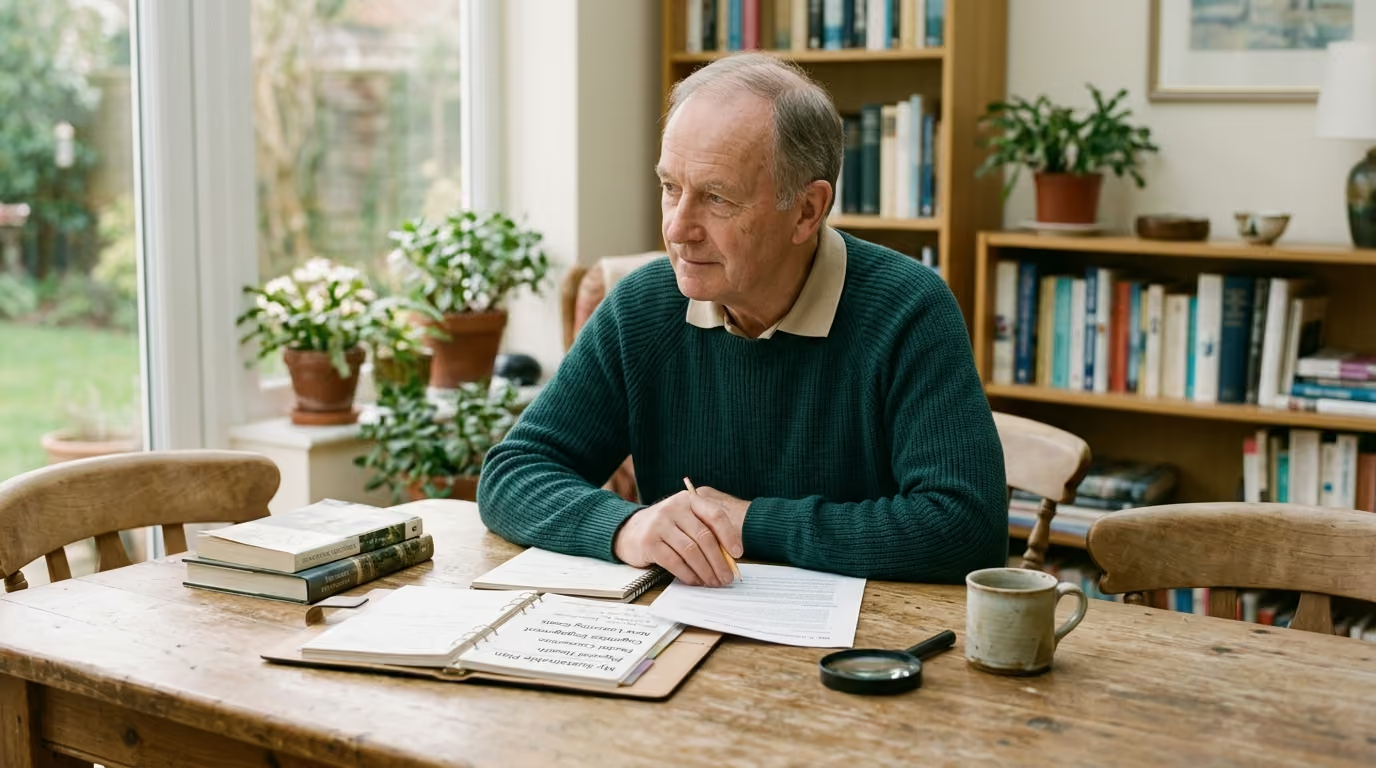

Loneliness after retirement is a natural biological response to losing daily workplace routines and can be resolved through structured social habits.





You likely searched for why you feel lonely after leaving your career, or how to build real friendships when work routines vanish. The transition from full-time work to retirement changes your daily habits, your identity, and your access to casual conversation. This guide provides a clear, evidence-based roadmap to understand retirement loneliness and rebuild meaningful human connection on your own terms.
Loneliness is not a moral failing or a character flaw. In simple neurological terms, loneliness acts like physical hunger or thirst. When your body needs water, it creates thirst to prompt you to drink. When your brain perceives a lack of reliable social support, it triggers loneliness to motivate you to seek connection.
Human brains evolved in close-knit groups where safety depended on shared effort. When you spend long periods without meaningful contact, your nervous system can perceive your environment as less secure. This response can keep your stress system on higher alert.
Retirement often removes the steady background noise of the workplace. In an office, hospital, school, or job site, your brain receives hundreds of small social cues each day. You see familiar faces in the hallway. You exchange comments about the weather. You solve problems alongside colleagues.
When those cues disappear overnight, your brain registers the sudden quiet as an alert. Recognizing this biological mechanism helps remove the shame often attached to feeling lonely. The goal is not to force yourself to become an extrovert. The goal is simply to provide your nervous system with the regular, predictable human contact it needs to feel settled.
Research provides a nuanced view of how leaving the workforce affects social health. Retirement does not automatically create loneliness, but it exposes the structural supports that were previously taken care of by a job.
The World Health Organization reports that approximately one in six people worldwide experiences loneliness. Among older adults specifically, global estimates suggest that around 11.8 percent experience loneliness regularly. Public health organizations view social connection as a fundamental component of physical and cognitive health.
The National Academies of Sciences, Engineering, and Medicine notes that social isolation and loneliness are associated with higher rates of depression, cardiovascular issues, and cognitive decline. Some reviews report that older adults experiencing high levels of chronic loneliness show twice the likelihood of developing cognitive impairment.
These findings describe statistical associations rather than direct cause and effect. Chronic health conditions, pain, limited mobility, and sensory changes can contribute to isolation while also directly affecting brain health. You can learn more about preserving mental clarity through our cognitive resilience resources.
A systematic review of nine studies involving over 37,000 participants found that retirement can increase loneliness for some individuals, while easing it for others. The outcome depends heavily on health status, income stability, whether the retirement was voluntary, and existing social networks.
A longitudinal study tracking 3,758 adults examined what happens across the retirement transition. The researchers found that retirement did not cause a notable short-term increase in subjective loneliness. In fact, newly retired individuals showed lower odds of objective social isolation compared to peers who continued working, because retirement freed up time for community activities. Over the long term, retirement showed no direct negative association with either isolation or loneliness.
These findings show that retirement loneliness is not an unavoidable phase. It is an adjustable life transition.
Recent systematic reviews and meta-analyses offer clear direction on what helps older adults re-establish connection:
To address social challenges effectively, you need clear definitions. People often use isolation, loneliness, and solitude interchangeably, but they describe very different experiences.
Loneliness is the distressing internal feeling that your current relationships do not meet your emotional or practical needs. You can feel lonely in a crowded room, within a marriage, or among busy acquaintances if you do not feel understood or supported. Loneliness comes in several forms:
Social isolation is a structural, measurable lack of contact with other people. It involves objective measures:
A person can be objectively isolated without feeling distressed if they enjoy quiet routines. Another person may have dozens of weekly interactions yet suffer from intense loneliness because those interactions remain superficial.
Solitude is time spent alone by choice. It allows space for rest, reading, creative projects, gardening, or reflection. Solitude restores your energy, while unwanted isolation drains it.
Preserving healthy solitude is important for retirees, particularly introverts. The goal of social health is never constant interaction. The goal is having access to meaningful connection when you want it.
Social anxiety involves fear of judgment, embarrassment, or awkwardness in social settings. When you leave a familiar workplace, your social script disappears. At work, your role and your tasks dictated how you spoke to people.
Without that script, striking up a conversation can feel risky. If social anxiety causes you to avoid leaving the house or cancel plans repeatedly, you may need gentle, structured exposure strategies rather than simply forcing yourself into large crowds.
The National Academies outlines social health using three distinct dimensions:
Focusing exclusively on structure by trying to meet as many people as possible often leads to burnout. Improving function and quality creates durable protection against loneliness. For more guidance on structuring your post-career life, explore our articles on retirement mental fitness.
Understanding why the end of full-time work destabilizes social life makes it easier to find practical solutions. Leaving employment changes several areas of daily life at once.
Workplaces function as automatic social ecosystems. They provide low-effort contact throughout the day. You do not need an invitation to say good morning to a coworker or chat by the coffee maker.
Work also provides shared goals. When you and your colleagues work together on a deadline, you form bonds through shared effort. When you retire, those automatic interactions vanish. Maintaining relationships suddenly requires deliberate scheduling, initiative, and vulnerability.
Your career often answers the question, "What do you do?" For decades, your title gave you a recognizable social identity, whether you were an electrician, an educator, an accountant, or a nurse.
Retirement can strip away that identity before a new one has time to form. If your sense of personal value was tied to your professional authority, ordinary social interactions can feel awkward. Rebuilding connection requires building a identity based on current interests, character, and community contribution.
A complete lack of scheduling can feel relaxing for the first few weeks of retirement. Over months, however, an open calendar can cause days to blend together.
Without fixed times to wake up, leave the house, or meet others, social initiative tends to drop. People often stay home longer, watch more television, and let minor communication lapses stretch into months of silence. Regular routines provide the repeated exposure needed for organic friendships to take root.
Social disconnection in retirement is often driven by practical barriers rather than psychological resistance:
Addressing these practical elements is often the fastest way to reopen social pathways.
Rebuilding a fulfilling social life does not happen through sheer willpower or random outings. It works best through a structured, step-by-step process.
Before joining groups or inviting neighbors over, address the basic physical factors that affect social ease:
You do not need to make a lifelong friend on day one. Start by re-engaging with casual, low-stakes public interactions. These micro-contacts remind your brain that you are part of a broader community.
The National Institute on Aging highlights that even brief daily communications help maintain mental engagement. These low-pressure touchpoints build social confidence without creating performance anxiety.
One-time social events rarely build friendships. Meaningful connection relies on the psychological principle of repeated exposure. Seeing the same people at the same time each week allows familiarity to grow naturally.
When choosing an activity, look for options with clear structure:
Structure removes the awkwardness of wondering what to say. The activity itself provides the topic of conversation.
Once you have attended a recurring group three or four times, move from passive attendance to active participation. Belonging grows when you become useful to the group.
Small contributions establish your presence as an active member of the community, turning you from a visitor into an integral participant.
When you feel comfortable around group members, you can begin extending one-to-one invitations. Moving from a group setting to an individual conversation is how acquaintances become friends.
Use a simple, low-pressure formula:
Retirement offers the opportunity to apply your skills toward causes that matter to you. Purpose-driven activities provide connection along with a strong sense of personal value.
The National Institute on Aging notes that regular volunteering provides a clear sense of mission, which correlates with better physical and emotional health. Studies tracking the retirement transition show that individuals who pick up volunteer work often replace the social satisfaction lost from their careers.
Look for roles that fit your energy and interests:
Match the commitment to your realistic capacity. A dependable two-hour shift each week is far more sustainable than an exhausting twenty-hour schedule. You can find more ideas in our library of retirement purpose resources.
Sometimes loneliness is intertwined with clinical depression, profound grief, or severe social anxiety. Self-help strategies alone may not feel sufficient.
Healthcare systems increasingly use social prescribing, where doctors and community coordinators connect individuals directly to local non-clinical programs, counseling, and peer networks. Seeking professional guidance provides structured tools to navigate difficult emotional transitions.
Social advice must match your specific living situation. What works for a healthy retiree in a walkable city does not always apply to someone in a rural area or a caregiver at home.
Living outside urban centers makes casual walk-ins and neighborhood groups harder to access. Rebuilding connection requires different strategies:
Caring for a spouse or family member can severely restrict your freedom to leave home for social activities. Caregiver loneliness requires targeted support:
Physical restrictions do not have to mean social isolation. Focus on accessible engagement:
Older adults from minority communities often face distinct challenges finding welcoming social environments. Generic senior centers may not always feel culturally safe or affirming.
Some retirees fill their calendars with clubs, golf, and dinner parties, yet still feel deeply lonely. This pattern occurs when interactions remain entirely superficial.
Clearing away myths about aging and connection prevents unnecessary frustration and self-blame.
Retirement changes your routine, but chronic loneliness is not an inevitable outcome of aging. Longitudinal studies confirm that many older adults expand their social circles and deepen their satisfaction after leaving work. Connection is a skill and an environment that can be built at any age.
Living alone is an objective household arrangement, not an emotional diagnosis. Many people living alone maintain rich, satisfying social lives. Conversely, living with a partner or family member does not protect against loneliness if the relationship lacks warmth, reciprocity, or mutual understanding.
Companion animals offer wonderful affection, sensory comfort, and daily routine. However, a pet cannot fully replace the human need for conversation, shared problem-solving, and emotional validation. Pets also require physical care and financial resources, making them a personal lifestyle choice rather than a universal remedy for isolation.
Overfilling your schedule with random clubs often leads to physical fatigue and shallow acquaintances. Attending six different groups once a month produces less connection than attending one group every single week. Focus on depth, consistency, and shared interests over pure volume.
Introversion simply means you recharge your mental energy through quiet time rather than large crowds. Introverted retirees do not need a packed social calendar. They thrive on one or two dependable, high-quality friendships paired with comfortable, chosen solitude.
Before making changes, take an honest look at your current social landscape. This simple self-assessment helps you identify where your social architecture needs attention.
If you answered "no" to several of these questions, select one specific area to address over the coming month. Attempting to fix every dimension at once is unnecessary and overwhelming.
Your primary care provider can be a valuable partner in supporting your social and emotional well-being. Physical health, brain function, and social connection are closely linked. For more evidence-based perspectives on healthy aging, read our brain health and memory articles.
When you attend your next medical appointment, consider bringing these specific questions to your doctor:
Rebuilding social connection does not require a dramatic life overhaul. It happens through small, steady actions repeated week after week. Use this checklist to begin establishing your social architecture starting this week.

Follow FitBrainLab for research-led insights on memory, focus, brain aging, nutrition and mental fitness after 60. Stay connected for new articles, practical guidance and ideas for a sharper, more engaged life.


Build habits that support memory, focus and a curious, connected life.
Read the Blog