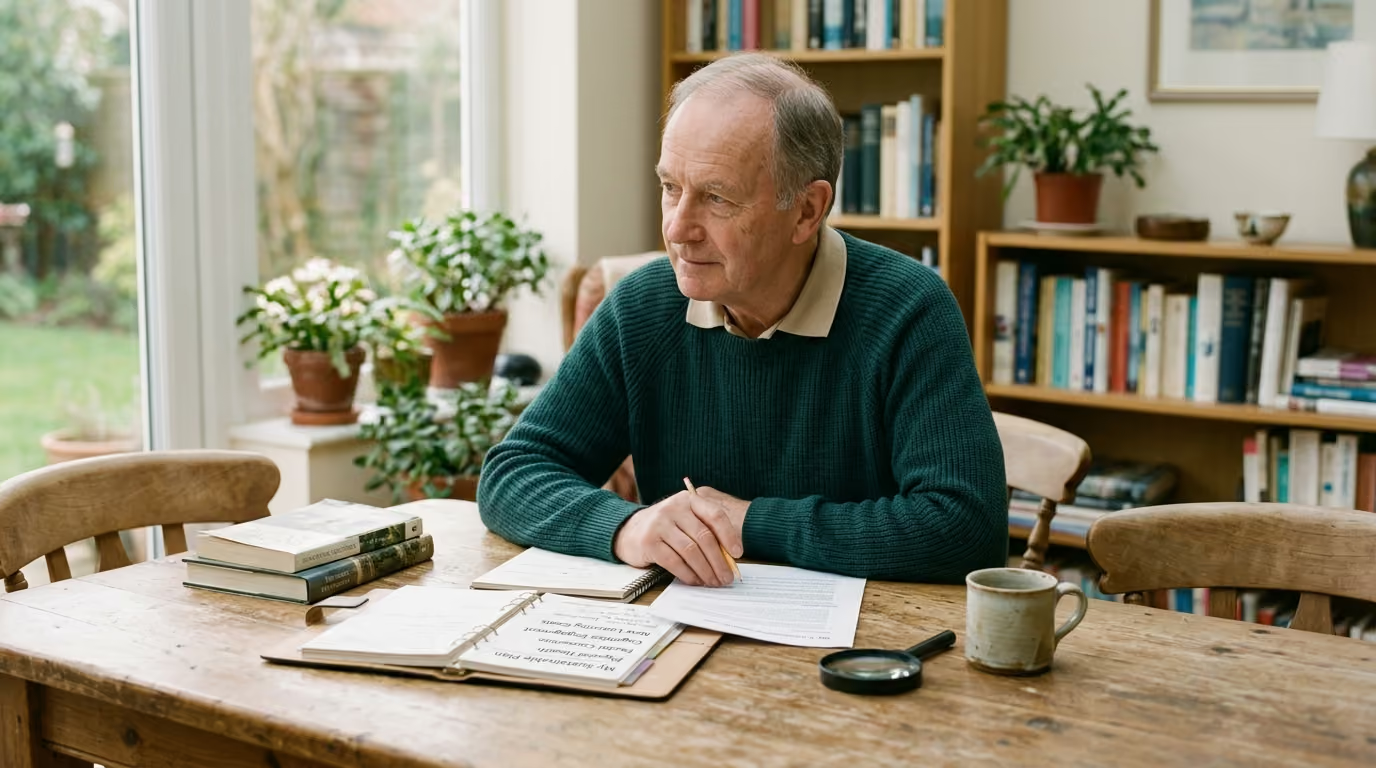

Retirement is often viewed as pure leisure, but active civic participation provides the essential mental structure and purpose needed for long-term cognitive health.





You wake up on a Tuesday morning with a calendar that is completely clear. The work deadlines, team meetings, and complex operational problems that once filled your working years are gone. While the initial relief of unscheduled time is welcome, the sudden absence of structure, shared goals, and daily problem-solving can feel disorienting.
Retirement marks a major transition in how you use your mind and where you direct your energy. Many adults look for ways to stay intellectually sharp and socially connected without returning to traditional employment.
Civic engagement offers a practical pathway to rebuild mental structure around community contribution. By participating in local boards, neighborhood planning, advocacy, or grassroots projects, you place your brain in dynamic environments that require planning, debate, and social coordination.
When you evaluate a community issue, your brain activates multiple neural networks simultaneously. You are not simply memorizing facts or completing repetitive exercises. You are absorbing new information, regulating emotional reactions during debates, and coordinating with diverse groups of people.
Cognitive engagement in civic spaces draws heavily on executive function. Executive function is the set of mental skills managed primarily by the prefrontal cortex. It includes working memory, cognitive flexibility, and inhibitory control.
When you read a municipal zoning proposal, your working memory holds complex details while you analyze the trade-offs. When a public meeting shifts direction, cognitive flexibility helps you adapt your perspective and consider alternative solutions. When a contentious debate arises, inhibitory control allows you to remain calm, listen to opposing views, and respond with reasoned arguments.
Social interaction adds another layer of neurological demand. Communicating with committee members requires theory of mind, which is the ability to understand another person's perspective, intentions, and beliefs. Processing verbal and nonverbal social cues stimulates widespread neural circuits across the brain.
Meaningful civic action also supports the brain's reward pathways. Working toward a shared goal triggers the release of dopamine and serotonin. These neurotransmitters support sustained attention, positive mood, and motivation.
You can learn more about daily cognitive habits through our guide to memory and focus articles. Understanding how real-world challenges activate these cognitive systems helps explain why community involvement serves as such a practical mental exercise.
Scientific literature on aging provides useful insights into how structured community participation relates to cognitive health and psychological well-being. Researchers consistently find that staying active in collective life correlates with positive health outcomes in older adulthood.
Longitudinal data from the Health and Retirement Study indicates that older adults who volunteer regularly show increases in cognitive activity, physical activity, and social interaction. Analysts observed that individuals volunteering at least 100 hours annually, or roughly two hours per week, showed meaningful increases in higher-level cognitive tasks compared to non-volunteers. This elevated cognitive activity was associated with better long-term cognitive functioning.
In a four-year follow-up study of older adults, participants volunteering at least 100 hours per year demonstrated lower risks of physical limitations and reduced mortality. They also reported greater optimism, higher purpose in life, fewer depressive symptoms, and lower levels of loneliness.
Research also highlights the specific role of generativity, which is the drive to guide, support, and improve conditions for future generations. Studies show that active generative behavior, rather than passive concern alone, is associated with fewer depressive symptoms among older adults. Taking concrete steps to improve a neighborhood or assist a local group translates general concern into purposeful psychological resilience.
Older adults represent a vital pillar of civic life. Data from national surveys show that adults aged 50 and older contribute more than half of all volunteer hours in the United States. Furthermore, national figures from AmeriCorps and the Census Bureau show that formal volunteering through organizations has steadily rebounded in recent years. Older volunteers consistently log more annual hours and serve more regularly than younger cohorts.
While these associations are encouraging, they should be interpreted with scientific balance. Much of the available research is observational. Observational studies show correlations between civic activity and health, but they do not prove that volunteering alone prevents cognitive decline.
People who choose to participate in civic organizations may already enjoy better baseline health, higher education, or stronger social safety nets. Civic participation should be viewed as a valuable component of an active lifestyle rather than a medical treatment. You can read more about overall resilience strategies in our lifestyle and brain resilience articles.
To evaluate whether a civic activity supports your mental fitness, it is helpful to look at the specific benefits it provides. Community involvement can produce four distinct returns: learning, connection, purpose, and agency.
Civic participation introduces you to unfamiliar systems, specialized vocabularies, and evolving technologies. When you join a local environmental committee, you might learn about stormwater management, state runoff regulations, and watershed biology. When you assist with a community budget review, you learn how tax revenues are allocated across municipal departments.
This type of active learning requires continuous mental effort. It forces your brain to build new neural connections, a process known as neuroplasticity. Unlike passive reading, civic learning requires you to apply new information immediately to resolve real-world dilemmas.
Workplaces naturally provide daily social interaction, but retirement often shrinks your social circle. Civic participation builds what sociologists call weak ties. Weak ties are casual, regular acquaintances who link you to the wider world beyond your immediate family and close friends.
Interacting with municipal staff, fellow volunteers, local business owners, and younger residents exposes you to diverse viewpoints. These recurring social interactions combat isolation, expand your perspective, and keep your social communication skills sharp.
Purpose is the felt sense that your daily actions have value and contribute to aims outside yourself. In a civic setting, purpose is tied to tangible, localized progress.
You might see purpose in helping a local library expand its hours for school children. You might find it in organizing an emergency preparedness list for vulnerable neighbors. Knowing that others rely on your preparation and follow-through provides a healthy reason to structure your week.
Personal agency is the knowledge that your actions can influence your immediate environment. Retirement can sometimes create feelings of powerlessness when daily authority over work projects ends.
Civic engagement restores personal and collective agency. When you write a well-researched public comment that prompts a city council to repair a dangerous crosswalk, you see a direct link between your effort and a community improvement. Seeing that your voice matters strengthens self-confidence and mental resilience.
Not every civic role is appropriate for every person. Taking on an ill-fitting or excessively stressful role can lead to frustration, exhaustion, and burnout. Before committing your time to an initiative, evaluate the opportunity using the capacity, access, and fit framework.
Begin with an honest appraisal of what you can comfortably take on. Consider the following factors:
Access barriers can turn a well-intentioned volunteer role into an exhausting chore. The World Health Organization emphasizes that age-friendly environments must provide accessible communication, reliable transportation, and inclusive spaces. Ask yourself:
A role has good fit when its demands align with your core values and desired lifestyle. If you value quiet contemplation, serving on a contentious planning commission might drain your mental reserves. You might find deeper satisfaction cataloging artifacts for a local historical society.
Select roles that offer moderate intellectual challenge, genuine social warmth, and adequate recovery time. If you are structuring your broader post-career lifestyle, explore our curated retirement and mental fitness resources for additional guidance.
Civic engagement is not an all-or-nothing commitment. You do not need to run for public office or manage a major charity to make a meaningful difference. You can move up or down a participation ladder depending on your current health, available time, and personal interests.
At the entry level, you observe civic life without taking on formal responsibilities. You might read the weekly newsletter published by your town clerk. You could watch a recorded school board meeting or review the minutes of a park district session. This builds baseline knowledge about how decisions are structured in your community.
Once you understand the basic topics, you begin gathering context. You might attend an open house hosted by the regional transit authority. You could speak with a reference librarian about historical zoning patterns or review an informational pamphlet from a watershed association.
If you prefer to avoid public speaking, you can make valuable contributions from home. You can submit written comments on a proposed pedestrian trail, complete municipal surveys, or help a nonprofit edit its quarterly educational flyer. This allows you to apply your analytical skills on your own schedule.
At this stage, you voice your perspective in open forums. You might step up to the microphone at a city council meeting to support funding for crossing guards. You could ask a clarifying question during a public hearing regarding community clinic services.
Here, you become a consistent member of an organized civic body. You might join a neighborhood association traffic safety committee, an advisory group for the local senior center, or a river cleanup coalition. This level provides regular social interaction and shared responsibility.
Formal roles carry appointed responsibility and structured oversight. Examples include serving on a municipal library board, a historic preservation commission, or the board of directors for a community foundation. You review operational budgets, shape administrative policies, and ensure regulatory compliance.
Leadership involves organizing neighbors and resources to address a specific, neglected issue. You might lead an initiative to plant shade trees along a walking route frequented by older residents. This role requires comprehensive project planning, delegation, budgeting, and public communication.
At the top of the ladder, your focus turns toward transferring knowledge and building capacity in newer participants. You might mentor a younger resident taking their first seat on an advisory board. You help them read procedural documents, understand organizational history, and communicate constructively with public officials.
To understand how civic engagement functions in everyday life, consider these four realistic case patterns. Each illustrates how distinct roles challenge cognitive skills and build purposeful community connections.
A retired high school science teacher joins the local public library board of trustees. The board meets monthly to review library circulation statistics, oversee building maintenance contracts, and approve the annual operating budget.
In this role, the former teacher reviews financial spreadsheets, learns state public records requirements, and evaluates bids for a new heating system. During meetings, the board weighs competing community priorities, such as expanding digital media collections versus upgrading children's reading spaces.
The cognitive return involves quantitative reasoning, verbal debate, and procedural memory. The purpose return comes from directly improving educational access for children and families across the township.
To keep this role sustainable, the board member clarifies time expectations upfront. They establish a personal boundary of spending no more than three hours reviewing documents prior to each monthly session.
A retired accountant notices that many older adults in their neighborhood struggle to walk safely to the nearest pharmacy due to broken curbs and fast turning traffic. Rather than just worrying about the issue, they decide to organize a focused local effort.
The retiree walks the route, notes specific intersections, and takes photographs of damaged curb cuts. They look up the city's capital improvement schedule to determine which department oversees roadway repairs. Next, they speak with nearby neighbors to collect brief statements about walking difficulties.
They prepare a three-page summary outlining the safety concerns and present it during the public comment period of a public works meeting. They follow up by checking meeting minutes and tracking when the repair work appears on the municipal schedule.
This role combines moderate physical activity with spatial observation, structured documentation, and clear written advocacy. It provides a direct sense of personal agency when the public works department schedules curb repairs.
A retired mechanical designer volunteers with a community youth robotics club hosted at a local maker space. The club prepares middle-school students for regional technical design competitions.
Instead of running the team, the volunteer adopts a mentoring posture. They ask the students questions about structural balance, guide them through tool safety protocols, and help them troubleshoot coding logic. When the students encounter design failures, the mentor encourages calm problem-solving and systematic testing.
This role requires rapid task switching, active listening, and emotional regulation. It fosters intergenerational relationships, breaking down ageist assumptions on both sides. The mentor passes along decades of technical problem-solving experience while allowing younger participants to retain project ownership.
A resident with limited physical mobility and chronic joint pain wants to support local environmental preservation without attending lengthy evening hearings. They offer their services to an open-space advocacy coalition as a remote research analyst.
Working from home on their computer, they read draft environmental impact reports, summarize key findings, and draft clear bullet points for coalition members who speak at hearings. They verify citations, cross-check historical flood data, and organize background reference files in a shared folder.
This role exercises focused attention, reading comprehension, and synthesis skills. It demonstrates how adults managing mobility constraints can make substantial civic contributions without physical strain.
When you decide to address a specific issue in your community, having a clear method prevents overwhelm. Applying a structured problem-solving cycle keeps your efforts organized and mentally engaging.
Take time to look closely at what is happening around you. Collect objective facts rather than general impressions. If you notice a bus stop lacks shelter, record how many people use it during rain or heat, which bus lines stop there, and the specific stop number.
Distill your observations into a concise, well-bounded problem statement. Avoid vague complaints like "transit in our town is terrible." Instead, write: "The bus stop at 4th Avenue and Elm Street lacks seating and weather protection, creating safety hazards for older commuters."
Find out which public or private body has legal responsibility and budget authority for the issue. Is the bus stop managed by the municipality, the regional transit authority, or the county? Look up existing public policies, transit service standards, and available improvement grants.
Identify everyone who has a stake in the outcome. This includes the transit riders, adjacent property owners, transit system planners, and elected ward representatives. Understanding who benefits and who might object helps you build a realistic proposal.
Select the smallest practical intervention that can create progress. Instead of demanding an immediate overhaul of every bus stop in town, request a pilot installation of a single bench and shelter at the most heavily used stop.
Share your findings with neighbors, local transit advocacy groups, and nearby community centers. A unified request supported by twenty local residents carries significantly more weight with public officials than an isolated complaint.
Present your proposal through appropriate formal channels. Submit concise written comments, deliver a two-minute public statement at a transit board meeting, or schedule a brief informational meeting with your local representative. Present your data calmly and maintain a respectful tone.
Monitor what happens after your presentation. Read the official meeting minutes, check subsequent committee agendas, and review transit board votes.
Did the agency accept the request, refer it to a study committee, or decline it due to budget limits?
Public processes move slowly, and initial efforts often meet procedural delays. If the agency cites budget shortages, research whether local business sponsorships or community foundation grants could fund the bench. Modify your request and re-engage through official channels.
When improvements occur, write a sincere thank-you letter to the municipal staff, committee members, and neighbors who assisted. Acknowledging everyone's contribution strengthens working relationships for future community initiatives.
Many cultural stereotypes surround retirement and volunteerism. Examining these myths allows you to make informed choices about where to direct your mental energy.
While relaxation, travel, and rest are enjoyable parts of retirement, human beings continue to need structure, intellectual challenge, and social purpose throughout life. Disengaging entirely from productive activities can lead to boredom, routine stagnation, and increased risk of loneliness. Civic engagement offers a flexible balance between leisure and purposeful contribution.
Some people believe that if volunteering two hours a week is beneficial, volunteering thirty hours must be fifteen times better. In reality, excessive commitments can produce fatigue, emotional depletion, and chronic stress.
Studies show that volunteer-role quality matters more than raw volume. Feeling appreciated, performing mentally engaging tasks, and having adequate rest time are strongly linked to psychological well-being.
Popular wellness articles sometimes claim that staying socially active completely prevents cognitive decline. While mentally stimulating civic activities support cognitive vitality and build cognitive reserve, they are not guaranteed medical shields against neurological conditions. Engaging in civic life is valuable for the purpose, joy, and agency it provides right now, regardless of long-term medical certainty.
Many adults avoid community involvement because they dislike partisan hostility. Civic participation encompasses far more than election campaigns. It includes neighborhood trail maintenance, public library support, food bank logistics, historical preservation, and emergency preparedness. These local activities focus on practical community stewardship rather than ideological conflict.
Meaningful contribution does not require being a board president, committee chair, or public speaker. Behind-the-scenes support, such as proofreading grant applications, checking equipment, or organizing files, is essential for any group's success. Modest, reliable contributions often provide the most sustainable mental fitness return.
Integrating civic participation into your retirement routine works best when approached gradually. Here are two practical ways to start building engagement into your calendar.
Choose one local public meeting to attend or observe online each month. Rotate through different civic bodies to learn how your community operates:
Before each session, download the agenda and read the background memos. During the meeting, note how decisions are made, which procedural rules are used, and how members handle disagreement. This simple habit exercises attention and working memory while helping you identify issues you might want to support later.
Reserve a fixed, three-hour window on your calendar each week for a single community project. Treat this appointment with the same reliability as a medical visit or personal commitment.
Use this block to work on an assigned project:
Establishing a fixed weekly block creates healthy daily structure. It protects your free time on other days while ensuring your volunteer contributions remain bounded, predictable, and sustainable. For more ideas on maintaining balanced habits, visit our articles on retirement and mental fitness.
When discussing your lifestyle, cognitive health, and activity levels with your healthcare provider, consider asking these practical questions:
Return to this guide whenever you experience major transitions in your retirement routine. If you feel uninspired by your current volunteer commitments, find yourself feeling drained by meeting conflicts, or notice that your calendar has become either too empty or too chaotic, re-read the sections on capacity, access, and fit. Re-evaluating your participation ladder will help you reset your boundaries and select activities that support genuine mental vitality and long-term community purpose.
Staying actively engaged with the world around you is one of the most rewarding ways to exercise your mind, build lasting human connections, and leave your community stronger than you found it.

Follow FitBrainLab for research-led insights on memory, focus, brain aging, nutrition and mental fitness after 60. Stay connected for new articles, practical guidance and ideas for a sharper, more engaged life.


Build habits that support memory, focus and a curious, connected life.
Read the Blog