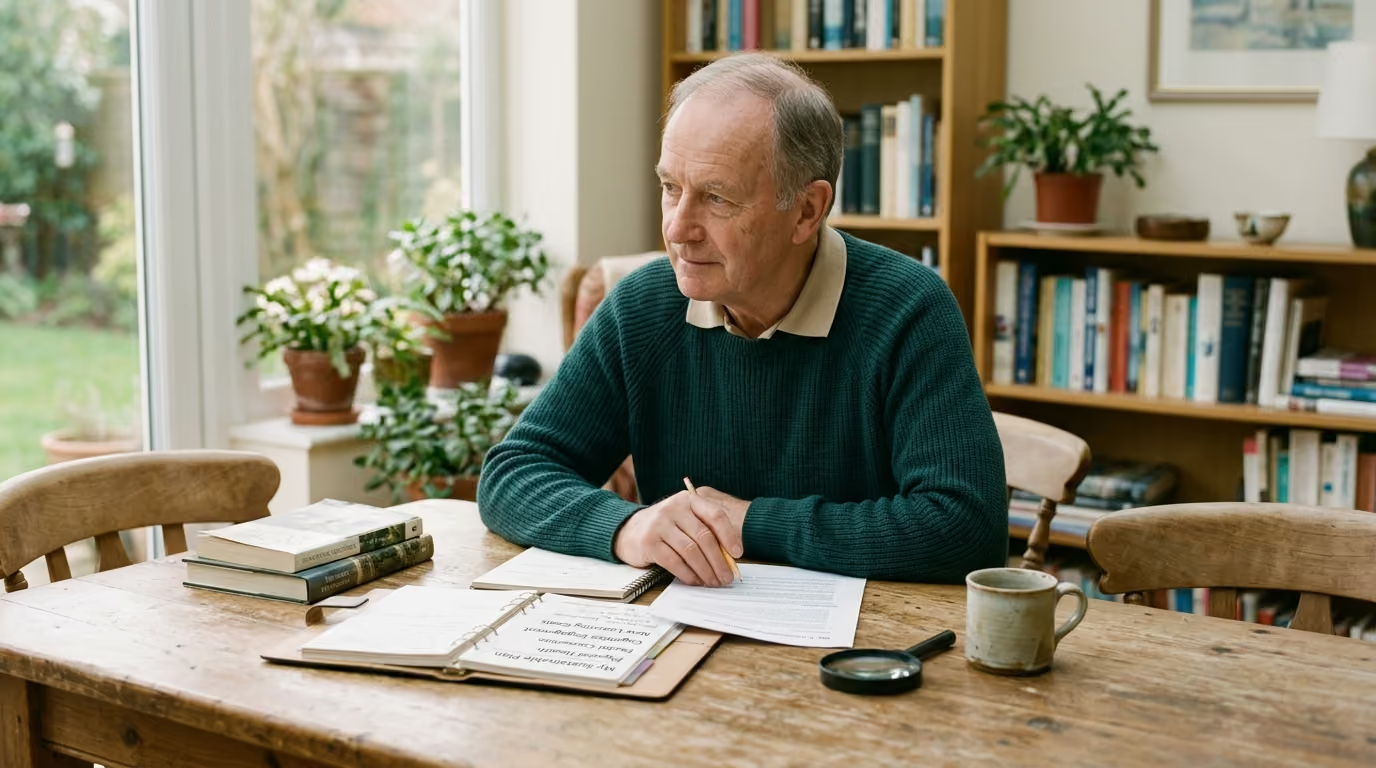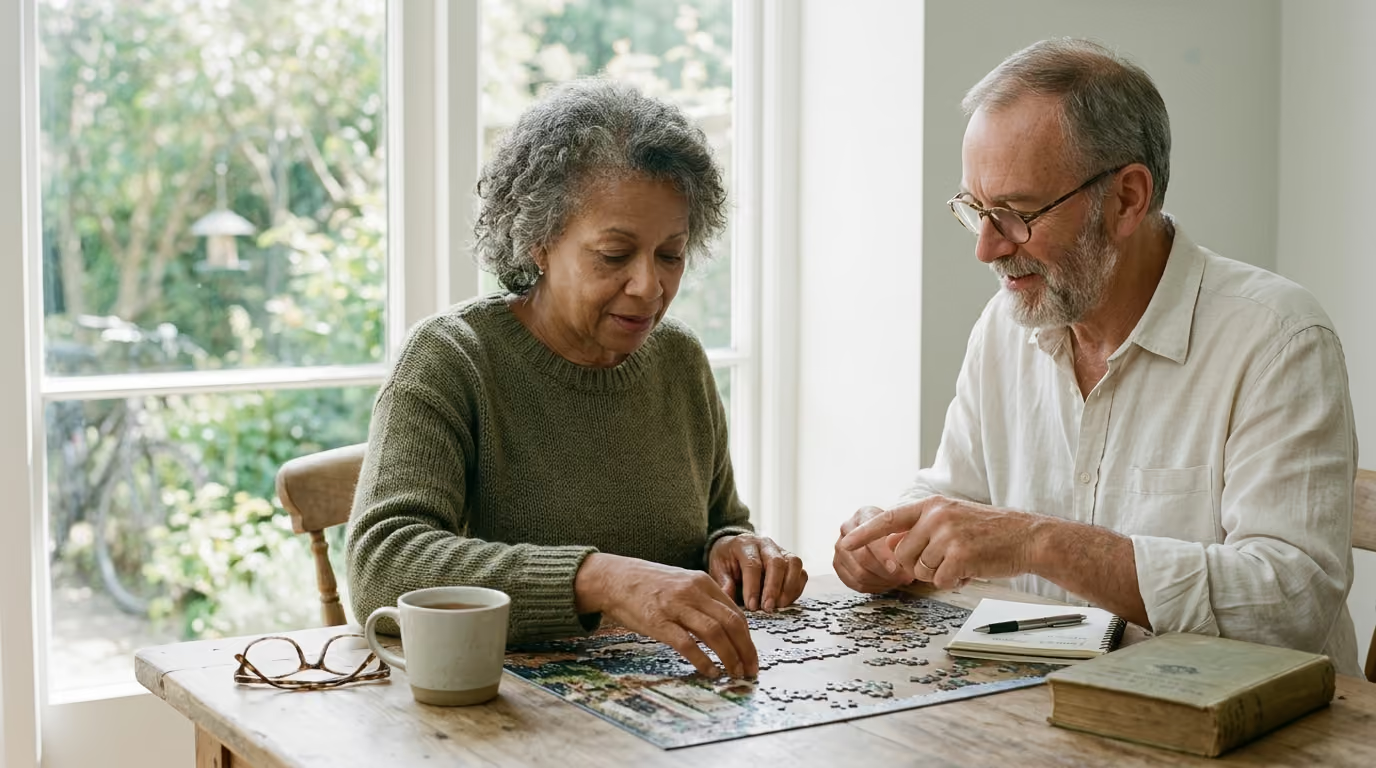

Choosing between television viewing and mentally challenging hobbies shapes neurological health, daily activity balance, and long-term cognitive resilience.





Many older adults find themselves searching online for whether watching television harms the aging brain or if crossword puzzles prevent memory loss. The sheer volume of conflicting advice makes it difficult to know how to spend free time in retirement. This guide provides a definitive, research-based explanation of how different forms of leisure influence cognitive health after 60.
The human brain adapts to the demands placed upon it throughout life. When you engage in an activity, specific neural pathways activate to process incoming sensory information, retrieve memories, and make decisions.
Passive entertainment requires low cognitive effort. Watching a familiar sitcom or listening to background music relies on recognition rather than active recall. The brain receives sensory input without needing to organize complex responses, solve novel problems, or correct errors. This state lowers mental fatigue and helps regulate stress.
Active leisure demands deliberate mental processing. Reading an unfamiliar history book, learning a musical instrument, or playing a strategy game forces the brain to recruit multiple networks at once. Working memory holds new details in mind while long-term memory connects those details to past knowledge.
These active demands stimulate synaptic connections. Challenging tasks encourage communication between different brain regions, such as the prefrontal cortex for planning and the temporal lobes for language and memory. Engaging in complex, novel tasks over time helps build cognitive reserve, which gives the brain greater resilience as it ages.
Scientific research on leisure and cognitive aging includes observational studies, longitudinal cohort tracking, and structured intervention trials. The overall body of evidence shows a consistent relationship between rich leisure habits and better cognitive outcomes in later life. Researchers note that observational studies cannot fully prove direct cause and effect. Healthier individuals with higher baseline cognitive abilities or greater financial resources may naturally seek out stimulating hobbies.
Systematic reviews of leisure activities demonstrate that older adults who maintain active routines experience slower rates of age-related cognitive decline. A review of cognitive leisure interventions examined twenty different studies covering activities like board games, creative writing, reading, handicrafts, and computer skills training. Thirteen of those twenty studies showed measurable improvements in at least one cognitive domain. Activities that required learning new skills, processing complex information, and interacting with others showed the most promise.
The relationship between television viewing and cognition has received close attention in longitudinal research. One study tracked older adults over six years and found that watching more than 3.5 hours of television per day was associated with poorer verbal memory performance. The association remained even after researchers adjusted for demographic factors, health status, and overall physical activity. Another study reported that television viewing below roughly 2.06 hours per day showed no negative association with dementia risk, while higher viewing showed an increased hazard ratio of 1.17. Television is a sedentary behavior, and extended viewing often displaces more demanding activities.
Digital technology use presents a contrasting pattern. A 2025 meta-analysis examining digital technology engagement found that regular, purposeful computer and internet use was associated with a lower risk of cognitive impairment. The meta-analysis reported an odds ratio of 0.42 for cognitive impairment and a hazard ratio of 0.74 for time-dependent cognitive decline. Using a computer often requires active navigation, troubleshooting, information retrieval, and communication.
Social engagement also shows protective associations. A meta-analysis of formal social participation across fifteen studies and over 136,000 participants found that active community involvement was linked to reduced cognitive decline, though researchers rated the certainty of evidence as low. A separate systematic review found that poor social relationships were associated with higher odds of cognitive decline, with pooled odds ratios between 1.11 and 1.15. The Lancet Commission on dementia prevention identifies social isolation, physical inactivity, depression, hearing loss, and vision loss as significant modifiable risk factors across the lifespan.
Intervention studies testing commercial brain-training software show mixed results. The National Institute on Aging notes that evidence for lasting, transferable cognitive benefits from commercial brain games remains inconclusive. Practicing a specific computer game makes a person better at that specific task, but the skill rarely transfers to broad everyday memory. Organizations like the National Academies emphasize that structured lifestyle habits provide a more grounded path to long-term cognitive vitality.
Categorizing activities simply as active or passive overlooks how physical movement and mental engagement intersect. A clearer framework evaluates leisure across two primary dimensions: physical movement and cognitive or social demand.
Activities in this category involve sitting or resting while consuming content that requires minimal mental processing.
These activities serve an important restorative purpose when used intentionally for relaxation. Problems arise when they expand to fill most of the day, replacing physical exercise, intellectual challenge, and human connection.
This category includes sedentary pastimes that require intense focus, planning, memory retrieval, or analytical thinking.
These pursuits provide strong intellectual stimulation. They prove that sitting down is not automatically harmful to the brain if the mind remains deeply engaged. Readers looking to build these habits can review resources on retirement and mental fitness to design a balanced routine.
Pastimes in this group involve physical exertion or bodily coordination with straightforward, repetitive mental requirements.
Physical movement supports brain health by promoting blood flow, improving cardiovascular markers, and supporting sleep quality. The World Health Organization recommends that older adults accumulate 150 to 300 minutes of moderate-intensity aerobic physical activity per week. These low-demand movement habits help meet those physical targets while allowing the mind to rest.
These activities combine cardiovascular or balance work with continuous mental processing, problem-solving, or social interaction.
This category offers the highest combined cognitive and physical return. Learning dance choreography forces the motor cortex, memory systems, and spatial processing networks to operate simultaneously while delivering aerobic benefits.
Electronic media and printed texts represent a massive share of leisure time after 60. How you interact with each medium determines whether it functions as a passive time-filler or an active cognitive workout.
Television is not universally negative for cognitive function. High-quality documentaries, investigative journalism, and intricate foreign-language dramas present rich information that can spark curiosity and new learning. The main cognitive risks of television relate to total duration and passive viewing styles.
Leaving the screen on in the background creates passive consumption. Viewers sit for hours without processing narrative structure or remembering key facts. You can transform television into an active pastime by selecting specific programs in advance, watching with a partner, and discussing the themes afterward. Taking standing or stretching breaks during long viewing blocks helps reduce the physical risks of prolonged sitting.
Podcasts, radio broadcasts, and audiobooks allow older adults to engage with complex topics while resting their eyes or performing daily chores. Audio content requires listeners to interpret tone, follow spoken arguments, and visualize narrative details without visual prompts.
Listening can become passive if audio runs as background noise while attention drifts. To make audio engagement active, choose topics that introduce unfamiliar concepts. Pause the recording periodically to summarize the main argument in your mind. Pairing educational podcasts with an outdoor walk combines mental stimulation with aerobic exercise.
Reading remains one of the most accessible and effective forms of cognitive engagement. Engaging with challenging text demands sustained focus, vocabulary retrieval, and narrative tracking.
A reader can increase mental effort by stepping outside comfortable habits. Exploring unfamiliar genres, analyzing non-fiction topics, or reading articles in a second language recruits broader neural networks. Participating in a book discussion group adds social interaction, requiring you to explain your ideas, defend your viewpoints, and listen to alternate interpretations. Readers interested in brain health mechanisms can consult guides on brain aging and neuroplasticity to understand how continuous learning shapes cognitive function.
Digital technology provides powerful opportunities for active leisure when used with clear intent. Managing a digital photo archive, conducting online genealogy research, taking a virtual class, or communicating with distant relatives requires active planning and problem-solving.
The primary hazard of internet use is passive browsing. Endless scrolling through short video feeds or alarmist news updates drains attention without providing cognitive benefits. Setting clear time boundaries and focusing on creative or educational goals keeps digital use productive and mentally stimulating.
Interactive pastimes require participants to generate solutions, adapt to shifting rules, and coordinate actions with other people. These activities provide rich opportunities for active mental effort.
Games vary widely in the specific mental faculties they require. Crossword puzzles rely heavily on semantic memory and vocabulary retrieval. Sudoku demands working memory, pattern recognition, and deductive reasoning. Card games like bridge require probability calculation, memory for played cards, and strategic cooperation with a partner.
A common limitation of puzzles is task familiarity. Solving the exact same type of crossword puzzle every morning for years builds high proficiency on that single task, but it stops challenging the brain. When a puzzle becomes routine, introducing new game formats or increasing the difficulty level forces the brain to build new problem-solving strategies.
Group conversations represent a sophisticated cognitive exercise. Participating in a live discussion requires you to listen closely, process rapid auditory information, interpret emotional cues, retrieve relevant knowledge, and structure a coherent spoken response.
Discussion-based activities include philosophy groups, local history roundtables, community planning committees, and peer-led study circles. An analysis of social-interaction interventions found significant positive effects on executive function among healthy older adults. In-person social interactions showed stronger cognitive benefits than remote interactions in subgroup analyses. Navigating the unpredictable flow of in-person conversation challenges attention and executive control in ways solitary activities cannot replicate.
Creative pursuits combine physical dexterity with mental planning, aesthetic evaluation, and emotional expression. Activities like painting, wood carving, knitting, playing the piano, and creative writing require continuous decision-making and sensory-motor coordination.
Learning to play a musical instrument is especially demanding. Musicians must read musical notation, translate visual symbols into motor actions, keep steady rhythm, and listen closely to correct errors in real time. Crafting physical objects also requires spatial reasoning and manual precision. These varied demands activate motor, sensory, and executive control networks simultaneously.
To evaluate whether a hobby provides meaningful mental engagement, look for specific active ingredients rather than generic labels. Activities that support long-term brain health typically share several foundational features.
Novelty forces the brain to build new neural pathways rather than relying on automated routines. Taking up an unfamiliar hobby, such as learning a foreign language or studying music theory, creates initial mental effort. That temporary awkwardness indicates that your brain is actively adapting to unfamiliar rules and structures.
An effective cognitive activity becomes gradually more difficult as your proficiency grows. If an activity remains at the same difficulty level indefinitely, it transitions from an active challenge into a comfortable routine. Increasing the complexity of your reading material, tackling harder musical pieces, or playing against more skilled opponents maintains a productive level of mental effort.
Active retrieval occurs when you recall information from memory without looking at notes or solutions. Summarizing a chapter after reading it, recalling the rules of a complex game, or teaching a craft to a beginner requires active retrieval. This process strengthens memory pathways far more effectively than simply rereading or reviewing material passively.
Producing something tangible requires a higher level of cognitive organization than consuming content created by others. Writing an essay, painting a canvas, building a garden bed, or cooking an unfamiliar recipe requires planning, sequencing, and error correction. These constructive steps demand sustained executive control and forward planning.
Interacting with other people introduces unpredictability and dynamic feedback. Conversations require quick adjustments, emotional awareness, and memory for shared experiences. The social dimension also provides emotional support and accountability, making it easier to sustain hobbies over many months or years. Those seeking strategies for long-term mental resilience can review materials on lifestyle and brain resilience for broader lifestyle integration.
Sedentary intellectual hobbies become far more powerful when paired with physical movement. Physical activity stimulates blood circulation, supports metabolic health, and encourages the release of neurotrophic factors that aid neuronal survival. Integrating light movement or outdoor walking into daily learning routines supports both physical and neurological health.
Real-world daily routines often fall into distinct habits. Examining common lifestyle patterns shows how simple, practical adjustments can turn unbalanced schedules into healthy leisure routines.
Consider an individual who spends five to six hours each day watching television. They remain seated for long stretches, engage in little physical movement, and participate in few daily conversations.
The main concern is not the television content itself, but the accumulated sedentary time and the displacement of social and physical activities. Longitudinal research links high daily television viewing with declines in verbal memory over time.
Practical adjustments:
Consider an older adult who reads books for four to five hours every day. They stay intellectually engaged with complex narratives, but they rarely leave the house, engage in physical exercise, or speak with others.
Reading offers strong intellectual stimulation and supports vocabulary retention. Reading alone does not fulfill weekly physical activity guidelines or provide the dynamic challenges of live social interaction.
Practical adjustments:
Consider a retiree who spends several hours each day on a tablet computer. They participate in online genealogy research and watch educational lectures, but they also get pulled into hours of passive social media scrolling.
Purposeful internet use provides problem-solving and organizational practice, which observational research links with preserved cognitive function. Passive scrolling can disrupt focus, raise stress, and displace physical movement.
Practical adjustments:
Consider an individual who attends club meetings, card groups, and committee lunches several days a week. They enjoy rich social connections, but they spend nearly all their waking hours sitting down.
Frequent social participation supports emotional well-being and is associated with lower cognitive decline. High amounts of sedentary time can still negatively affect cardiovascular health, mobility, and brain blood flow.
Practical adjustments:
Consider an older adult who walks five miles every morning and works in the yard for hours. They meet physical activity guidelines, but they rarely converse with others, read challenging material, or learn new skills.
Regular aerobic movement provides cardiovascular and metabolic benefits that support brain health. Physical activity alone does not provide the cognitive complexity of new learning or social communication.
Practical adjustments:
A healthy leisure portfolio must adapt to individual physical capacities and sensory changes. Chronic health conditions, sensory impairments, and mobility limitations require personalized adjustments rather than total withdrawal from stimulating activities.
Sensory impairments can make social and mental activities difficult. Age-related hearing loss makes conversations in crowded rooms exhausting, which often leads people to withdraw into isolation. The Lancet Commission identifies unaddressed midlife hearing loss as a major modifiable risk factor for dementia.
Older adults experiencing hearing changes should obtain regular audiometric evaluations and use properly fitted hearing aids. Choosing quiet meeting locations, sitting face-to-face in well-lit rooms, and using closed captions for videos lowers listening fatigue.
Vision changes can make reading standard print frustrating. Using large-print books, adjustable e-readers, proper task lighting, and audiobooks allows individuals with vision loss to stay engaged with literature and news.
Arthritis, joint replacements, and neurological conditions can limit standing or walking. World Health Organization guidelines emphasize that older adults with chronic conditions should remain as physically active as their abilities allow.
Seated exercises, chair yoga, resistance band routines, and aquatic exercise classes provide safe movement without excessive joint stress. Intellectual and social pursuits like book clubs, choir singing, seated strategy games, and online courses remain fully accessible for individuals with limited mobility. The primary goal is finding movements and challenges that fit your current functional level.
Individuals experiencing mild cognitive impairment or cognitive fatigue following illness need structured, low-stress engagement. Highly complex or fast-paced tasks can cause frustration and anxiety, leading to complete withdrawal.
Breaking complex tasks into smaller, manageable steps helps maintain confidence. Using written checklists, following consistent daily schedules, and engaging in familiar creative crafts provides mental satisfaction without overwhelming working memory. Activities that focus on memory and focus can help individuals structure their days effectively while accommodating cognitive limits.
Public discussions around cognitive aging often oversimplify complex research findings. Clarifying common misconceptions helps older adults make realistic, practical decisions about their daily routines.
Passive leisure is frequently described as wasted time. Resting quietly, listening to favorite music, or enjoying an entertaining film provides essential relaxation, mood regulation, and stress recovery. Passive entertainment becomes counterproductive only when it expands to dominate the entire day and displaces active habits.
Marketing for puzzle books and digital brain games often claims to protect against memory loss. Scientific research does not show that solving crosswords or digital puzzles prevents neurodegenerative conditions like Alzheimer's disease. Puzzles provide enjoyable mental exercise, but they should be viewed as one small part of a broader lifestyle rather than a guaranteed medical shield.
Pushing cognitive difficulty to extreme levels does not automatically produce better results. When an activity is excessively hard, confusing, or frustrating, people quickly abandon it. The most effective cognitive activities provide a moderate level of challenge that feels achievable, engaging, and enjoyable enough to sustain over many years.
Lumping all screen use into a single negative category ignores the major differences between digital activities. Watching television passively for six hours involves very different cognitive processes than video-calling grandchildren, managing household finances, or taking an interactive digital art class. Content, intentionality, and engagement matter far more than the screen itself.
Observational studies frequently find that people who engage in active hobbies have healthier brains in later life. These findings show a positive association, but they do not prove that the hobby directly caused the protection. People with higher education, better physical health, and stronger social support are naturally more likely to participate in diverse leisure activities.
A practical way to manage leisure time after 60 is to build a diversified weekly schedule. Rather than searching for a single perfect hobby, assemble a routine that includes rest, physical activity, learning, social interaction, and creative contribution. Those seeking to structure their time around long-term goals can explore resources on purpose and cognitive engagement to guide their weekly planning.
You can assess your current habits by tracking your time across the five core categories for seven days. Ask yourself these practical questions at the end of the week:
Adjust your schedule gradually based on your answers. If your audit reveals four hours of daily television and no social interaction, do not attempt to overhaul your entire life overnight. Replace thirty minutes of television with a daily walk, and add one weekly group activity. Small, consistent adjustments are easier to maintain over time.
Discussing lifestyle habits with a physician or geriatric specialist helps ensure that your leisure activities align with your physical and cognitive health needs.
Building a balanced leisure routine starts with small, deliberate actions. Use this simple checklist to guide your schedule this week:

Follow FitBrainLab for research-led insights on memory, focus, brain aging, nutrition and mental fitness after 60. Stay connected for new articles, practical guidance and ideas for a sharper, more engaged life.


Build habits that support memory, focus and a curious, connected life.
Read the Blog