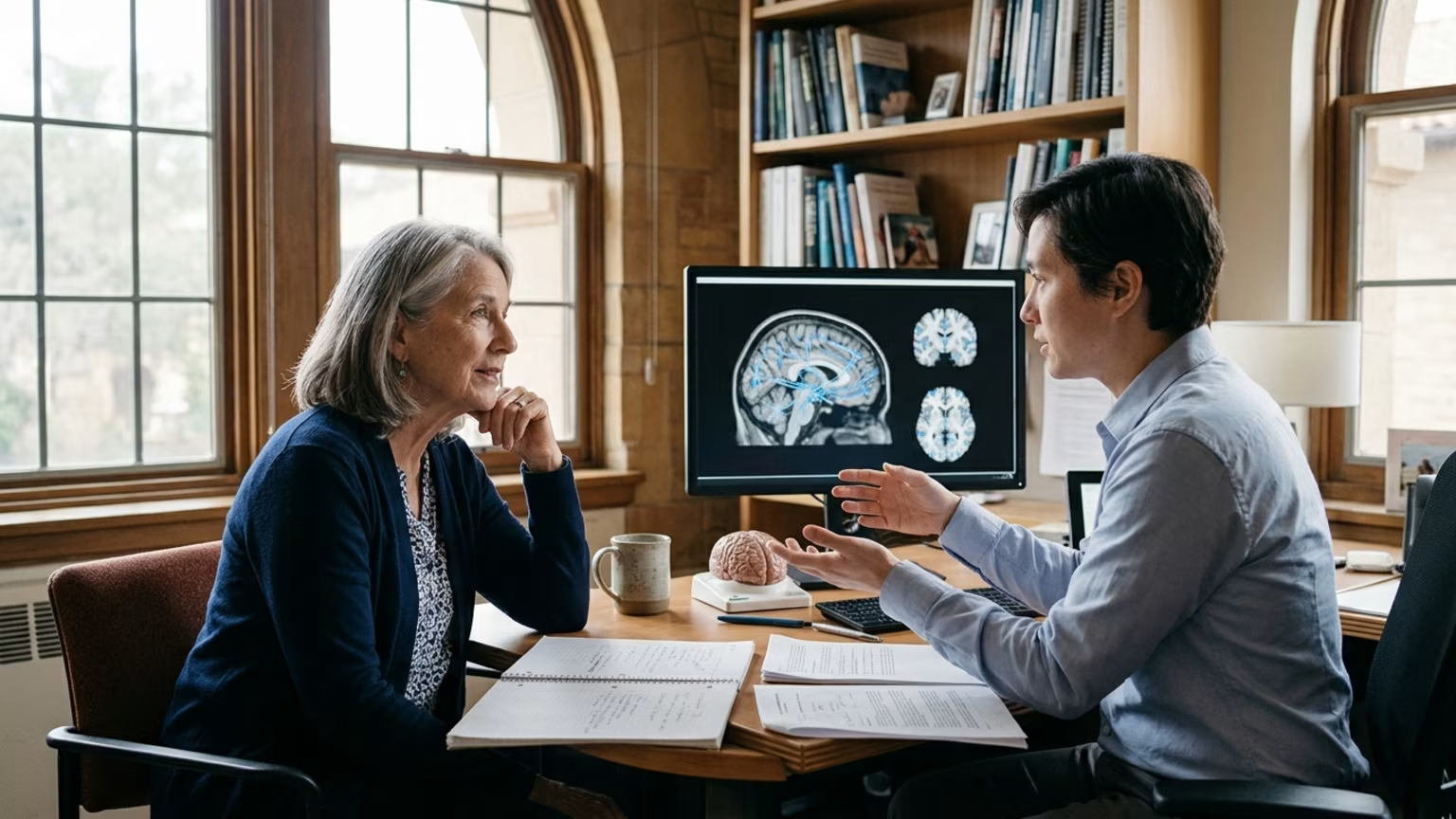

A Stanford-led study links resting brain activity with later cognitive outcomes. Learn how ARC was tested and why it is not a screening test.





On November 4, 2026, Stanford Medicine-led researchers published a study in Science Advances linking resting brain-activity patterns with later cognitive vulnerability or resilience among people who had no apparent cognitive impairment when scanned.
According to Stanford Medicine’s account, the researchers developed the Alzheimer’s Resilience-Vulnerability Connectome, or ARC. This machine-learning score uses resting-state functional MRI, which measures brain activity while a person lies still in a scanner. The team examined whether those activity patterns could help distinguish different paths of cognitive aging.
To build ARC, researchers compared scans from 180 SuperAgers and 110 people diagnosed with Alzheimer’s disease. Everyone in those development groups was at least 75 years old. These groups provided the contrasting patterns used to establish the score.
Stanford defined SuperAgers in this study as people whose memory capacity was typical of a 45-year-old. Their executive function was normal for their age. That definition gave the researchers a specific example of unusually strong memory in later life to compare with diagnosed disease.
Stanford reported that ARC distinguished the two development groups with roughly 85% accuracy. The accompanying research release also reported that the framework generalized to an independent replication cohort of 143 people. Testing the framework beyond its original development groups added another layer of evidence.
The work drew on imaging data from large projects. Stanford named the Open Access Series of Imaging Studies, the Harvard Aging Brain Study and the Alzheimer’s Disease Neuroimaging Initiative. Rather than relying on a single comparison alone, the researchers examined the framework across several datasets.
The next question was whether ARC related to later outcomes among people who initially appeared cognitively well. The research release reported that the team applied it to groups of 818 and 497 cognitively unimpaired people. The latter was an independent cohort in which the framework showed similar performance.
According to the Stanford account, the groups with higher and lower ARC scores did not have clear cognitive differences at the time of imaging. Differences became apparent in later records. This is the central finding behind the report’s interest in earlier signs of vulnerability.
Participants with more Alzheimer’s-like brain-activity patterns later showed faster decline on tests of memory, attention and executive function. They also showed greater amyloid-beta accumulation and a higher likelihood of progressing to clinical Alzheimer’s disease. These outcomes linked the imaging patterns with several aspects of later cognitive health.
Stanford also reported comparisons with demographics, disease biomarkers and genetics. ARC performed comparably or better than the measures tested, according to the researchers’ account. Combining ARC with existing biomarkers improved prediction performance in their analysis.
The immediate change is in the research picture. This study adds resting brain-network activity to efforts to understand why initially similar cognitive performance can be followed by different outcomes. It also places unusually strong memory in later life within the same research framework as Alzheimer’s disease.
For researchers, the findings provide a basis for asking whether functional imaging adds useful information to other measures. The reported improvement when ARC was combined with existing biomarkers makes that combined approach a clear subject for further work. Senior author Yu Zhang said the team hopes the findings may help identify earlier signs of decline and support timely interventions.
For adults thinking about memory after retirement, the practical value is understanding what kind of development this is. The study concerns a possible future way to assess vulnerability or resilience. Its central question is about recognizing different cognitive paths, rather than identifying a daily activity that readers should add to their schedules.
Readers interested in this scientific question can also read FitBrainLab’s coverage of other research approaches to cognitive resilience. That offers a separate reading path for understanding how researchers study resilience from different perspectives.
Personal concerns about changes in memory or thinking belong in a discussion with a qualified clinician. That conversation can stay focused on the changes a person has noticed and their effect on daily life. There is no need to interpret a research headline as a personal assessment.
Several boundaries matter when reading this finding. Keeping them together helps separate the study’s contribution from claims it did not establish.
ARC is not a diagnostic or routine screening test. Stanford explicitly cautioned against treating it as diagnostic. The roughly 85% accuracy figure describes distinguishing the study’s SuperAger and Alzheimer’s development groups. It is not an accuracy rate for diagnosing Alzheimer’s disease in the general population.
Zhang also described an individual score as a snapshot rather than destiny. An association with later outcomes across study participants does not establish what will happen to a particular person. The reporting does not support seeking an ARC scan as an appropriate clinical step for a cognitively healthy reader.
The age groups were specific. The primary cognitively unimpaired cohorts were aged 55 to 70. The groups used to define the SuperAger and Alzheimer’s ends of the score were at least 75. Those distinct samples do not amount to a validated prediction for every adult over 60.
There was no single prediction window. Stanford reported that most datasets covered about five to six years, with the longest extending up to 12 years. The research release described outcome windows of five and 15 years, depending on the available data. These differing summaries should not be turned into a claim that ARC predicts disease a fixed number of years ahead.
The biomarker comparison also needs a narrow reading. Stanford’s account did not provide a numerical comparison for the reported prediction advantage or the improvement from combining measures. The finding therefore does not establish that ARC is superior to every current Alzheimer’s test.
Prediction is not proof of cause or prevention. The study did not establish that the activity patterns caused later decline. It also did not show that changing those patterns would redirect a person’s cognitive path. Zhang said that question remains unanswered.
Stanford reported that the team plans to examine ARC scores before and after cognitive training. Zhang also mentioned transcranial magnetic stimulation as a possible future direction. Neither approach was tested for cognitive decline in this study. The planned work is not evidence that training changes ARC scores or prevents Alzheimer’s disease.
The practical response is to leave scan-driven changes to health routines out of this finding. The study supplies a research lead, not a tested training plan or a reason to purchase a brain-health intervention.
The long-term value of this work lies in a more detailed view of cognitive aging. Rather than studying disease markers alone, the team examined resting activity patterns alongside examples of unusually resilient memory. Applying that framework to initially unimpaired groups connected the original comparison with later cognitive outcomes.
That is a meaningful direction for research. A fuller account of resilience could help researchers ask better questions about how brain function relates to changes over time. Future studies will determine how useful this approach becomes beyond the datasets examined here.
For retirement, the broader conversation remains about living an active and meaningful life rather than organizing each day around a research score. FitBrainLab’s coverage of purpose and engagement after work addresses that separate practical topic. This Stanford finding matters because it adds a new way to study cognitive differences while leaving everyday life larger than a scan result.
Following this brain-imaging report means weighing later claims about everyday habits, a step FitBrainLab supports through clear explanations of cognitive-health research. For adults 60+ who are uncertain which routines deserve attention, the publication connects evidence on memory and aging with practical context about learning, movement and sleep without promising a particular health outcome.

Follow FitBrainLab for research-led insights on memory, focus, brain aging, nutrition and mental fitness after 60. Stay connected for new articles, practical guidance and ideas for a sharper, more engaged life.




Build habits that support memory, focus and a curious, connected life.
Read the Blog
