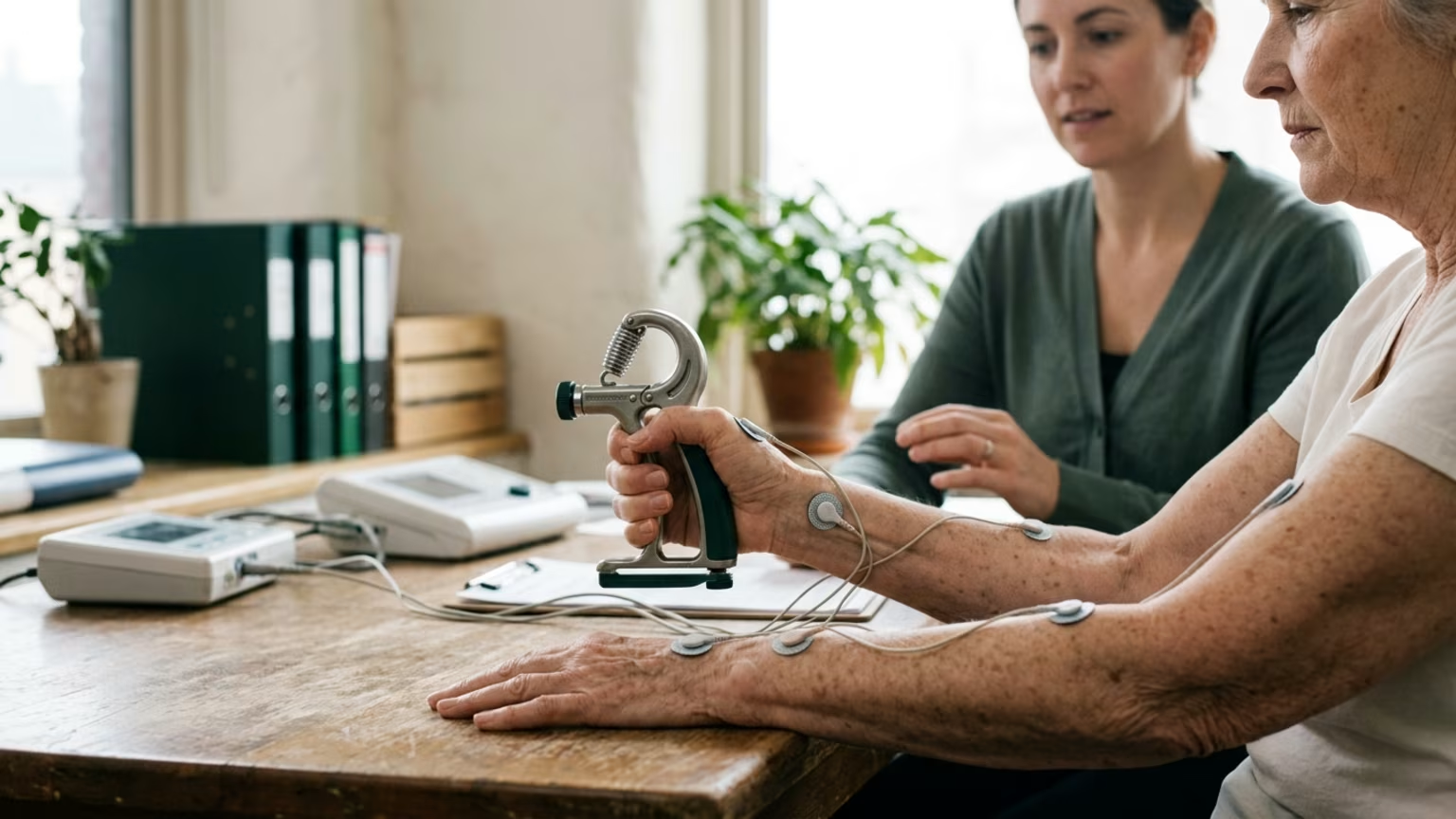

A 2026 GeroScience study highlights how multi-finger force deficits and dual-task testing might reveal neural factors behind age-related handgrip weakness.





On September 8, 2026, researchers Gregory M. Shaw, Leatha A. Clark, and Brian C. Clark published a study in GeroScience investigating neural contributions to age-related handgrip weakness.
The research publication is titled "Neural contributions to age-related handgrip weakness revealed by multi-finger force deficit and dual-task testing." The scientific title indicates a shift away from measuring basic muscle mass toward evaluating complex neural coordination. A Ground News summary of the event reports that the research team used a biomimetic multi-finger dynamometer for their measurements. This specific instrument allows scientists to capture the distinct force applied by individual fingers during a gripping task.
The news summary notes that the weakest older adults displayed nearly twice the multi-finger force deficit of their stronger peers. This finding highlights a potential gap in how the nervous system controls physical movement in later life. By isolating the force of multiple fingers, the researchers attempted to separate pure muscle decline from coordination limits. This approach provides a new framework for understanding why some adults lose hand strength faster than others.
The inclusion of dual-task testing in the study's title is particularly notable for aging research. In clinical studies, a dual task typically requires a participant to perform a physical movement while managing a secondary demand. This method forces the brain to divide its attention and its available cognitive resources. By observing how handgrip performance changes under these conditions, researchers can better isolate neural limits from sheer muscle capacity.
To understand why hand function matters for aging populations, we can look at parallel observational research. A separate 2026 cross-sectional study examined 104 community-dwelling adults in Bali. These participants were between the ages of 60 and 80. The researchers measured their grip strength using a calibrated digital dynamometer before evaluating their daily capabilities.
The Bali research team assessed each participant using the Barthel Index. This established scale measures a person's ability to manage fundamental daily tasks independently. These tasks include eating, dressing, bathing, and basic mobility around the home. Evaluating these specific actions helps researchers connect physical strength directly to personal autonomy.
The Bali study reported a positive association between grip strength and the ability to perform daily activities. The researchers recorded a moderate correlation, noting an r-value of 0.536 with a 95 percent confidence interval of 0.38 to 0.66. The statistical significance was high, with a p-value of less than 0.001. This confirms that basic hand strength aligns closely with everyday physical independence.
It is crucial to remember that this cross-sectional study only establishes a mathematical association. It does not prove that improving grip strength directly causes greater independence. Adults reading brain health and memory blogs must separate statistical correlations from absolute medical guarantees. These findings simply reinforce the practical reality that reliable hand function supports a self-sufficient lifestyle.
For many years, physical evaluations have focused heavily on single maximal squeeze tests. These standard clinical tests measure raw muscle output without heavily considering the nervous system. The GeroScience publication broadens how researchers might approach physical decline moving forward. By measuring multi-finger deficits, the researchers highlight the critical role of motor control.
Right now, most routine doctor visits do not include complex dual-task evaluations. If clinical studies validate these new biomimetic methods, standard medical assessments might eventually evolve. Doctors could start looking at how well the brain coordinates small physical movements. Recognizing that physical weakness might stem from neural limits gives medical professionals a wider lens for observation.
Historically, medical professionals have treated the brain and the muscular system as distinct areas for diagnosis. This strict separation often limits how doctors approach gradual physical decline in older patients. Research incorporating dual-task testing bridges this gap by treating physical movement as a cognitive output. Viewing physical strength through a neurological lens could eventually improve how doctors evaluate overall patient vitality.
If age-related weakness stems partly from the brain, physical therapy approaches might eventually need to adapt. Currently, most strength recovery programs focus heavily on repetitive muscle resistance. If neural coordination plays a significant role in hand weakness, simply squeezing a rubber ball may be insufficient. Future rehabilitation programs might incorporate tasks that challenge the brain and the hands simultaneously.
This development prompts a practical shift in how we think about aging bodies. Muscle loss is visible and easily measurable with simple clinical tools. Neural coordination is much harder to observe during a standard routine checkup. By testing multi-finger force deficits, researchers are trying to quantify that hidden neural component.
This shift in understanding changes how doctors might discuss physical aging with their patients. Instead of framing physical decline purely as a loss of muscle mass, physicians could explain the neural components. A clearer explanation of these biological processes empowers older adults to view their bodies holistically. Open conversations about neural coordination can clarify some of the frustrating physical changes associated with growing older.
Readers must approach early medical reports with healthy skepticism and clear boundaries. The accessible GeroScience listing only confirms the article title, the publication date, and the authors. It does not provide the full abstract, the participant count, or the specific age range of the subjects. The listing also omits the detailed measurement protocols and the study's stated limitations.
Because the primary data is not fully accessible, the claim that the weakest adults showed a doubled deficit comes entirely from the news summary. Without reading the full methodology, we cannot treat the summary's statistics as fully independent, verified facts. The available material does not establish that brain changes directly cause a weak grip. The research also fails to quantify the exact balance between neural factors and simple muscular decline.
It is incredibly common for the media to exaggerate early neurological research findings. A single study about hand weakness can quickly become an alarmist headline about imminent cognitive decline. Readers must recognize that this specific GeroScience publication focuses purely on motor control mechanics. It does not measure cognitive memory, language skills, or broad problem-solving abilities.
Drawing a direct line from a weak grip to severe neurological conditions is scientifically irresponsible based on this single event. Older adults should not use this limited report to self-diagnose their neural coordination. The current evidence does not support recommending a specific home test or new exercise program based solely on the GeroScience study. Maintaining a calm, objective view of early research helps prevent unnecessary stress.
Navigating health news requires a disciplined approach to reading scientific summaries. When critical data like methodology are hidden behind a publication paywall, cautious reading becomes necessary. Relying solely on a news event summary leaves significant room for misinterpretation. Adults can protect their peace of mind by prioritizing lifestyle and brain resilience habits rather than reacting to isolated research updates.
This study serves as a valuable starting point for future scientific inquiries. By questioning the neural roots of physical weakness, researchers are expanding our understanding of human aging. The focus on multi-finger deficits introduces a more sophisticated way to observe physical capability over time. This approach respects the incredible complexity of the human nervous system.
Scientists are slowly moving away from viewing muscle and brain health as entirely separate domains. The GeroScience study encourages a more respectful, comprehensive view of the aging body. It acknowledges that physical tasks are driven by intricate neural pathways that change over decades. This unified perspective will likely drive better, more accurate studies in the coming years.
For older adults prioritizing long-term health, this research reinforces the connection between the brain and the body. It supports the concept that maintaining everyday capability involves complex, overlapping biological systems. While early studies rarely provide immediate lifestyle answers, they help build a foundation for better clinical tools. Integrating these incremental findings into a broad perspective helps readers interested in brain aging and neuroplasticity articles stay informed without panic.
Misinterpreting early research on physical coordination can create unnecessary confusion about what normal brain aging actually looks like. When studies on grip strength lack accessible methodology, FitBrainLab translates these limited findings into objective analysis that prevents alarmist overreactions. We provide calm, research-led guidance on cognitive longevity, helping older adults maintain focus and independence without fear.

Follow FitBrainLab for research-led insights on memory, focus, brain aging, nutrition and mental fitness after 60. Stay connected for new articles, practical guidance and ideas for a sharper, more engaged life.






Build habits that support memory, focus and a curious, connected life.
Read the Blog